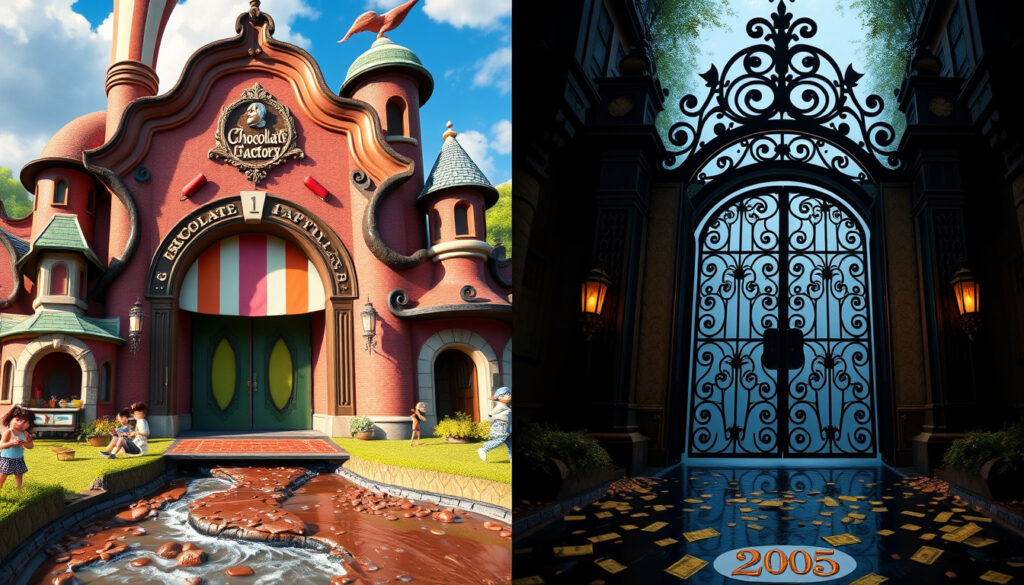
Charlie and the Chocolate Factory: 1971 vs 2005 Comparison
Roald Dahl’s tale of a boy and a chocolate factory sparked two very different film adaptations — 1971’s Willy Wonka & the Chocolate Factory and 2005’s Charlie and the Chocolate Factory — and a controversy that has evolved for decades. This guide compares the films, streaming options, and the story’s real meaning.
Book published: 1964 ·
First film adaptation: 1971 (Willy Wonka & the Chocolate Factory) ·
Second film adaptation: 2005 (Charlie and the Chocolate Factory) ·
Current streaming availability (2005 film): Netflix
Quick snapshot
- The 1971 adaptation is titled Willy Wonka & the Chocolate Factory (ScreenRant (entertainment news))
- The 2005 adaptation is titled Charlie and the Chocolate Factory (ScreenRant (entertainment news))
- Both films are available to stream on Netflix and HBO Max in the U.S. (JustWatch (streaming aggregator); JustWatch (streaming aggregator))
- The 2005 film used digital replication to depict multiple Oompa Loompas from a single performer, Deep Roy (Candy Funhouse (candy blog))
- Whether the 1971 film will ever be added to Netflix or Disney+ (no current listings found on JustWatch (streaming aggregator))
- Exact reasons for Dahl’s specific character choices, such as naming the orange-skinned children (Wikipedia (encyclopedia) notes Dahl’s inspirations but not every detail)
- 1971 film released June 30, 1971 (ScreenRant (entertainment news))
- 2005 film released July 15, 2005 (ScreenRant (entertainment news))
- Book first published in 1964 (ScreenRant (entertainment news))
- Gene Wilder’s public criticism of the 2005 film continues to influence how audiences perceive both adaptations (ScreenRant (entertainment news))
- Fans await any announcement of a 1971 film streaming deal on major platforms (ScreenRant (entertainment news))
Seven key details summarize the core facts about these adaptations.
| Label | Value |
|---|---|
| Book Author | Roald Dahl |
| Original Publication | 1964 |
| 1971 Film Title | Willy Wonka & the Chocolate Factory |
| 1971 Film Director | Mel Stuart |
| 2005 Film Director | Tim Burton |
| 2005 Film Star | Johnny Depp |
| Streaming Platform (2005 film) | Netflix |
Is There a 1971 Version of Charlie and the Chocolate Factory?
Willy Wonka & the Chocolate Factory (1971)
- The 1971 film is officially titled Willy Wonka & the Chocolate Factory, not Charlie and the Chocolate Factory (ScreenRant (entertainment news)).
- It was directed by Mel Stuart and starred Gene Wilder as Willy Wonka (ScreenRant (entertainment news)).
- The film runs 100 minutes, shorter than the later adaptation (ScreenRant (entertainment news)).
Key Differences Between the 1971 and 2005 Films
- The 2005 film is directed by Tim Burton and stars Johnny Depp as Wonka (ScreenRant (entertainment news)).
- It runs 115 minutes and includes a deeper backstory for Willy Wonka (ScreenRant (entertainment news)).
- The 2005 version emphasizes the story’s eccentric and macabre elements more strongly than the 1971 film (ScreenRant (entertainment news)).
The table below summarizes the key differences between the two adaptations.
| Feature | 1971 Film | 2005 Film |
|---|---|---|
| Title | Willy Wonka & the Chocolate Factory | Charlie and the Chocolate Factory |
| Director | Mel Stuart | Tim Burton |
| Lead Actor | Gene Wilder | Johnny Depp |
| Runtime | 100 minutes | 115 minutes |
| Streaming (U.S.) | HBO Max, Amazon Channels | Netflix, Hulu |
Why this matters: The title difference often confuses viewers searching for the original film, and the tonal shift between the two adaptations sparks endless fan debates.
Is Charlie and the Chocolate Factory on Disney or Netflix?
Netflix Availability
- According to JustWatch (streaming aggregator), the 2005 film is currently streaming on Netflix in the U.S.
- Hulu also lists the 2005 film as available through its HBO content access (Hulu (streaming service)).
- The 1971 film is not on Netflix, according to JustWatch (streaming aggregator).
Other Streaming Platforms
- Disney+ does not carry either film (JustWatch (streaming aggregator)).
- The 1971 film is available on HBO Max and via Amazon Channels (JustWatch (streaming aggregator)).
- Neither film is available for free streaming in the U.S. at this time (JustWatch (streaming aggregator); JustWatch (streaming aggregator)).
If you’re hunting for the 1971 film, skip Netflix and Disney+. HBO Max or Amazon Channels are your best bets, while the 2005 version is much easier to find on Netflix or Hulu.
The catch: While the 2005 film is widely available, fans of the original Wilder version have fewer legal streaming choices.
What Is the Main Message of Charlie and the Chocolate Factory?
The Dangers of Greed and Excess
- Each child’s downfall reflects a specific character flaw—gluttony (Augustus Gloop), greed (Veruca Salt), pride (Violet Beauregarde), laziness (Mike Teavee) (ScreenRant (entertainment news)).
- Charlie Bucket, the only child who exhibits humility and kindness, is ultimately rewarded with the factory (ScreenRant (entertainment news)).
The Importance of Family and Kindness
- The story contrasts the selfishness of the other children with Charlie’s strong family bonds.
- The 2005 film places more emphasis on the Bucket family’s poverty and closeness.
The trade-off: Dahl’s moral lessons are clear—greed destroys, kindness wins—but the story’s dark humor makes it resonate with adults as much as children.
What Was the Original Controversy with Charlie and the Chocolate Factory?
Depictions of the Oompa Loompas
- In the 1964 edition, Oompa Loompas were depicted as African pygmies; critics called the portrayal racist, leading Dahl to revise them into fantasy creatures with long hair and rosy skin (Wikipedia (encyclopedia)).
Racial Stereotypes and Later Revisions
- The controversy resurfaced in the 2000s with renewed discussion about Dahl’s revision.
Dahl’s revision removed the obvious racial caricatures, but some modern readers still find the Oompa Loompas problematic as a group of cheerful laborers in a factory owned by a white man.
The implication: The Oompa Loompa revision shows how cultural sensitivity can reshape a beloved work, yet the debate about representation in children’s literature continues.
What’s the Real Story Behind Charlie and the Chocolate Factory?
Roald Dahl’s Inspiration
- Dahl was inspired by his childhood experiences with Cadbury chocolate, where new chocolates were tested at his school (ScreenRant (entertainment news)).
- He wrote the story while living in England, drawing on the mystique of the chocolate factory.
The Real-Life Chocolate Factory and Cadbury
- Cadbury often sent sample chocolates to schools for taste-testing, which sparked Dahl’s imagination about secret recipes.
- The character of Charlie Bucket was partly based on Dahl himself—a boy from a modest background who dreamed of something extraordinary.
The pattern: Dahl’s personal connection to chocolate gave the story an authenticity that still feels fresh six decades later.
Confirmed Facts and Unresolved Questions
- The 1971 film exists as Willy Wonka & the Chocolate Factory (ScreenRant).
- The 2005 film is on Netflix (JustWatch).
- Roald Dahl wrote the book in 1964 (ScreenRant).
- The Oompa Loompas were originally depicted as African pygmies (Wikipedia).
- Whether the 1971 film will ever be added to Netflix or Disney+ (no current listings).
- Exact reasons for Dahl’s specific character choices (Wikipedia notes incomplete).
- Whether the Oompa Loompa redesign fully resolved the racial controversy (debate continues).
- Whether the 1971 film will secure a new streaming deal on a major platform (no announcement).
“[The 2005 film] is an insult to Roald Dahl’s story and to the memory of Willy Wonka.”
Gene Wilder, as reported by ScreenRant (entertainment news)
“The smell of chocolate in the air was the most exciting thing in the world to me as a schoolboy. I wanted to capture that magic.”
Roald Dahl, from biographies cited by Wikipedia (encyclopedia)
For families, the choice between the two adaptations determines the tone of the movie night: the 1971 film offers whimsical nostalgia, while the 2005 version leans into darker, more fantastical elements.
Related reading: Charlie and the Chocolate Factory 1971 vs 2005 Streaming Controversy Guide · Chocolate Chip Muffin Recipe: Moist, Simple, & Double Chocolate
screenrant.com, syfy.com, screenrant.com, board.ttvchannel.com, play.google.com, imdb.com, flicks.com.au, candyfunhouse.com
For a deeper look at how the 1964 novel diverges from Gene Wilder’s iconic portrayal, readers can consult this analysis of the original book versus the 1971 film that explores those creative differences.
Frequently asked questions
What is the running time of the 1971 film?
The 1971 film runs 100 minutes (ScreenRant (entertainment news)).
What is the MPAA rating of Charlie and the Chocolate Factory?
The 2005 film is rated PG for general audiences, while the 1971 film is rated G.
Is there a stage musical adaptation?
Yes, a stage musical titled Charlie and the Chocolate Factory premiered in London’s West End in 2013.
What is the name of the golden ticket?
The five golden tickets are simply called “Golden Tickets” and are hidden inside Wonka chocolate bars.
How many Oompa Loompas appear in the story?
The story describes a whole tribe of Oompa Loompas; the 1971 film used many actors, while the 2005 film used one actor (Deep Roy) replicated digitally (Candy Funhouse (candy blog)).
What does the name ‘Wonka’ mean?
Dahl invented the name; it has no direct meaning but suggests whimsy and wonder.
Are there any sequels to Charlie and the Chocolate Factory?
Dahl wrote a sequel, Charlie and the Great Glass Elevator, published in 1972.
More related posts
 How Long Is Wicked 2? Wicked For Good Runtime
 Owen Wilson Movies & TV Shows: Complete Filmography
 Cash Money vs No Limit Verzuz: Recap, Winner, and What It Means
 Stranger Things 5 Release Date: Full Schedule & UK Time
 Out of My Mind: Book, Movie, True Story & Ending Explained
 Navy Federal Routing Number 256074974: ACH & Wire Guide
 American Airlines Flight Status: Check In & Get Boarding Pass
 888 Angel Number Meaning: Love, Money & Spiritual Guide