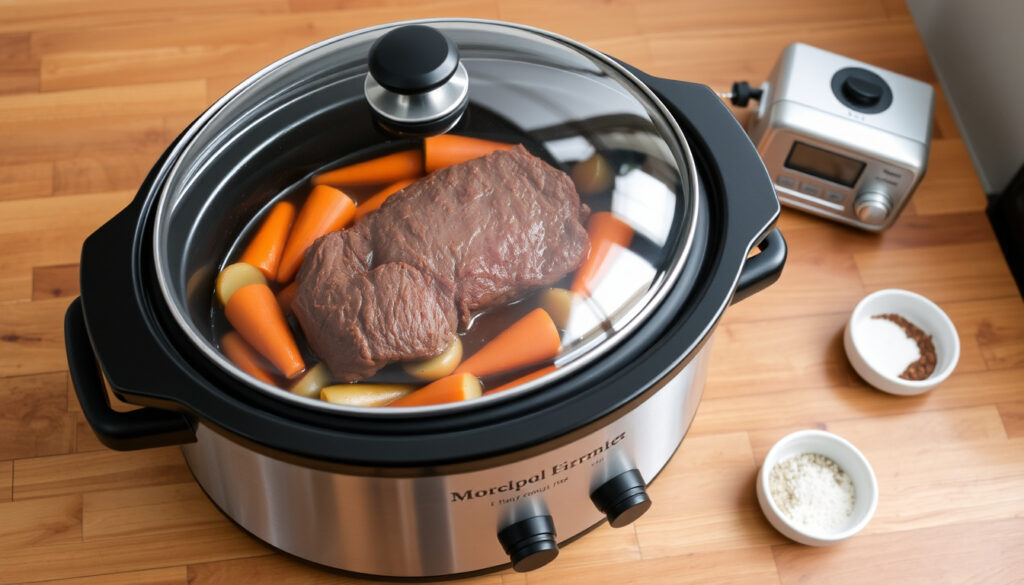
Slow Cooker Pot Roast: Time, Liquid, Mistakes & Tips
Anyone who’s tried to nail a tender, shreddable pot roast knows the frustration of pulling out dry, tough meat instead. The difference between a melt-in-your-mouth result and a disappointingly chewy one usually comes down to three things: cooking time, the amount of liquid, and whether you took the extra step to brown the meat first — and this guide walks you through the timing, the common pitfalls, and the best liquids to use so your next slow cooker pot roast turns out exactly the way you want.
Low heat cooking time: 5-8 hours ·
High heat cooking time: 3-5 hours ·
Ideal beef cut: Chuck roast ·
Optimal liquid volume: 1/2 to 1 cup ·
Internal temperature target: 195°F (90°C)
Quick snapshot
- Low: 5-8 hours (Tasting Table)
- High: 3-5 hours (Tasting Table)
- Use a meat thermometer for precision (Tasting Table)
- Beef broth (NewsCanvas)
- Red wine (optional) (NewsCanvas)
- Cream of mushroom soup (NewsCanvas)
- Avoid excess water (Tasting Table)
- Wrong cut of meat (NewsCanvas)
- Too much liquid (Tasting Table)
- Lifting the lid (The Takeout)
- Not browning (NewsCanvas)
- Overcooking (The Food Charlatan)
- Optional but recommended (NewsCanvas)
- Enhances flavor (NewsCanvas)
- Can be skipped for convenience (NewsCanvas)
- Select a chuck roast (3-4 pounds).
- Brown the meat on all sides (optional but recommended).
- Add 1/2 to 1 cup of liquid (beef broth, red wine, or cream of mushroom soup).
- Cook on low for 8 hours or on high for 4-5 hours, until internal temperature reaches 195°F.
- Use a meat thermometer to check doneness, and let rest before serving.
A standard 3-4 pound chuck roast cooked in a slow cooker needs specific timing and liquid amounts to turn out tender rather than dry or mushy. Here is the key data at a glance.
| Variable | Value |
|---|---|
| Ideal beef cut | Chuck roast |
| Low heat cooking time | 5-8 hours |
| High heat cooking time | 3-5 hours |
| Optimal liquid amount | 1/2 to 1 cup |
| Internal temperature for tenderness | 195°F (90°C) |
| Browning benefit | Adds flavor, not required |
Slow cookers generate steam and condensation that keep the meat moist, so adding more than 1 cup of liquid actually dilutes the flavor rather than helping tenderness. Home cooks who pour in 2 cups of broth hoping for a juicier roast end up with a watery, bland result.
How long do you cook a pot roast in a slow cooker?
Cooking time on low heat
- A 3-4 pound chuck roast needs about 8 hours on low for fall-apart tenderness, according to NewsCanvas, a cooking resource site.
- The low setting breaks down collagen gradually, producing a shreddable texture when the internal temperature hits 195°F (90°C).
Cooking time on high heat
- Tasting Table, an established recipe publication, recommends reducing high-heat cooking to about 4 hours for a pot roast of similar size (Tasting Table).
- High heat works faster but can leave the meat tougher if the time exceeds 5 hours, as the connective tissue may not have enough time to break down fully.
Adjusting time for roast size
- For every additional pound, add roughly 30-60 minutes on low or 15-30 minutes on high.
- The most reliable method is to use an instant-read thermometer: the roast is ready when the center reaches 195°F to 205°F, at which point collagen has transformed into gelatin (The Food Charlatan, a recipe blog).
The pattern: low heat for 8 hours gives the most forgiving window for doneness, while high heat demands closer attention with a thermometer.
What are common mistakes when making crock pot roast?
Using the wrong cut of meat
- Chuck roast is the standard choice because it has enough marbling and connective tissue to break down into tender strands. Lean cuts like sirloin or round dry out quickly in the slow cooker.
Adding too much liquid
- Tasting Table explicitly warns that too much liquid is a top pot roast mistake (Tasting Table).
- The Daily Meal, a food news site, notes that most recipes call for only 1/2 to 2 cups of broth or water (The Daily Meal).
- Adding more liquid submerges the roast and leaches flavor, producing a boiled taste rather than a braised one (The Food Charlatan).
Lifting the lid too often
- Each time the lid is lifted, heat escapes and the slow cooker needs 20-30 minutes to recover, according to The Takeout, a food culture site. Check only near the end of the suggested cooking window.
Not browning the meat
- Skipping the sear is a common shortcut, but browning creates the Maillard reaction that deepens flavor (NewsCanvas).
- The trade-off: you add about 10-15 minutes of prep time, but the resulting gravy has more complexity.
Overcooking or undercooking
- Without a meat thermometer, you are guessing. A roast that hits 210°F starts to dry out; one that stays below 190°F remains chewy. The sweet spot is 195°F-205°F.
What this means: every major mistake shares a root cause — ignoring the slow cooker’s sealed, moist environment. Treat it like a humid oven, not a stovetop pot, and most errors disappear.
What’s the best liquid for slow cooking roast?
Beef broth or stock
- Beef broth is the most common base because it reinforces the meat’s natural flavor without competing. Use low-sodium broths to control salt levels.
Red wine
- Red wine adds acidity that helps break down connective tissue and contributes complexity. A dry red like Cabernet Sauvignon or Merlot works best. Limit to about 1/2 cup to avoid overpowering the dish.
Cream of mushroom soup
- Cream of mushroom soup creates a thicker, richer gravy with minimal effort. It is a classic shortcut for slow cooker pot roast and pairs well with potatoes and carrots.
Water and seasonings
- Using water alone is acceptable if you add robust seasoning, but it will produce a thinner, less flavorful liquid. Most guides, including The Daily Meal, recommend broth as the minimum.
The trade-off: beef broth is the safe default, wine delivers deeper flavor, and cream soup adds body. The best choice depends on whether you want a clean beef flavor or a saucier finish.
Do you have to brown a roast before putting it in the crock pot?
Flavor impact of browning
- Browning triggers the Maillard reaction — a chemical process that produces hundreds of flavor compounds. A seared roast delivers a noticeably richer, more savory result than an unseared one (NewsCanvas).
Texture impact of browning
- The sear creates a thin crust on the surface that helps the meat hold its shape during long cooking. Without it, the exterior can turn mushy before the interior is tender.
Time-saving alternative
- If you are short on time, you can skip browning entirely. The roast will still become tender, but the flavor profile will be milder and the gravy may taste less complex.
Browning only adds 10 minutes to prep and delivers a measurable flavor upgrade. For the home cook chasing a restaurant-quality result, that trade-off tilts strongly toward searing. For a busy weeknight, skipping it works fine — just boost the seasonings.
The pattern: browning is a flavor investment that pays off, but it’s not mandatory.
Does roast need to be covered in liquid in a slow cooker?
Liquid level guidelines
- No. The roast should not be fully submerged. Tasting Table recommends adding liquid only up to about the midway mark on the beef roast (Tasting Table).
Why less is more
- The slow cooker’s sealed lid traps steam and condensation, creating a moist cooking environment. The Takeout notes that the roast itself releases a lot of juice during cooking (The Takeout).
- Adding more liquid dilutes the concentrated flavors that develop from the meat and seasonings.
Effect on tenderness
- The steam generated from 1/2 cup of liquid is enough to cook a 3-4 pound roast to tenderness. The collagen breaks down through heat and time, not submersion. 365 Days of Crockpot even reports adding no liquid at all when cooking a beef roast (365 Days of Crockpot).
The implication: the slow cooker is a braising vessel, not a boiling pot. Trust the steam, not the liquid line.
Expert quotes and recipe guidance
“A standard 3-4 pound chuck roast is commonly cooked in a slow cooker for about 8 hours on low or 4-5 hours on high.”
— NewsCanvas (NewsCanvas)
“Each time you open the lid, you lose heat. Let the cooker work without interruption until the last 30 minutes.”
— The Takeout (The Takeout)
“Too much broth or water can reduce the roasty flavor by submerging too much of the meat.”
— The Food Charlatan (The Food Charlatan)
“A good rule of thumb for added liquid is roughly 1/4 cup per pound of beef.”
— The Daily Meal (The Daily Meal)
A slow cooker pot roast is surprisingly forgiving once you internalize a few rules. The meat needs at least 5 hours on low, you only need about half a cup of liquid, chuck roast is non-negotiable, and browning is a bonus you will want to include when time allows. For the home cook in a busy household, the clear move is to stick with low heat, keep the lid on, and trust the thermometer over the clock.
The takeaway: slow cooker pot roast is a braise, not a boil, and the principles are simple.
tastingtable.com, allrecipes.com, fosugufen.com, youtube.com, youtube.com, kitchenpearls.com
For a detailed breakdown of cooking times and common pitfalls, see this crock pot pot roast guide for similar tips.
Frequently asked questions
Can I use a different cut of beef for pot roast in a slow cooker?
Yes, but chuck roast is preferred for its marbling and collagen. Brisket or bottom round can work but may turn out drier or tougher.
How do I thicken the gravy from slow cooker pot roast?
Remove the roast and whisk 2 tablespoons of cornstarch mixed with 2 tablespoons of cold water into the hot liquid. Simmer on the stovetop for 2-3 minutes until thickened.
Should I add vegetables at the beginning or end of cooking?
Add root vegetables like carrots and potatoes at the start. Add softer vegetables like peas or mushrooms only in the last 30 minutes to prevent them from turning to mush.
Can I cook a frozen roast in a slow cooker?
It is not recommended because the roast spends too long in the danger zone temperature (40°F-140°F), increasing food safety risk. Thaw completely first.
How do I store leftover slow cooker pot roast?
Store in an airtight container in the refrigerator for up to 4 days. Reheat gently on the stovetop or in the microwave with a splash of broth to restore moisture.
What is the best way to reheat slow cooker pot roast?
Reheat in a covered skillet over medium-low heat with a few tablespoons of broth, or in a 300°F oven for 20 minutes wrapped in foil.
Why is my pot roast tough in the slow cooker?
It likely needs more time. If it is tough after the recommended window, continue cooking on low and check every 30 minutes until it reaches 195°F internal temperature.
Can you cook a slow cooker pot roast on high?
Yes, for 3-5 hours, but the texture may be slightly less shreddable than a low-cooked roast. Use a thermometer to confirm doneness.
More related posts
 Games Coming Out in 2025: Release Dates & Schedule
 United States Men’s National Soccer Team: 2026 World Cup Guide
 Black Eyed Peas Food: Nutrition, Recipes, Benefits
 Mustang Mach-E Worth It? Irish Price, Range & Downsides
 UEFA Women’s Champions League: Prize Money and Arsenal’s Record
 Find Home Insurance Allstate: Coverage, Quotes & Claims
 Galaxy A42 to Buy – Best Deals in USA 2025