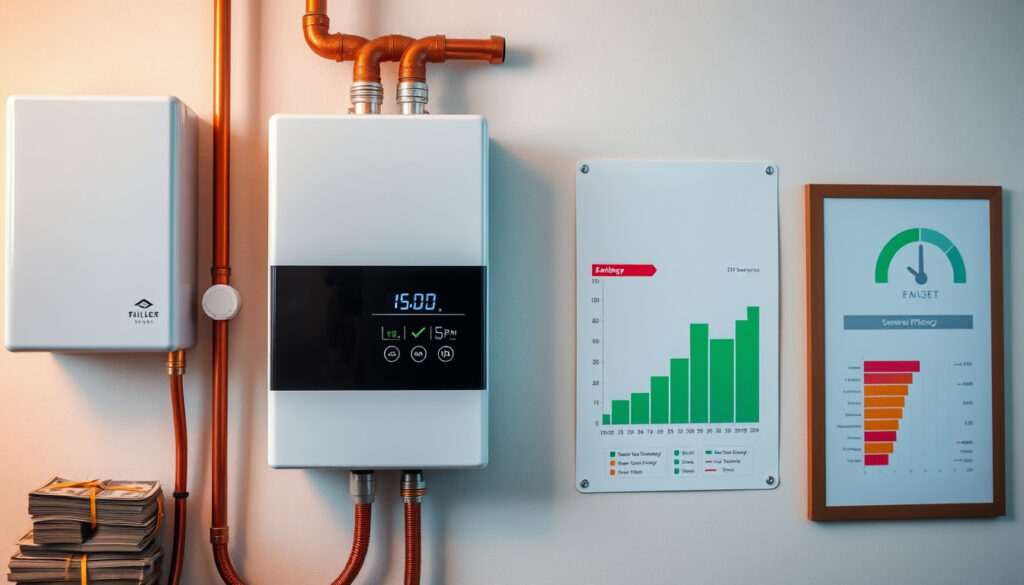
Tankless Water Heater Cost: Worth the Investment
If you’re tired of running out of hot water mid-shower, a tankless water heater might have crossed your mind. The promise of endless hot water and lower energy bills sounds great, but the upfront cost can be a serious hurdle.
Average installed cost (unit + labor): $2,400 ·
Price range (most homes): $1,600 – $3,800 ·
Energy efficiency gain vs tank: up to 34% ·
Typical unit lifespan: 20 years ·
Annual energy savings (est.): $100 – $200
Most homeowners pay around $2,400 installed, with prices ranging from $1,600 to $3,800 depending on your home’s setup and fuel choice.
Quick snapshot
- Average installed cost is $2,400 (range $1,600–$3,800) per The Home Depot (home improvement retailer).
- Tankless units are up to 34% more efficient than standard tank heaters, per the U.S. Department of Energy (via Home Depot). (The Home Depot (home improvement retailer))
- Electric units cost less to install than gas but have lower flow rates, according to Angi (home services marketplace).
- Tankless water heaters last 20+ years vs 10–15 years for tank models, as noted by R.J. Groner (plumbing contractor).
- Exact payback period varies heavily by local utility rates and household usage patterns.
- Long-term maintenance cost differences vs tank heaters are not widely published.
- More homeowners are expected to switch as gas prices rise and electric heat pump tankless models become more efficient.
- The U.S. Department of Energy estimates that homes using ≤41 gallons of hot water daily can see 24%–34% efficiency gains with tankless units, per The Home Depot.
- Gas tankless water heaters cost $1,000 to $1,500, with annual fuel expenses around $200 to $350, per Angi.
Six key cost and performance metrics, one pattern: the upfront price is substantial, but the long-term energy savings can offset the initial outlay over time.
| Metric | Value |
|---|---|
| Average installed cost | $2,400 |
| Unit cost (gas) | $600–$1,800 |
| Unit cost (electric) | $300–$1,000 |
| Installation labor | $500–$1,500 |
| Annual energy savings vs tank | $100–$200 |
| Typical payback period | 8–12 years |
How Much Does It Cost to Install a Tankless Water Heater?
Unit price by fuel type
- Gas tankless units typically cost between $600 and $1,800, according to Angi (home services marketplace).
- Electric models are cheaper, ranging from $300 to $1,000, per EcoFlow (energy solutions provider).
Labor and installation complexity
- Installation labor averages $600 to $1,850, reports Angi, with complex jobs reaching $1,500 or more.
- Gas installations often require venting upgrades and gas line resizing, adding $200–$800, notes The Home Depot.
Retrofit vs new construction cost
- Retrofitting from a tank heater adds $500–$1,500 in plumbing and electrical work, per HVACBase (HVAC resource site).
- New construction installations are simpler and typically cost $1,200–$2,500, according to The Examiner News (local news outlet).
For a typical homeowner replacing a 40-gallon tank, the total installed cost will fall between $1,600 and $3,800 — but gas models almost always cost more upfront because of venting and gas line work.
The implication: the upfront cost is the main barrier, but the investment can pay off over time for those who stay put.
What Are the Downsides of a Tankless Water Heater?
Higher upfront cost
- Tankless units cost 2 to 2.5 times more than a standard tank heater, notes The Home Depot.
- While a tank heater might cost $1,000 installed, a tankless system can run $2,400 or more.
Intermittent cold water (cold water sandwich)
- A common complaint: when the burner cycles off and on, a brief slug of cold water can appear — known as “cold water sandwich,” acknowledged by HVACBase.
Flow rate limitations
- Most whole-house tankless units deliver 6–11 GPM. Running two showers plus a dishwasher at once can exceed capacity, warns R.J. Groner.
The biggest downside for most homes is not the cost itself, but the risk of undersizing. If you pick a unit that’s too small for your household’s peak demand, you’ll get cold showers when you need hot water most.
The pattern: these downsides are manageable with proper sizing and maintenance, but they require upfront planning.
Is It Worth Switching to a Tankless Water Heater?
Long-term savings vs initial investment
- Annual energy savings of $100–$200 are typical, says Angi.
- Payback period runs 8–12 years, depending on local utility rates and household hot water usage, per EcoFlow.
Lifespan comparison
- Tankless units last 20+ years, while tank models typically need replacement every 10–15 years, according to HVACBase.
Environmental impact
- Because they heat water only on demand, tankless units waste less energy. The Department of Energy estimates 24%–34% more efficiency for homes using ≤41 gallons per day, notes The Home Depot.
How Big of a Tankless Water Heater Do I Need for 3 Bathrooms?
Flow rate calculation (GPM)
- A typical 3-bathroom home needs 6–8 GPM to run two showers simultaneously, says R.J. Groner.
Temperature rise required
- If your incoming groundwater is 50°F and you want 110°F water, you need a 60°F temperature rise. Higher rise reduces flow rate, so you may need a larger unit.
Recommended unit size (e.g., 9-11 GPM for 3 baths)
- Gas units rated 9–11 GPM are common for 3-bath homes. Electric units often require multiple smaller units or a dedicated electrical panel upgrade, per EcoFlow.
Undersizing is the #1 mistake. A 6 GPM unit won’t keep up with two showers in winter. Always have a contractor calculate your peak demand before buying.
The implication: choosing the right size is critical for performance, and a professional load calculation is a wise investment.
Why Do Plumbers Not Recommend Tankless Water Heaters?
Maintenance requirements
- Annual descaling is required to prevent mineral buildup, especially in hard water areas, says HVACBase.
Installation complexity
- Many plumbers prefer simpler tank replacements. A retrofit can involve gas line upsizing, new venting, and electrical work — all expensive and time-consuming, notes The Home Depot.
Reliability in hard water areas
- Hard water scaling is the most common cause of failure, according to R.J. Groner. Without regular flushing, the heat exchanger can clog.
Plumbers aren’t anti-tankless — they’re anti-callbacks. A tankless system that isn’t maintained properly will fail, and the contractor gets blamed. If you commit to annual maintenance, the risk drops dramatically.
The pattern: plumbers’ reluctance is rooted in maintenance demands, not inherent flaws.
Can I Replace My 40 Gallon Water Heater with a Tankless Water Heater?
What needs to change: gas line, venting, electrical
- Gas tankless units require a larger gas line — often 3/4-inch vs 1/2-inch — costing $200–$800, reports Angi.
- Venting must be stainless steel or PVC, not the galvanized pipe used for tank heaters, per HVACBase.
Permits and codes
- Most jurisdictions require a permit for gas line work and a professional inspection. Skipping permits can void insurance, warns The Home Depot.
Cost comparison of replacement vs conversion
- Replacing a 40-gallon tank with a similar tank costs $800–$1,500. Converting to tankless adds $1,000–$2,500 in extra work, according to The Examiner News.
How Often Do I Need to Flush My Tankless Water Heater?
Standard recommendation: once a year
- Manufacturers like Rheem and Navien recommend annual descaling to prevent mineral scale buildup, per HVACBase.
More frequent if hard water or water softener used
- Homes with hard water (above 10 grains per gallon) may need flushing every 6 months. A water softener can reduce frequency to every 2 years, notes R.J. Groner.
Flushing procedure overview
- Flushing involves circulating a vinegar or descaling solution through the heat exchanger using a pump and bucket. DIY is possible, but many homeowners hire a plumber ($100–$200 per service), reports Angi.
Skipping annual flushing is the #1 reason tankless water heaters fail prematurely. The repair cost for a clogged heat exchanger can exceed $1,000.
The implication: regular maintenance is non-negotiable for long-term reliability.
Three key differences, one pattern: tankless units win on efficiency and lifespan, but lose on upfront cost and complexity.
| Feature | Tankless Water Heater | Tank Water Heater |
|---|---|---|
| Average installed cost | $2,400 | $1,000 |
| Lifespan | 20+ years | 10–15 years |
| Energy efficiency | Up to 34% more efficient | Standby heat loss 10–15% |
| Hot water supply | Unlimited (flow-limited) | Limited by tank size |
| Maintenance | Annual descaling required | Minimal (drain sediment yearly) |
| Space required | Wall-mounted, compact | Floor space, 60-gallon tank |
Six common tankless water heater specifications, one pattern: gas units deliver higher flow rates but require more complex installation.
| Specification | Gas Tankless | Electric Tankless |
|---|---|---|
| Flow rate (GPM) | 7–11 | 3–7 |
| Unit cost | $600–$1,800 | $300–$1,000 |
| Installation cost | $1,500–$3,000 | $800–$1,500 |
| Venting required | Yes (stainless steel or PVC) | No |
| Gas line upgrade | Often needed | N/A |
| Electrical panel | Standard outlet | Often needs 200A panel |
Pros and Cons of Tankless Water Heaters
Upsides
- Endless hot water on demand
- Up to 34% more efficient than tank heaters
- Lifespan of 20+ years
- Compact design saves floor space
- Lower risk of water damage (no tank to leak)
Downsides
- Higher upfront cost (2–3x tank)
- Flow rate limitations during peak demand
- Annual descaling required
- Cold water sandwich effect
- Installation complexity for retrofits
The pattern: the trade-offs are clear — higher upfront cost and maintenance for long-term efficiency and endless hot water.
Step-by-Step: How to Flush Your Tankless Water Heater
- Turn off the unit and disconnect power/gas.
- Close the shut-off valves on the water lines.
- Attach a pump to the service ports using hoses.
- Submerge the pump inlet in a bucket of white vinegar or descaling solution.
- Run the pump for 45–60 minutes to circulate the solution through the heat exchanger.
- Flush the system with clean water by running the pump in fresh water for 5 minutes.
- Reconnect the water lines, open valves, restore power/gas, and test the unit.
For a detailed guide, see HVACBase (HVAC resource site).
The implication: annual flushing is a straightforward DIY task that can save hundreds in repair costs.
Clarity Check: What’s Confirmed and What’s Still Unclear
Confirmed facts
- Average installed cost is $2,400 (range $1,600–$3,800) per The Home Depot.
- Tankless units are up to 34% more efficient than standard tank heaters, per the U.S. Department of Energy (via Home Depot).
- Annual descaling is required to prevent scaling, per R.J. Groner.
What’s unclear
- Exact payback period varies heavily by local utility rates and household usage patterns.
- Long-term maintenance cost differences vs tank heaters not widely published.
- Electric units are cheaper to install than gas but have lower flow rates, per Angi.
- Gas line resizing costs $200–$800, per Angi.
The pattern: the confirmed facts are solid, but the unclear items highlight the need for site-specific calculations.
What Experts Say
“The average installed cost of a tankless water heater is $2,400, with a typical range of $1,600 to $3,800.”
— SolarReviews (industry comparison site)
“Tankless water heaters cost about 2 to 2.5 times as much as a standard water heater because of unit cost, venting, and gas line resizing.”
— The Home Depot (home improvement retailer)
“Electric tankless water heaters are generally cheaper to install than natural gas, with electric at $1,400 to $3,000 installed and natural gas at $2,100 to $5,600 installed.”
— EcoFlow (energy solutions provider)
“Annual flushing is required — more often with hard water. Skipping it is the #1 cause of failure.”
— Budds Plumbing (local plumbing blog)
The pattern: experts agree on the cost and maintenance trade-offs, underscoring the importance of proper sizing and care.
For the average homeowner in the U.S., the decision to switch to a tankless water heater comes down to one question: how long do you plan to stay? If you’re settling in for a decade or more, the $100–$200 annual savings and longer lifespan make the $2,400 upfront cost a smart investment. But if you’re planning to move in five years, the payback likely won’t catch up. A family using 40 gallons of hot water a day faces a clear choice: save your money for a tank heater, or commit to the maintenance and reap the long-term rewards of a tankless system.
tanklesswaterheaterinstallationcost.com, hvaccalc.org, waterclue.com, nerdwallet.com, remodelingexpense.com, housegrail.com
Frequently asked questions
Does a tankless water heater increase home value?
Yes, but only if the system is properly sized and maintained. A well-installed tankless unit can be a selling point, especially in energy-conscious markets. However, a poorly maintained or undersized system may raise red flags during inspection.
Can a tankless water heater freeze?
Yes, if the unit is installed in an unheated space and temperatures drop below freezing. Many models have built-in freeze protection, but it requires power to operate. If the power goes out, the unit can freeze and crack.
Do tankless water heaters need electricity?
Yes, even gas models need electricity to power the electronic ignition, control board, and fan. Without power, the unit won’t operate. Battery backup systems are available for critical situations.
How noisy is a tankless water heater?
Most modern units produce a low hum around 50–60 decibels — comparable to a refrigerator. Some older or poorly maintained units can be noisier due to burner or fan issues.
What size tankless water heater do I need for a family of 4?
For a family of 4, a gas unit rated 7–9 GPM is typically sufficient, assuming moderate simultaneous use (e.g., one shower and a dishwasher). A professional load calculation is recommended.
Is a tankless water heater better for the environment?
Generally yes, because they avoid standby heat loss and use less energy overall. The exact environmental benefit depends on the fuel type and local energy mix. Gas units still produce emissions, but less than tank heaters.
How much does it cost to run a tankless water heater per day?
For a typical household, the daily cost ranges from $0.50 to $1.50 for gas, or $1.00 to $2.50 for electric, depending on usage and local utility rates. That’s about $15–$45 per month.
Related reading
More related posts
 Cincinnati Reds vs Pittsburgh Pirates Match Player Stats
 Museum of Ice Cream: Tickets, What to Expect & Worth It
 Chicago Bears vs Detroit Lions Match Player Stats – 2024 Full Breakdown
 Words That Start With A: Lists for Kids, Scrabble & More
 The Batman Who Laughs: Origin, Powers, and Defeat Explained
 NBA YoungBoy Net Worth: $60M Deal, $70M Tour, $500M
 Lee Do-hyun – Age, Height, Girlfriend and Key Dramas
 The Hunger Games: Catching Fire – Plot, Watch Order, FAQ