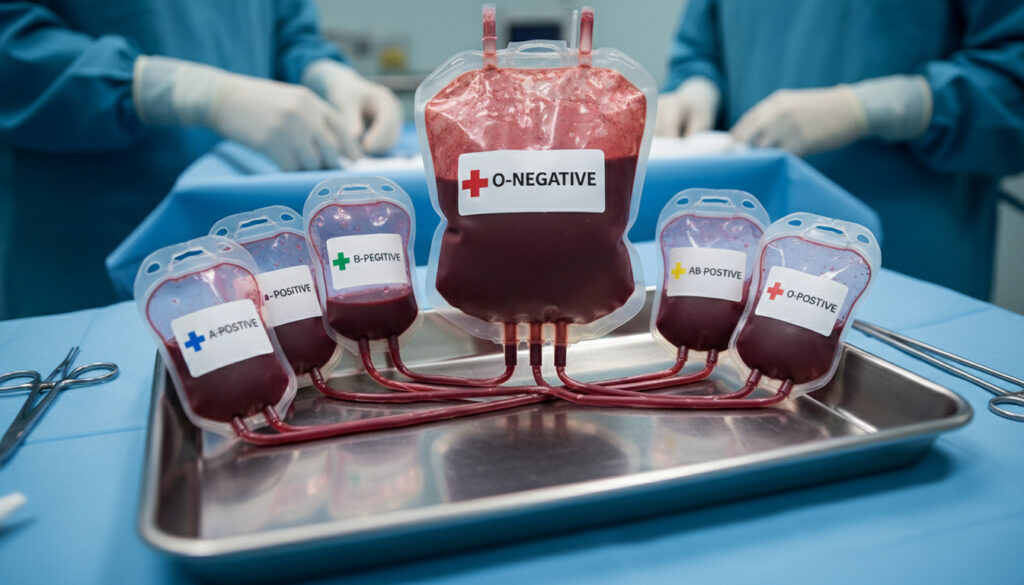
What Blood Type Is the Universal Donor – O-Negative Explained
O-negative blood serves as the ultimate safety net in emergency medicine. When trauma patients hemorrhage and identification bands remain unprinted, this blood type flows into veins without triggering the immune attacks that kill. The designation rests on biochemistry: these red blood cells carry no A, B, or Rh(D) antigens, presenting a blank surface that any recipient’s body accepts as native.
This absence makes O-negative the universal donor for red blood cell transfusions. The American Red Cross confirms compatibility extends across all ABO and Rh types, a status that renders O-negative simultaneously indispensable and perpetually scarce. Hospitals exhaust supplies rapidly during mass casualty events and routine surgeries alike.
Understanding this universal status requires distinguishing between red blood cell donations and plasma donations, between donor antigens and recipient antibodies, and between the universal donor and its counterpart, the universal recipient.
What Blood Type is the Universal Donor?
The universal donor designation applies specifically to red blood cell transfusions. Medical protocols established by the University of Texas Medical Branch identify O-negative as the only type compatible with every recipient regardless of their personal blood composition.
- O-negative red blood cells lack A, B, and Rh(D) antigens entirely
- Compatibility spans all eight major blood types for RBC transfusion
- Emergency departments rely on it when typing crosses take too long
- Only 7% of the population carries this blood type
- Demand perpetually outstrips supply in hospital blood banks
- O-negative donors can receive red cells only from other O-negative donors
| Blood Type | Can Donate RBCs To | Can Receive RBCs From |
|---|---|---|
| O- | All Types | O- only |
| O+ | O+, A+, B+, AB+ | O+, O- |
| A- | A+, A-, AB+, AB- | A-, O- |
| A+ | A+, AB+ | A+, A-, O+, O- |
| B- | B+, B-, AB+, AB- | B-, O- |
| B+ | B+, AB+ | B+, B-, O+, O- |
| AB- | AB+, AB- | AB-, A-, B-, O- |
| AB+ | AB+ only | All Types |
What is the Universal Recipient Blood Type?
AB-positive blood occupies the opposite pole in transfusion medicine. This type accepts red blood cells from any donor, earning the title of universal recipient for RBC transfusions. The mechanism mirrors the universal donor logic in reverse: AB-positive red blood cells display both A and B antigens plus the Rh factor, but their plasma contains no anti-A or anti-B antibodies.
Why AB-Positive Plasma Defies the Pattern
The relationship inverts when considering plasma donations. While AB-positive serves as the universal recipient for red cells, its plasma makes it the universal donor for plasma transfusions. Without antibodies against A or B antigens, AB plasma cannot attack the recipient’s blood cells regardless of their type.
Red blood cell compatibility follows forward matching—donor antigens must not trigger recipient antibodies. Plasma compatibility follows reverse matching—donor plasma must lack antibodies against recipient antigens. The Red Cross emphasizes this distinction determines safe transfusion practices.
Blood Type Compatibility for Donations and Transfusions
Transfusion medicine operates on antigen-antibody interactions. Every red blood cell carries surface markers determined by genetics; every blood plasma contains defensive proteins shaped by those same genetics.
The Rules for Red Cell Transfusions
Canadian Blood Services explains that donor red cells must survive the recipient’s immune surveillance. Type O individuals produce antibodies against both A and B antigens. Type A produces anti-B. Type B produces anti-A. Type AB produces neither. This immune reality determines who can safely receive whose cells.
Plasma Transfusion Dynamics
Plasma carries clotting factors and antibodies. Vitalant’s compatibility charts show that O plasma contains both anti-A and anti-B antibodies, making it dangerous for any recipient except another O type. AB plasma lacks these antibodies, rendering it safe for all.
The Red Cross reports O-negative blood faces chronic shortage due to constant demand for trauma care, surgeries, and neonatal transfusions. While comprising 7% of the population, it supports 100% of emergency transfusion needs.
Rh-negative patients prefer Rh-negative blood components, but Rh-positive units may substitute in emergencies per UTMB protocols. Rh-positive recipients accept either Rh type without complication.
Rarest and Most Needed Blood Types
Population Distribution Reality
Community Blood Center data indicates O-positive dominates at 37-39% of the population, making it the most common type. O-negative trails significantly at approximately 7%. Prevalence varies by ethnicity: 51% of African-Americans and 57% of Hispanics carry type O blood compared to 45% of Caucasians.
Hospital Demand Patterns
Stanford Blood Center identifies O-negative and O-positive as the most needed types. The universal donor status of O-negative creates disproportionate draw on limited supplies, while O-positive serves the largest patient population segment.
When Was the Universal Donor Discovered?
- : Karl Landsteiner identifies the ABO blood group system, establishing the existence of distinct blood types.
- : Scientists discover the Rh factor, expanding the system to include positive and negative designations.
- : Military medicine formalizes the use of O-negative blood for emergency battlefield transfusions when typing is impossible.
- : Blood banks maintain strict protocols reserving O-negative units for trauma cases, pregnant women, and infants.
Established Facts and Persistent Questions
- O-negative is the universal donor for red blood cell transfusions
- AB-positive is the universal recipient for red blood cells
- AB plasma is the universal donor for plasma transfusions
- O plasma is compatible only with O recipients
- Mismatched transfusions risk acute hemolytic reactions
- Platelets and cryoprecipitate tolerate broader ABO matching due to weak antigen expression
- Over 300 rare antigens exist beyond the main ABO/Rh system
- Synthetic blood products remain experimental, not standard care
The Science Behind Blood Type Antigens
Blood types manifest through inherited genetic instructions governing red blood cell surface chemistry. The A and B alleles code for specific sugar-protein complexes; the O allele codes for the H antigen alone, lacking the terminal sugars that define A and B.
The Rh factor involves a separate genetic complex centered on the D antigen. Red Cross educational materials describe how these antigens trigger immune responses when foreign types enter a bloodstream containing matching antibodies.
Historical parallels appear in unexpected places. Interview with the Vampire TV Series explores themes of blood transmission and transformation, though the medical reality proves more complex than fiction suggests. Similarly, Lamb to the Slaughter Meaning reminds us that biological realities often carry metaphorical weight in cultural narratives.
Medical Authority Perspectives
O negative is the universal donor. This means that it’s found compatible with all blood types.
American Red Cross
AB plasma is the universal donor for plasma. AB+ is the universal recipient for RBCs.
University of Texas Medical Branch Blood Bank
UCHealth laboratory protocols provide detailed charts guiding clinicians through component-specific compatibility decisions beyond basic ABO matching.
The Lifesaving Role of O-Negative Blood
O-negative blood maintains its position as the biomedical safety net for civilization’s most critical moments. When accident victims arrive unconscious and bleeding, when operating rooms face catastrophic hemorrhage, when newborns require emergency exchange transfusions—this single blood type bridges the gap between life and the time required for precise laboratory identification. Lamb to the Slaughter Meaning may explore dark narratives, but the reality of universal donation illuminates how biological diversity creates both challenges and solutions in human survival.
Frequently Asked Questions
Can universal donors receive from anyone?
No. O-negative donors, while universal donors for red blood cells, can receive red cell transfusions only from other O-negative donors. Their immune systems recognize all other types as foreign.
What is universal donor plasma?
AB plasma serves as the universal donor for plasma transfusions. Lacking anti-A and anti-B antibodies, it will not attack any recipient’s red blood cells regardless of their ABO type.
Can O positive donate to everyone?
No. O-positive donors can provide red blood cells to all Rh-positive recipients (O+, A+, B+, AB+), but not to Rh-negative recipients. Only O-negative qualifies as truly universal.
Which blood type is the rarest?
AB-negative ranks as the rarest major blood type in most populations, followed by B-negative and AB-positive. O-negative is rare at 7% prevalence but remains relatively common compared to these.
What blood type is most needed for donations?
O-negative faces the highest relative demand due to universal compatibility and emergency use, while O-positive serves the largest patient population due to its prevalence.
Is AB positive the universal recipient?
Yes, for red blood cell transfusions. AB-positive individuals can receive red cells from any ABO and Rh type. However, for plasma transfusions, they become universal donors rather than recipients.
Why is O negative the universal donor?
O-negative red blood cells lack A, B, and Rh(D) antigens. Without these markers, recipient immune systems do not recognize the cells as foreign, preventing transfusion reactions.
More related posts
 When Is Super Bowl 2025? Date, Time, Teams & Halftime Show
 Garden of Life Probiotics Review: Benefits, Side Effects & More
 How to Fix Phone Microphone: Guide for Android & iPhone
 What Is an NPI Number? Complete Guide
 Ulta Credit Card Payment: Pay Online, by Phone, or Mail
 Hootie & the Blowfish: Biggest Hit, Name Origin, Legal Facts
 Hard Boiled Egg Time: 10-Minute Boil for Perfectly Cooked Eggs
 170 lbs to kg: 77.11 kg Exact Conversion for Fitness and Health