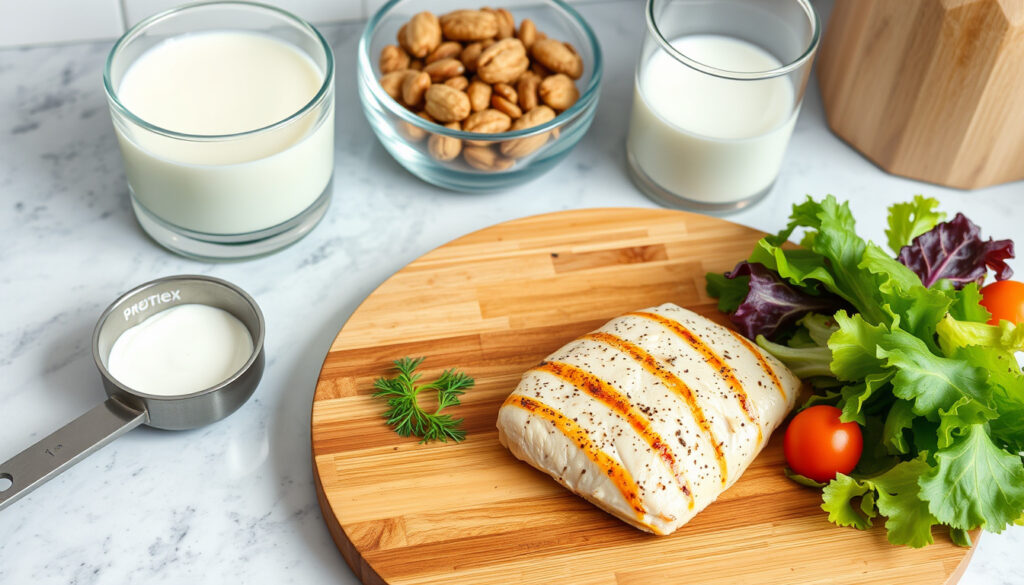
How Much Protein Do You Need? Daily Intake Guide
You’ve probably seen the protein numbers floating around — 0.8 grams per kilogram, 1.6 grams, maybe even 2 grams — and wondered which one actually applies to you. The answer changes depending on whether you’re trying to build muscle, lose weight, or just stay healthy.
RDA for sedentary adults: 0.8 g per kg of body weight ·
Range for active adults: 1.2–1.7 g per kg ·
Protein for muscle gain: 1.6–2.2 g per kg ·
Protein for weight loss: 1.2–1.6 g per kg ·
Typical daily intake (men): 55.5 g ·
Typical daily intake (women): 45 g
Quick snapshot
- 0.8 g/kg is the RDA for healthy, sedentary adults (Mayo Clinic Health System)
- Higher intakes up to 2.2 g/kg are safe for most people without kidney disease (Examine)
- Optimal protein intake for older adults to prevent sarcopenia — research still evolving (Stanford Lifestyle Medicine)
- Ideal protein timing for muscle protein synthesis — some studies favor even distribution, others post‑workout focus (British Heart Foundation)
- RDA unchanged since 2005 — but expert ranges for active people have increased (WebMD)
- More precise age- and sex-specific guidelines expected as sarcopenia research matures (Stanford Lifestyle Medicine)
The table below shows how your protein target climbs with activity level and goal — from the minimum to the maximum evidence-based range.
| Category | Protein per kg body weight | Source |
|---|---|---|
| RDA (minimum) | 0.8 g per kg | Mayo Clinic Health System |
| Active adult range | 1.2–1.7 g per kg | Mayo Clinic Health System |
| Muscle gain target | 1.6–2.2 g per kg | Examine |
| Weight loss target | 1.2–1.6 g per kg | UnityPoint Health |
| Example: 70 kg person | 56 g (sedentary) to 119 g (active) | Calculated from above |
How much protein do I need per day?
Daily protein recommendations for sedentary adults
- The Recommended Dietary Allowance (RDA) for a healthy, sedentary adult is 0.8 g per kilogram of body weight per day, according to the National Academy of Medicine via WebMD.
- The British Heart Foundation puts it at 0.75 g/kg for healthy-weight adults — nearly identical in practice.
- That’s the baseline for avoiding deficiency: about 10–35% of your daily calories from protein (WebMD).
The implication: if you sit at a desk most of the day, the RDA is your floor, not your ceiling. Hitting that minimum prevents muscle breakdown. But most of us need more.
Protein needs for active individuals
- People who exercise regularly need 1.1–1.5 g/kg/day, per the Mayo Clinic Health System.
- If you regularly lift weights or train for endurance events, the range rises to 1.2–1.7 g/kg/day (Mayo Clinic Health System).
- Endurance athletes and muscle builders can go as high as 1.2–2.0 g/kg/day (British Heart Foundation).
What this means: the more you move, the more protein your body pulls from food to repair tissue. Your sedentary friend’s 56 g won’t cut it if you’re running 10 km daily.
Gender differences in protein requirements
- Typical daily protein intake in the U.S. is around 55.5 g for men and 45 g for women, based on NHANES data (WebMD).
- These averages fall below optimal for active individuals. A 70 kg active man aiming for 1.6 g/kg would need 112 g/day — double the typical intake.
The pattern: the gender gap in actual protein consumption doesn’t reflect a difference in per-kg need. Both sexes use the same weight-based formula. Women’s lower absolute intake simply reflects lower average body weight.
How do you calculate your protein requirement?
Step 1: Determine your body weight in kg
- If you weigh in pounds, divide by 2.2046 to get kilograms. Example: 150 lb ÷ 2.2046 = 68 kg.
- Use your current body weight. For overweight individuals, some experts recommend using lean body mass, but current weight is the starting point in all major guidelines (Mayo Clinic Health System).
Step 2: Multiply by activity factor
- Sedentary: weight (kg) × 0.8 = daily g protein
- Moderately active (3–5 workouts/week): weight × 1.2–1.4
- Very active (daily hard training or athletics): weight × 1.6–1.8
- Muscle gain or high-quality weight loss: weight × 1.6–2.2 (Examine)
Example: 70 kg person
- Sedentary: 70 × 0.8 = 56 g/day
- Moderately active: 70 × 1.3 ≈ 91 g/day
- Muscle gain: 70 × 1.8 = 126 g/day
- Weight loss (preserving muscle): 70 × 1.4 = 98 g/day
The catch: these are starting points. Adjust based on hunger, recovery, and how your body responds. The formula gets you in the ballpark; real-world feedback dials it in.
How much protein do I need to gain muscle?
Optimal range for muscle hypertrophy
- Examine’s evidence review concludes that adults pursuing muscle gain should aim for 1.6–2.2 g/kg/day (Examine).
- At least 1.6 g/kg/day appears best for maximizing muscle accretion during weight gain or high-quality weight loss (Examine).
- The American College of Sports Medicine (ACSM), American Dietetic Association, and Dietitians of Canada jointly recommend 1.2–1.7 g/kg for strength athletes.
Timing and distribution of protein intake
- Spread protein across 3–4 meals per day to maximize muscle protein synthesis (Examine).
- Consuming 15–20 g of protein within an hour after intense training may support muscle recovery (British Heart Foundation).
Combining protein with resistance training
- Protein alone won’t build muscle — resistance training provides the growth stimulus. The two work synergistically (Examine).
- Aim for 3–5 weekly strength sessions with progressive overload. Then dial in protein on top.
The pattern: eating 2.0 g/kg without lifting is just extra calories. The muscle‑building benefit only fully unlocks when combined with training.
For an 80 kg lifter, 1.8 g/kg means 144 g of protein daily — roughly 4–5 chicken breasts. Missing that target by 40 g leaves muscle gains on the table. The dose makes the difference.
How much protein do I need for weight loss?
Protein’s role in satiety and metabolism
- Protein increases satiety — you feel fuller for longer, which helps with calorie restriction (UnityPoint Health).
- A higher protein intake also raises the thermic effect of food — your body burns more calories digesting protein than carbs or fat.
Recommended intake during caloric deficit
- Aim for 1.2–1.6 g/kg/day to preserve muscle while losing fat (UnityPoint Health).
- Examine notes 1.6–2.4 g/kg/day for those actively trying to lose fat while preserving or gaining muscle (Examine).
- Spread across meals: aim for 20–30 g per meal to keep satiety steady throughout the day.
Examples of high-protein, low-calorie foods
- Skinless chicken breast: ~31 g protein per 100 g (~165 kcal)
- Greek yogurt (nonfat): ~10 g per 100 g (~60 kcal)
- Eggs: ~6 g per large egg (~70 kcal)
- Tofu: ~8 g per 100 g (~76 kcal)
- Lentils (cooked): ~9 g per 100 g (~116 kcal)
The trade-off: higher protein during a deficit means you protect metabolically active muscle. Losing weight without adequate protein risks losing muscle along with fat — which slows your resting metabolism.
Upsides
- Preserves muscle mass during calorie restriction
- Increases satiety, making diet adherence easier
- Raises metabolic rate through thermic effect of food
Downsides
- Excess protein (above 2.2 g/kg) can strain kidneys in people with existing kidney disease (Mayo Clinic Health System)
- High‑protein diets may reduce intake of fiber‑rich carbs if not balanced
Is 100 g of protein a day a lot?
Comparing 100 g to typical recommendations
- For a 70 kg sedentary person, 100 g is 1.43 g/kg — well above the 0.8 g/kg RDA.
- For a 70 kg active person, 100 g (1.43 g/kg) sits within the 1.2–1.7 g/kg range.
- For a 50 kg woman, 100 g equals 2.0 g/kg — near the top of the muscle‑gain range.
When 100 g may be appropriate
- Active individuals weighing 60–85 kg who are training for muscle growth or endurance (Examine).
- People in a caloric deficit trying to preserve muscle (UnityPoint Health).
Signs of excessive protein intake
- Digestive discomfort (bloating, gas) if fiber intake drops (Mayo Clinic Health System).
- Dehydration — your kidneys excrete more urea, pulling water with it.
- In individuals with chronic kidney disease, high protein can accelerate decline (Mayo Clinic Health System).
The catch: for most healthy people, 100 g is not dangerous — it’s just unnecessary if you’re sedentary. It becomes valuable when your activity level demands it.
Signs you need more protein
- Persistent hunger: protein suppresses appetite more than carbs or fat (UnityPoint Health).
- Slow recovery after workouts: lingering soreness >48 hours may indicate insufficient protein for repair.
- Hair thinning and brittle nails: protein is the structural building block for keratin.
- Muscle loss despite training: if you’re lifting but not growing, your intake may be below the 1.6 g/kg threshold (Examine).
- Frequent illness: antibodies are proteins — low intake can impair immune function.
If you’re over 65, your muscles become less responsive to protein — a phenomenon called anabolic resistance. That’s why Stanford Lifestyle Medicine and the British Heart Foundation raise the recommended range for older adults to 1.2–1.6 g/kg/day or even higher. Skipping protein in your 70s doesn’t just slow recovery — it accelerates sarcopenia.
exerciselibrary.com, vedantu.com, learn.athleanx.com, calcvita.com, innerg.ca, calcdomain.com
For a more detailed breakdown of how much protein you need based on your activity level and goals, check out a complete guide to daily protein.
Frequently asked questions
Can you eat too much protein?
Yes, but only rarely. For people without kidney disease, intakes up to 2.2 g/kg are considered safe (Examine). Excessive protein above 2.5 g/kg may cause digestive issues, dehydration, or kidney strain in susceptible individuals (Mayo Clinic Health System).
What foods are high in protein?
Animal sources: chicken breast (~31 g/100 g), eggs (~6 g each), Greek yogurt (~10 g/100 g), fish. Plant sources: lentils (~9 g/100 g), tofu (~8 g/100 g), chickpeas (~7 g/100 g), nuts (~20 g/100 g).
Is plant protein as good as animal protein?
Yes, when you combine complementary sources (e.g., rice + beans) to provide all essential amino acids (British Heart Foundation). Soy protein is a complete plant protein on its own.
How much protein do I need if I am pregnant?
Pregnant women need about 1.1 g/kg/day, with additional 25 g/day in the second and third trimesters (WebMD). Standard pregnancy guidelines recommend an extra 10–20 g over baseline.
Do protein shakes help with weight loss?
They can — as a convenient way to hit protein targets without excess calories. A shake with 20–30 g protein and low added sugar supports satiety and muscle preservation during a deficit (UnityPoint Health).
How much protein should a vegetarian eat?
Same per‑kg targets as omnivores — 0.8–2.2 g/kg depending on activity. The challenge is getting enough leucine from plant sources; including soy, lentils, and quinoa helps (British Heart Foundation).
Is 2 eggs a day enough protein?
Two large eggs provide about 12 g of protein — fine for a snack but far short of a day’s needs for most adults. For a 70 kg person aiming for 90 g/day, 2 eggs only covers 13% of the target.
Related reading: Supplement Store Near Me · Garden of Life Probiotics Review
More related posts
 ACA Code of Ethics: 5 Principles, 9 Sections & APA Citation
 How to Change Signature in Outlook: Desktop, Web, Mobile
 Parts of the Eye – Anatomy Functions and Structures
 Autumn/Fall Nails 2026: Colors and Trends
 Willy Wonka and the Chocolate Factory Cast – 1971 Cast Guide
 New Movies to Stream: Top Picks on Netflix, Prime Now
 How Much Is Health Insurance in Ireland? 2025 Monthly Costs
 Mega Millions Jackpot Winner – Unclaimed $1.13B Prize Key Facts