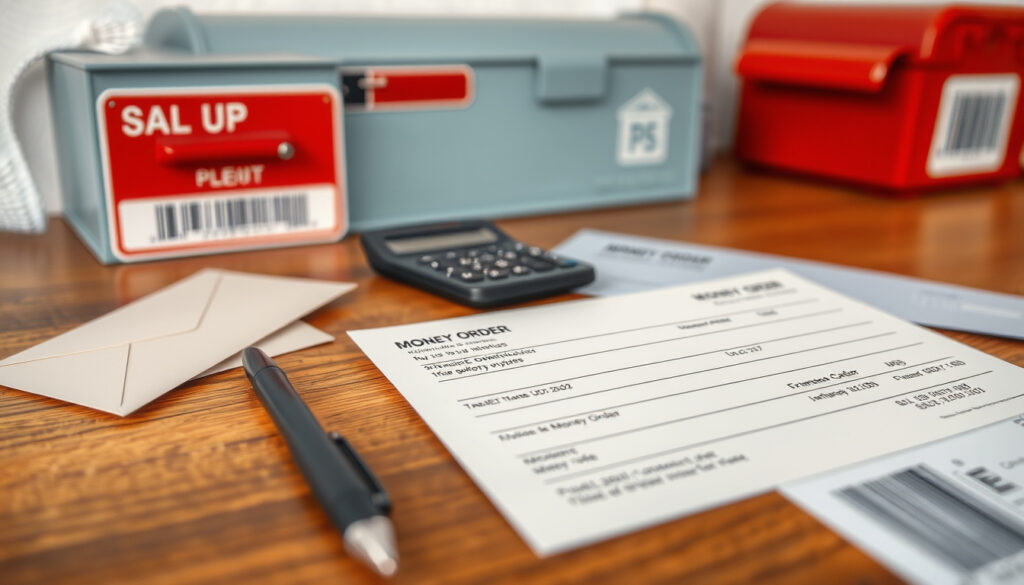
Money Order Near Me: Where to Buy, Cash, and Track
You found the nearest money order counter in minutes, and now the real questions start: who cashes it, what the fee is, and how long the money stays frozen. USPS sells domestic money orders up to $1,000, and Walmart’s MoneyCenter puts the same ceiling on its own orders. The part search results skip is what happens after you buy — cashing rules, tracking serial numbers, phone deposits, and alternatives that work harder for larger amounts.
USPS domestic money order limit: $1,000 ·
Walmart MoneyCenter money order limit: $1,000 ·
ATM money order acceptance: No ·
Cash App mobile money order deposits: Not accepted ·
USPS money order tracking: Serial number from receipt
Quick snapshot
- USPS domestic money orders are capped at $1,000 per order (USPS (official postal service)).
- ATMs do not accept paper money orders. (USPS (official postal service))
- Cash App does not accept money orders for mobile deposit. (USPS (official postal service))
- Walmart MoneyCenter sells money orders, not bank cashier’s checks. (USPS (official postal service))
- Exact retailer fees vary by state and by individual store.
- Bank mobile apps differ on whether money orders qualify for photo deposit.
- Walmart MoneyCenter hours vary by location.
- USPS domestic money orders never expire and earn no interest (USPS (official postal service)).
- Mailed MoneyGram orders normally need two weeks in transit before a status check means much (MoneyGram (money transfer provider)).
- Check the issuer’s store finder or the location’s own listing before driving over (MoneyGram (retailer locator)).
- Keep the customer receipt with the serial number for tracking and replacement claims (USPS (official FAQ)).
Ten rows, one pattern: a $1,000 ceiling on most retail orders, a paper receipt as the main proof of value, and deposit paths that close the moment an app or machine sees paper.
| Item | Value |
|---|---|
| USPS domestic money order maximum | $1,000 per money order (USPS (official postal service)) |
| Walmart MoneyCenter money order maximum | $1,000 per money order |
| USPS fee, $0.01–$500 | $2.65 (USPS fee schedule) |
| USPS fee, $500.01–$1,000 | $3.75 (USPS fee schedule) |
| USPS lost or stolen replacement fee | $23 processing fee (USPS replacement policy) |
| ATM money order acceptance | No |
| Cash App money order deposits | Not accepted |
| Typical ID needed to cash | Valid government-issued ID |
| USPS domestic money order expiration | Never (USPS official postal service) |
| Buying without a bank account | Allowed at USPS and MoneyGram retailers (MoneyGram money order overview) |
Where can I buy money orders near me?
MoneyGram’s own network sketches the shape of this market: supermarkets, financial institutions, check cashers, and other independent retailers all sell money orders (MoneyGram retailer network), and the same $1,000 cap follows you from one counter to the next. The practical search is about open hours, line length, and whether the store can cash what it sells.
Walmart MoneyCenter
- Walmart MoneyCenter and many customer service desks sell money orders, and most locations also cash checks on the spot.
- The MoneyCenter maximum is $1,000 per money order.
- MoneyCenter hours vary by location, so the store’s own listing is the reliable schedule.
For rent, utilities, and other sub-$1,000 payments, Walmart is usually the busiest but also the most available option, especially in towns where the Post Office counter closes early.
$1,000 is the practical cap at both Walmart MoneyCenter and USPS. A payment above that amount needs a cashier’s check, a wire, or several money orders — and several money orders means several fees.
USPS Post Offices
- USPS sells domestic money orders up to $1,000 per order (USPS official postal service).
- Fees run $2.65 up to $500 and $3.75 above that, up to the $1,000 limit (USPS fee schedule).
- Pay with cash or a debit/ATM card with a PIN; credit cards and checks are not accepted (USPS official FAQ).
- Some rural carriers and contract stations also sell money orders; call the station first to confirm availability (USPS official FAQ).
A Post Office will also cash a USPS money order at the counter, subject to available funds, which makes it a strong first stop when you need to buy and cash in the same trip (USPS official postal service).
CVS and other retailers
- CVS and many grocery and drugstore chains sell money orders through third-party financial services in many states.
- MoneyGram money orders, for instance, are sold at supermarkets, financial institutions, check cashers, and other independent retailers (MoneyGram retailer network).
- MoneyGram’s location finder shows which nearby retailers actually sell its orders (MoneyGram retailer locator).
Retail counters are convenient, but their fee schedules are set by the third-party processor and the state, not by the store chain — so the price can look different a few miles away.
Check cashing stores such as Easy Money
- Standalone check cashers sell money orders and often publish their local store hours online.
- Check-cashing locations set their own acceptance policies and may charge a fee to cash a MoneyGram money order (MoneyGram cashing policy).
- Most check-cashing locations require identification to cash money orders (MoneyGram ID requirement).
The pattern: the same $1,000 ceiling follows you from the MoneyCenter to the Post Office, so the real differentiator is convenience — open hours, line length, and whether the counter can cash what it sells.
Where can I cash out a money order for free?
Free cashing exists, but it lives on one condition: do business with a counter that already knows you. The issuing retailer, your own bank, and your credit union are the three places that routinely settle money orders without a fee.
Cash at the issuing retailer
- USPS money orders can be cashed at Post Office counters, subject to available funds (USPS official postal service).
- A primary form of identification is required to cash at a Post Office (USPS official FAQ).
- A USPS money order should not be signed before arriving at the counter; it must be signed in front of the employee when cashed there (USPS official FAQ).
Cash at your own bank or credit union
- Many banks and credit unions cash money orders at no cost for account holders.
- MoneyGram money orders may be deposited into a bank or credit-union account or cashed at many check-cashing locations (MoneyGram deposit options).
Your own bank or credit union is the lowest-friction cash-out counter in town when the payee line matches your account name. The trade-off is a clearing hold before the cash moves.
How can I cash a money order instantly?
- Instant cashing normally requires the exact payee name on the order and a valid government-issued ID.
- Check-cashing stores can pay immediately, but they set their own fee and may charge a percentage or flat fee (MoneyGram cashing fees).
What this means: “free” is an account-holder perk and an issuer perk, not a market standard. Anyone walking into an unfamiliar check casher should assume a fee until the counter confirms otherwise.
Can I cash a money order without having a bank account?
A bank account is not the password that unlocks a money order — the endorsement line is. Unbanked cash-out is routine, but the rules around signatures and ID are stricter than most people expect.
Can anybody cash a money order?
- No bank account is required to cash a money order; acceptable ID is the main requirement.
- Most check-cashing locations require identification to cash a MoneyGram money order (MoneyGram ID policy).
- The person named as the payee on the front must endorse the back before the value moves.
- If the money order is already filled out to another person, that person must sign before anyone else can collect.
“Anybody” has a boundary: the name on the order and the name on your ID must line up.
How to cash a money order to yourself
- You need the original money order made out to your name, a valid government-issued ID, and a counter that cashes money orders.
- Do not write anything in the endorsement area until you confirm the payee line matches your ID.
The counter sequence:
- Confirm the payee line shows your name.
- Sign the back in the endorsement area, using the same name that appears in the payee line.
- Bring valid government-issued ID to the cash-out counter.
- Present the money order and ID for verification.
MoneyGram recommends against signing a money order over to a third party, and the bank or check casher gets the final say on third-party acceptance (MoneyGram third-party policy).
Can you cash a money order that has already been filled out?
- Yes — if the named payee endorses it, the value can be paid to that person.
- Third-party acceptance is decided by the bank or check casher (MoneyGram third-party policy).
Can I cash out a money order at an ATM?
ATMs generally cannot cash money orders because a paper instrument requires endorsement and verification before value is released — a slot behind a screen cannot do either.
Why ATMs don’t accept money orders
- ATMs generally cannot cash money orders because paper instruments require endorsement and verification before value is released.
- Most bank ATM deposit screens offer check and cash deposit paths, but not a money-order deposit path.
- The same ID and signature checks that protect the counter are the checks an ATM is not built to perform.
The practical result: a money order cannot be converted to cash through the machine, no matter which bank owns the ATM.
Moving cash from a bank account after deposit
- After a money order is deposited into a bank account and clears, cash can typically be withdrawn at an ATM.
- The clearing hold is set by the bank, and the money order does not become spendable the moment the receipt prints.
The pattern: the ATM is the last mile, not the first. A bank account in the middle converts paper to plastic; without that account, the physical counter is the only exit.
Can I deposit a money order into my Cash App account?
Cash App’s mobile check deposit feature is for paper checks, and a money order sits outside that category. The same exclusion shows up at many bank apps, but the verdict is not uniform across every institution.
Can you deposit a money order on your phone?
- Cash App’s mobile check deposit covers eligible paper checks, but money orders are not accepted.
- Some bank mobile apps allow money-order photo deposits, but eligibility varies by bank and app version.
- Phone deposits require a clear photo of the front and back of the money order and may be subject to funds-availability holds.
The overpayment trick: a buyer sends a money order for more than the agreed price, then asks for the difference back through Cash App or another app. If that pattern appears, stop the transaction — the money order can be reversed after the refund leaves your account.
Mobile deposit rules at banks and prepaid card apps
- Some bank apps treat money orders like checks for photo deposit; others exclude them explicitly.
- Prepaid card and peer-to-peer transfers work only when the sender and receiver both use compatible services.
- Before endorsing the back, check the app’s deposit-eligibility list — the rejection arrives after the photo otherwise.
Why this matters: the phone-deposit door is narrower than most people assume. “I’ll just deposit it into Cash App” is a sentence that ends with a paper money order still in your hand.
How can I track the status of my USPS money order?
Tracking a USPS money order is not like tracking a package — there is no map with a moving dot. What exists is a status lookup tied to the serial number on your receipt, plus a claim process if the order never arrives.
Tracking online through USPS
- USPS money-order status can be checked online with the serial number, Post Office number, and dollar amount printed on the receipt (USPS official postal service).
- The customer receipt is the proof of value and the key to tracking a lost, stolen, or damaged order (USPS receipt guidance).
To check status:
- Find the serial number, Post Office number, and exact dollar amount on the customer receipt.
- Open the USPS money order status tool from the official money orders page.
- Enter the three receipt details and submit the lookup.
Filing a claim for a lost or stolen money order
- If a USPS money order is lost or stolen, the purchaser can file an inquiry or claim through USPS using the receipt information.
- USPS charges a $23 processing fee to replace a lost or stolen money order (USPS replacement policy).
- USPS cannot stop payment on or track a money order through the mailstream; payment status is the only check available (USPS official FAQ).
- Domestic USPS money orders never expire and do not accrue interest (USPS official postal service).
The implication: the receipt is the money order’s memory. Keep it and $23 is the worst-case price for a replacement; lose it and the tracking path narrows to a guess-and-check game.
What are the alternatives to money orders?
Money orders win when the amount is under $1,000 and a paper trail matters. Above that ceiling, or when both parties live in the same digital ecosystem, the alternatives start to make more sense.
Cashier’s checks
- Cashier’s checks are generally issued by banks and are a common alternative for larger payments.
- Walmart sells money orders but does not issue bank cashier’s checks.
Cash
- Cash is the simplest alternative when the recipient accepts it and the amount is manageable.
- Cash carries no fee, but also no record if it is lost, stolen, or disputed.
Prepaid cards and peer-to-peer transfers
- Prepaid cards and peer-to-peer transfers work only when the sender and receiver both use compatible services.
- App transfers move in seconds, but both parties need the same app, bank, or card network.
Will Walmart do a cashier’s check?
- No — Walmart MoneyCenter sells money orders, not bank cashier’s checks.
- Banks and credit unions are the typical issuers of cashier’s checks.
Four payment routes, one pattern: every alternative trades a different kind of friction — paper limits, bank requirements, missing records, or compatibility walls.
| Method | Best for | Key limitation |
|---|---|---|
| Money order (USPS official postal service / MoneyGram money order overview) | Recorded payments up to $1,000 with a paper receipt | ATMs and Cash App will not accept it |
| Cashier’s check | Larger payments backed by a bank | Requires a bank account or a branch visit |
| Cash | Small, in-person payments with no fees | No record if lost, stolen, or disputed |
| Prepaid card or P2P transfer | Digital payments between compatible services | Both parties need the same app or card network |
What’s confirmed and what’s still unclear
The cash-out side of a money order search is where the rumors live. These are the claims with clear answers, followed by the ones that genuinely depend on location, bank policy, or state rules.
Confirmed facts
- USPS sells domestic money orders up to $1,000 (USPS official postal service).
- ATMs do not accept paper money orders.
- Cash App does not accept money orders for mobile deposit.
- Walmart MoneyCenter sells money orders, not cashier’s checks.
- USPS domestic money orders never expire (USPS official postal service).
What’s unclear
- Exact retailer fees for money orders vary by state and store.
- Individual bank mobile apps differ on whether money orders are eligible for photo deposit.
- Walmart MoneyCenter hours vary by location.
- Whether a given supermarket or drugstore sells money orders depends on the third-party service contract in that state.
- Whether a check casher will accept a third-party money order is decided store by store (MoneyGram third-party policy).
- How quickly a specific bank clears a deposited money order depends on the account type and hold policy.
The pattern: the confirmed list is short and national, while the unclear list is long and local. Whenever a money order plan depends on a fee, a hold, or a branch visit, one phone call beats one search.
What issuers and cash-out counters say
Three voices matter when a money order leaves your hand: the issuer’s documentation, the retailer’s desk, and the teller who actually releases the cash.
Check the status of a domestic money order with the serial number, the Post Office number, and the exact dollar amount printed on your receipt.
— USPS Money Order customer guide
MoneyCenter hours and money order availability are set by each store, so the local listing tells you more than a national schedule.
— Walmart MoneyCenter staff guidance
Once the payee signs the back and the ID matches, account holders can usually cash a money order at no fee.
— Bank teller and credit union service desk
The pattern: the paper itself is the common thread. Every one of these voices — issuer, retailer, teller — points back to the same two objects: a signature on the back and a receipt in your hand.
The takeaway
Money orders still earn their place when a personal check feels unsafe and a wire transfer feels too heavy — but only if the paper path stays intact: buy from a counter that can also cash the item, keep the receipt with the serial number visible, and never assume an ATM or phone app will take it. For the unbanked renter paying first month’s rent and a security deposit, the choice is clear: buy the money order from a counter that will also cash it, or hand over cash in person — because a money order you cannot cash is just an expensive piece of paper.
Frequently asked questions
What ID do I need to cash a money order?
Valid government-issued ID is the typical standard. USPS requires a primary form of identification to cash a money order at a Post Office (USPS official FAQ), and most check-cashing locations require identification for MoneyGram money orders (MoneyGram ID policy). A driver’s license, state ID, or passport usually fits that definition.
How much does a money order cost?
At USPS, the fee is $2.65 for money orders from $0.01 through $500 and $3.75 for amounts from $500.01 through $1,000 (USPS fee schedule). MoneyGram and retail fees vary by state and store, so the counter price can differ from one block to the next.
Can I buy a money order with a credit card?
At USPS, no — domestic money orders can be purchased with cash or a debit/ATM card when the PIN is entered at the terminal; checks and credit cards cannot be used (USPS official FAQ). Retailers set their own payment rules, but cash is the safest assumption.
Do money orders expire?
USPS domestic money orders never expire and do not accrue interest (USPS official postal service). For mailed MoneyGram orders, fewer than two weeks in transit means the order may still be moving, so status checks before then are not meaningful (MoneyGram status check guidance).
Is a money order safer than a personal check?
In one sense, yes: the USPS receipt provides proof of value and helps track the payment if the money order is lost, stolen, or damaged (USPS receipt guidance). But USPS cannot stop payment on a money order once it is in circulation (USPS official FAQ). The safety lives in the receipt, not in the paper itself.
How long does a money order take to clear?
At a USPS counter, a money order is paid subject to available funds at the time of presentation (USPS official postal service). Deposited into a bank, the money is subject to the bank’s funds-availability hold, and the cash only reaches an ATM after the hold passes.
More related posts
 888 Angel Number Meaning: Love, Money & Spiritual Guide
 As Above So Below Meaning: Movie & Hermetic Origin
 Dolce and Gabbana Shoes: Complete Guide to Women’s & Men’s Styles
 Marriage Counseling Near Me: Costs, Rules & Options
 Best WiFi Adapter for PC: USB vs PCIe & Install Guide
 Dog Friendly Restaurants Near Me: Guide to Dublin, Galway & More
 Grokipedia.com: What Is It? Your Guide to the AI Encyclopedia
 Galaxy S20 FE to Buy in Ireland 2026: Price, Specs & Value