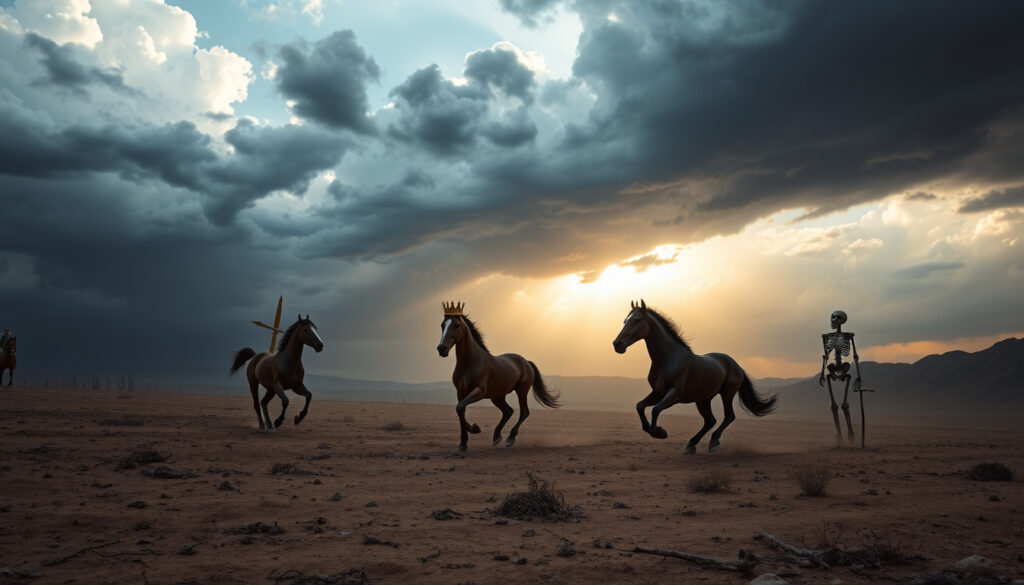
Four Horsemen of the Apocalypse: Names and Meanings
Few images from the Bible have captured the popular imagination quite like the four horsemen of the apocalypse. They ride out of Revelation 6 (BibleGateway (online Bible)), each with a distinct color and mission, and together they form a sequence of divine judgment that has been debated, reinterpreted, and referenced for nearly two millennia. Whether you’re studying the original Greek text or spotting their cameo in a movie, understanding what each horseman represents helps untangle one of scripture’s most vivid passages.
Biblical source: Revelation 6:1-8 ·
Number of horsemen: 4 ·
First horseman color: White ·
Second horseman color: Red ·
Third horseman color: Black ·
Fourth horseman color: Pale green
Quick snapshot
- Color: White (New Covenant Way (Christian commentary))
- Symbol: Bow and crown (New Covenant Way)
- Meaning: Conquest or Christ/Antichrist (Wikipedia (general reference))
- Color: Bright red (New Covenant Way)
- Symbol: Great sword (New Covenant Way)
- Meaning: War and bloodshed (David Jeremiah Blog (teaching ministry))
- Color: Black (New Covenant Way)
- Symbol: Pair of scales (New Covenant Way)
- Meaning: Famine and scarcity (Life, Hope & Truth (Christian teaching))
- Color: Pale green (New Covenant Way)
- Symbol: Named Death, followed by Hades (New Covenant Way)
- Meaning: Plague and death (Wikipedia)
Eight attributes, one pattern: each horseman’s color, tool, and meaning tells part of a story that moves from conquest to death.
| Attribute | Value |
|---|---|
| Biblical book | Revelation (Wikipedia (biblical book)) |
| Chapter and verses | Revelation 6:1-8 (BibleGateway) |
| Number of horsemen | 4 (New Covenant Way) |
| First horseman color | White (New Covenant Way) |
| Second horseman color | Red (New Covenant Way) |
| Third horseman color | Black (New Covenant Way) |
| Fourth horseman color | Pale green (New Covenant Way) |
| Primary interpretation | Divine judgment (David Jeremiah Blog) |
What are the names of the 4 Horsemen of the Apocalypse?
The Bible names only the fourth rider — Death — but tradition has assigned each a mission that matches their color and gear.
The rider on the white horse
The first seal reveals a white horse. Its rider carries a bow, is given a crown, and goes out “conquering, and to conquer” (New Covenant Way). This figure is the most debated: some identify him as Christ or the Gospel, others as the Antichrist or military conquest (Wikipedia).
The rider on the red horse
The second horse is bright red, and its rider is given a great sword. The text says he “was permitted to take peace from the earth, so that people would slaughter one another” (New Covenant Way). Most interpreters read this as war and civil strife (Life, Hope & Truth).
The rider on the black horse
The third horse is black, and its rider holds a pair of scales. A voice announces severe inflation: “a quart of wheat for a denarius, and three quarts of barley for a denarius” (New Covenant Way). The scene unmistakably depicts famine and economic hardship (David Jeremiah Blog).
The rider on the pale horse
The fourth horse is pale green. Its rider is named Death, and Hades follows close behind. They are given authority over a fourth of the earth to kill by sword, famine, pestilence, and wild beasts (New Covenant Way). This rider represents death in its fullest sense — natural, violent, and epidemic (Britannica (encyclopedia)).
What do the 4 horsemen represent?
The horsemen are not just symbols — they are divine agents acting within a framework of judgment that early Christians understood as both literal and metaphorical.
Symbolism of the white horse rider
Interpretations of the white horse rider split into three camps: Christ, the Antichrist, or a personification of conquest (Wikipedia). The bow and crown suggest a victor, but the absence of bloodshed in the first seal leaves room for a positive reading — the spread of the Gospel (Life, Hope & Truth). The white horse is one of the most disputed symbols in the entire cycle (Wikipedia).
Symbolism of the red horse rider
The red horse rider symbolizes violent conflict. The great sword and the mandate to take peace from the earth leave little ambiguity: this is war, and not just international conflict but internal slaughter (New Covenant Way). Many interpreters see this as civil war and societal collapse (David Jeremiah Blog).
Symbolism of the black horse rider
The black horse rider stands for economic injustice and famine. The scales are a measuring tool for grain, and the prices quoted show a day’s wage buying only a quart of wheat — a sign of extreme scarcity (New Covenant Way). The rider’s presence warns of the social chaos that follows when basic resources become unaffordable (Life, Hope & Truth).
Symbolism of the pale horse rider
The pale horse rider embodies death itself. The Greek word for the horse’s color, “chloros,” suggests a sickly green, the color of a corpse (Wikipedia). That Hades follows him confirms that this is not just physical death but the realm of the dead (New Covenant Way). The four methods of killing — sword, famine, pestilence, wild beasts — cover every manner of mortality (Britannica).
Is Jesus the fifth horseman?
A common question, but the canonical text is clear: Revelation 6 describes only four horsemen. No fifth horseman appears when the first four seals are opened (New Covenant Way).
Biblical basis for a fifth horseman
Some readers point to Revelation 19:11-16, where a rider on a white horse appears again — this time named “Faithful and True” and wearing many crowns. That figure is widely identified as Christ returning as Judge (Britannica). But the text calls him the “Word of God,” not a horseman in the first-four sequence. Scripture does not give him the same role or position (Life, Hope & Truth).
Interpretations of the fifth horseman
The concept of a fifth horseman arises more from cultural adaptations — films, novels, and video games — than from biblical scholarship (David Jeremiah Blog). Mainstream Christian teaching does not support a fifth horseman in Revelation 6 (Wikipedia).
The catch: mixing the white horse of Revelation 19 with the first horseman of Revelation 6 conflates two different scenes. Jesus does appear on a white horse later, but he is not part of the fourfold judgment sequence.
What is the meaning of the four horsemen of the apocalypse?
Historical and theological context
The Book of Revelation was written around AD 95, during a period of persecution under Emperor Domitian (Wikipedia). The horsemen are part of the seven seals, a literary structure that unveils God’s judgment on the earth. They are not random symbols — they follow the pattern of divine warnings found in the Old Testament prophets, such as Ezekiel’s four judgments: sword, famine, wild beasts, and plague (New Covenant Way).
Modern cultural references
The four horsemen have transcended their biblical origins. The 1919 silent film The Four Horsemen of the Apocalypse brought the imagery to a global audience (Wikipedia). Since then, they have appeared in everything from Ingmar Bergman’s The Seventh Seal to Stephen King’s The Stand and the manga series Attack on Titan. For a deeper look at apocalyptic horror in film, check out Scary Movies to Watch. The horsemen even show up in discussions of angel numbers and biblical numerology — see 888 Angel Number Meaning for more on how numbers carry prophetic weight.
The trade-off: widespread cultural use has sometimes blurred the original meaning. The horsemen are often reduced to generic symbols of doom, losing their specific theological role as agents in a structured judgment narrative.
Timeline
- c. 95 AD — Book of Revelation written by John of Patmos (Wikipedia).
- 4th century — Revelation canonized as part of the New Testament (Britannica).
- Middle Ages — Four horsemen imagery appears in art and literature (New Covenant Way).
- 1919 — Film The Four Horsemen of the Apocalypse popularizes the concept (Wikipedia).
- 1962 — Film adaptation starring Glenn Ford released (Wikipedia).
This timeline traces the journey of the four horsemen from biblical composition to modern media influence.
Clarity
Confirmed facts
- The four horsemen appear in Revelation 6:1-8 (BibleGateway).
- The first horseman rides a white horse (New Covenant Way).
- The second horseman rides a red horse (New Covenant Way).
- The third horseman rides a black horse (New Covenant Way).
- The fourth horseman rides a pale green horse (New Covenant Way).
What’s unclear
- Whether the white horse rider represents Christ or the Antichrist is debated among scholars (Wikipedia).
- The exact identity of a fifth horseman is not supported by canonical scripture (David Jeremiah Blog).
- Whether the horsemen represent literal future events or symbolic warnings is a matter of interpretive disagreement (New Covenant Way).
- The meaning of the bow carried by the white horse rider is not explicitly explained in the biblical text (Wikipedia).
- The exact identity of Hades following the pale horse is interpreted differently in different traditions (Britannica).
The clarity section highlights the certainties and uncertainties surrounding the horsemen, separating accepted facts from open questions.
Quotes from interpreters
The white horse rider is one of the most disputed symbols in Four Horsemen interpretation.
— Wikipedia (general reference)
The imagery of the four horsemen has been adapted in films, manga, and literature as symbols of impending doom.
— Britannica (encyclopedia)
A major interpretive tradition identifies the horsemen as conquest, war, famine, and death.
— Wikipedia (general reference)
The editorial takeaway: these quotes show the range of interpretation — from strict literalists to symbolic theologians. Each source brings a different lens, but all agree on the core sequence.
For readers exploring biblical prophecy, the four horsemen remain a powerful framework for understanding divine judgment. The choice for believers is clear: take the sequence as literal future events, or as a symbolic warning against the consequences of human sin. Either way, the riders point to a God who acts through history.
For a detailed breakdown of each horseman, including their symbolic colors and biblical order, refer to detailed breakdown of each horseman.
Frequently asked questions
What is the order of the four horsemen of the apocalypse?
The order is: white horse (conquest), red horse (war), black horse (famine), pale horse (death) — as the first four seals are opened in Revelation 6 (New Covenant Way).
What does the white horse in Revelation represent?
The white horse rider is interpreted as conquest, Christ, or the Antichrist, depending on the theological tradition (Wikipedia).
What does the red horse in Revelation represent?
The red horse rider represents war and bloodshed, taking peace from the earth (Life, Hope & Truth).
What does the black horse in Revelation represent?
The black horse rider symbolizes famine and economic scarcity, shown by the pair of scales and inflated grain prices (David Jeremiah Blog).
What does the pale horse in Revelation represent?
The pale horse rider is named Death, followed by Hades, and represents plague, death, and the underworld (New Covenant Way).
Are the four horsemen of the apocalypse in the Old Testament?
No. The four horsemen appear only in the New Testament book of Revelation. However, similar judgment motifs — sword, famine, plague, wild beasts — appear in Ezekiel 14:21 (BibleGateway).
How are the four horsemen depicted in popular culture?
They appear in films like The Seventh Seal, The Stand, and the X-Men series, often as personifications of apocalyptic destruction (Wikipedia).
These FAQs address common questions about the four horsemen, from their order to their cultural impact.
More related posts
 Floor and Decor Near Me: Stores, Costs & 2026 Trends
 Pittsburgh Steelers 2026 Depth Chart: Starters & Analysis
 How Much Is Health Insurance in Ireland? 2025 Monthly Costs
 How to Lose Weight Fast Naturally and Permanently – Safe Sustainable Strategies
 Hard Boiled Egg Time: 10-Minute Boil for Perfectly Cooked Eggs
 WWE Hall of Fame 2025: Complete Inductee & Viewing Guide
 East Tennessee State University: Rankings, Tuition, Sports & More
 Chocolate Chip Muffin Recipe: Moist, Simple, & Double Chocolate