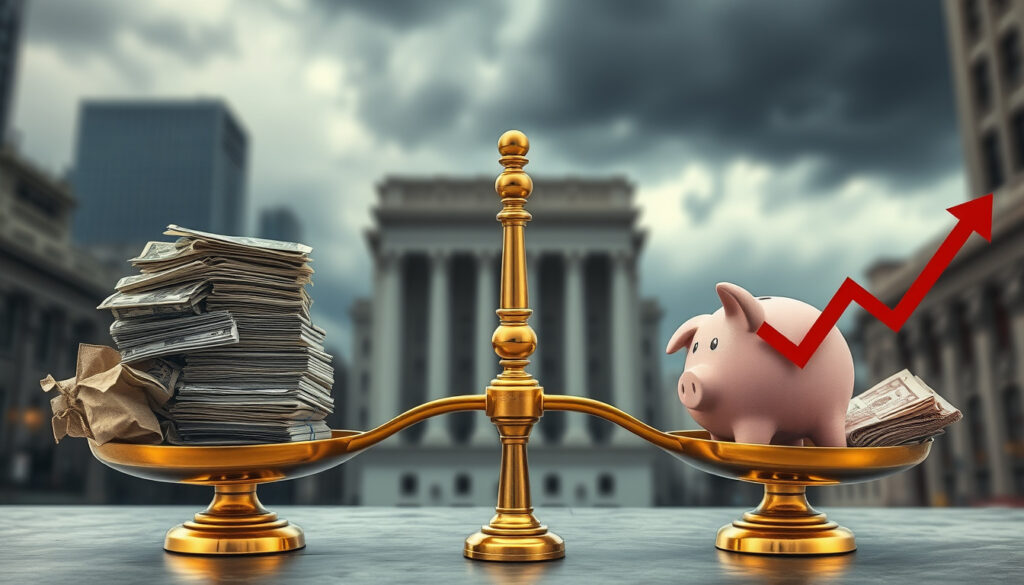
U.S. Economy News Today: Record Spending vs Recession Risks
If you’ve been watching the news lately, you’ve probably noticed a strange disconnect: Wall Street keeps sounding recession alarms while millions of Americans are still spending like the economy is just fine. The numbers tell both stories at once—and they don’t fully agree on which ending comes next. Here’s where the data actually stands today, pulled from the sources investors and policymakers watch most closely.
Consumer Spending Status: Under Strain · Recession Odds: Climbing on Wall Street · Fuel Costs Impact: Raising Food and Travel Prices · Home Sales: Slump · Stock Market Effect: Shaky, Tamps Down Spending
Quick snapshot
- Consumer spending hit $16,665.20B in Q4 2025, an all-time high (Trading Economics)
- BEA reports +0.5% monthly spending in February 2026, +0.3% in January (U.S. Bureau of Economic Analysis)
- U.S. added 151,000 jobs in February with unemployment at 4.1% (UCLA Anderson Forecast)
- Exact timing of any potential recession
- Whether Trump’s tariff reversals will fully offset earlier policy impacts
- How long upper-income spending surge can mask middle-class strain
- Q3 2025: $16,585.90B in consumer spending
- Q4 2025: $16,665.20B (all-time high)
- March 2026: Goldman Sachs raises odds to 30%
- Feb 2027: YCharts recession probability forecast at 20.73%
- TD Economics projects 2.8% consumer spending growth for 2026
- Fed not expected to ease until late 2025 at earliest
- Major economic reports due this week from MarketWatch
Here is how the major indicators stack up against each other across spending, jobs, and recession forecasts.
| Indicator | Latest Data | Source |
|---|---|---|
| Consumer Spending (Q4 2025) | $16,665.20 USD Billion | Trading Economics (BEA) |
| Consumer Spending (Q3 2025) | $16,585.90 USD Billion | Trading Economics (BEA) |
| BEA Monthly Spending (Feb 2026) | +0.5% MoM | U.S. Bureau of Economic Analysis |
| BEA Monthly Spending (Jan 2026) | +0.3% MoM | U.S. Bureau of Economic Analysis |
| 2025 Spending Growth (annualized) | 2.7% | TD Economics |
| Jobs Added (February) | 151,000 | UCLA Anderson Forecast |
| Unemployment Rate | 4.1% | UCLA Anderson Forecast |
| Goldman Sachs Recession Odds | 30% (March 2026) | NerdWallet |
| J.P. Morgan Recession Odds | 40% (2025) | J.P. Morgan Research |
| YCharts Recession Probability | 20.73% (Feb 2027) | YCharts |
What is the current situation of the U.S. economy?
Key Indicators Today
Consumer spending reached $16,665.20 USD Billion in the fourth quarter of 2025, marking a new all-time high and a jump from $16,585.90 USD Billion the prior quarter (Trading Economics). The U.S. Bureau of Economic Analysis reports monthly gains of +0.5% in February 2026 and +0.3% in January 2026, suggesting demand remains firm even as inflation pressures persist (U.S. Bureau of Economic Analysis). Meanwhile, Wall Street forecasters are anything but calm.
The public tells a different story than the data: 65% of Americans believe a recession will hit within the next 12 months, per an April NerdWallet/Harris Poll, even as the jobs market adds 151,000 positions in February with unemployment holding at 4.1% (NerdWallet).
Consumer Spending Trends
High-frequency data from U.S. Bank shows year-over-year spending growth above 7% through late March, with Johnson Redbook weekly retail sales running at 6% (U.S. Bank). Yet Deloitte finds discretionary spending intent pulled back below the 2021 baseline by March 2026, while McKinsey reports post-holiday consumers cutting back on discretionary items but spending more on home improvement (+11 percentage points) and domestic flights (+5 percentage points) (Deloitte; McKinsey).
TD Economics identifies a stark K-shaped pattern: upper-income households drive growth through wages, equity gains, and credit access, while the lower-income tier shows modest gains post-2022 (TD Economics). The Boston Fed confirms that real aggregate spending since 2022 has been propelled by the highest-income consumers, with seasonal patterns intact (Boston Fed).
Housing and utilities costs remain elevated, pressuring middle-class budgets and amplifying cutbacks in discretionary categories—exactly the dynamic that could shift a resilient trend into a reversal.
What is the biggest economic news today?
Wall Street Recession Odds
Wall Street analysts are raising recession alarms even as consumers keep spending. Goldman Sachs placed U.S. recession probability at 30% for the next 12 months as of March 2026 (NerdWallet), while J.P. Morgan estimates a 40% chance of U.S. and global recession for 2025—down from an earlier 60% that reflected fears before the tariff backtrack (J.P. Morgan Research). YCharts shows the February 2027 recession probability forecast at 20.73%, up from 18.78% the prior month and above the long-term average of 15.28% (YCharts).
“The recent backtrack on U.S.–China tariffs has altered our thinking… imparting less of a purchasing power squeeze.”
— Joseph Lupton, Global Economist, J.P. Morgan
Housing Market Slump
The housing market presents a clearer picture of strain. Home sales have slumped as buyers face affordability constraints, with higher mortgage rates and elevated home prices keeping many would-be buyers on the sidelines (BBC). This weakness in real estate activity compounds broader uncertainty, as housing typically leads economic cycles both up and down.
The implication: even as consumer spending holds at record levels, the housing sector’s weakness signals trouble ahead for the wealth effect and broader consumer confidence.
Is the U.S. economy going into recession?
Recent Cracks in Data
Not all indicators point the same direction. UCLA Anderson Forecast sees no signs of imminent recession as of early 2025, citing 151,000 jobs added in February and unemployment at 4.1% (UCLA Anderson Forecast). However, Conference Board models show lower GDP growth and higher inflation risk if oil spikes continue or supply disruptions persist (Conference Board). The New York Fed’s Treasury spread model predicts recession probabilities through March 2026, tracking signals that often precede downturns by 6-12 months (New York Fed).
Fed and Market Views
The Federal Reserve is not expected to ease monetary policy until December 2025 at the earliest, with three rate cuts projected to bring the federal funds rate to 3.25–3.5% by Q2 2026 (J.P. Morgan Research). Higher fuel costs are already rippling into food and travel prices, squeezing household budgets and raising the risk of a spending pullback that forecasters haven’t fully priced in.
Consumer spending outpaced disposable income in 2025, relying on savings drawdowns and wealth gains to bridge the gap—conditions that can’t sustain indefinitely without income growth or wealth recovery.
Is the US economy actually doing well?
Strengths vs Weaknesses
The U.S. economy shows genuine strengths alongside real vulnerabilities. On the positive side, steady wages, low layoff rates, and resilient household finances support continued spending (U.S. Bank). Household debt remains manageable with income growth offsetting higher borrowing costs, and retail sales data confirms steady demand rather than a broad pullback.
However, the recovery is uneven. Upper-income households are spending freely on discretionary categories, while middle and lower-income consumers face persistent pressures from elevated housing costs and utility bills (Deloitte). The K-shaped divide means headline spending figures can look healthy even as tens of millions of households struggle with actual purchasing power.
Comparison to Past
TD Economics forecasts inflation-adjusted consumer spending growth at 2.8% in 2026, matching the 2.7% actual growth rate recorded in 2025 (TD Economics). While still positive, this represents a slower pace than the post-pandemic surge and leaves less margin for error if job markets weaken or costs continue climbing.
The pattern: the economy looks stronger on paper than it feels for most households, a divide that could narrow only if costs ease or wages accelerate meaningfully.
Has the U.S. economy improved under Trump?
First Term Policies
J.P. Morgan Research notes that Trump’s quick unilateral tariff reversal on U.S.-China goods signals less tolerance for short-term economic pain than markets initially feared (J.P. Morgan Research). This policy shift reduced the projected tariff tax hike impact and contributed to J.P. Morgan cutting its recession probability estimate from 60% to 40% for 2025. The U.S. is also set for an easier fiscal policy stance than expected for the 2026 financial year amid ongoing tariff negotiations.
Current Projections
UCLA Anderson Forecast offers a cautiously optimistic view, citing AI investment, deregulation, and infrastructure spending as factors supporting a brighter future outlook (UCLA Anderson). TD Economics warns, however, that 2026 tax cuts may further favor high earners, widening the income divide that already defines the current K-shaped recovery.
“Consumer spending continues to benefit from steady income growth and a labor market that remains supportive.”
— Bill Merz, Head of Capital Markets Research, U.S. Bank Asset Management
The data suggests that while policy shifts have reduced immediate recession risks, they may also be deepening the divide between those who benefit from asset-driven growth and those squeezed by living costs.
Timeline
Key milestones show how consumer spending and recession forecasts have evolved over recent quarters.
| Period | Event | Source |
|---|---|---|
| Q3 2025 | Consumer Spending at $16,585.90 USD Billion | Trading Economics |
| Q4 2025 | Consumer Spending reaches $16,665.20 USD Billion (all-time high) | Trading Economics |
| Early 2026 | J.P. Morgan cuts recession odds to 40% after tariff backtrack | J.P. Morgan Research |
| January 2026 | BEA reports +0.3% monthly consumer spending | U.S. Bureau of Economic Analysis |
| February 2026 | BEA reports +0.5% monthly consumer spending | U.S. Bureau of Economic Analysis |
| March 2026 | Goldman Sachs raises recession odds to 30% | NerdWallet |
| February 2027 | YCharts recession probability forecast at 20.73% | YCharts |
Clarity: What’s confirmed vs. still uncertain
Confirmed
- Consumer spending reached all-time high of $16,665.20B in Q4 2025
- Monthly BEA data shows +0.3% in January 2026, +0.5% in February 2026
- Home sales have slumped amid affordability constraints
- K-shaped spending divide between income tiers is widening
- Goldman Sachs and J.P. Morgan both estimate 30-40% recession probability
Uncertain
- Exact timing of any potential recession (NBER has not declared one)
- Whether Trump’s tariff reversals will fully offset earlier policy damage
- How long upper-income spending surge can mask middle-class strain
- Whether the Fed’s delayed easing will arrive in time to prevent downturn
What analysts are saying
“On balance, we still see considerable downside risk, with a 40% probability of a U.S. and global recession.”
— Joseph Lupton, Global Economist, J.P. Morgan
“Consumer spending continues to benefit from steady income growth and a labor market that remains supportive.”
— Bill Merz, Head of Capital Markets Research, U.S. Bank Asset Management
Related reading: Where Is Trump Today
Record consumer spending hit $16,665B in Q4, yet recession definition and signs loom large as Wall Street odds climb to 30-40% amid housing slumps.
Frequently asked questions
What is Donald Trump’s plan to help the economy?
Trump’s administration has focused on tariff policy reversals, deregulation, and infrastructure investment, with J.P. Morgan noting the quick reversal on U.S.-China tariffs signaled less tolerance for short-term economic pain. Fiscal policy is set to be easier than expected for 2026, though tax policy details continue to evolve.
Is the USA a declining power?
Economic data doesn’t support a clear decline narrative: the U.S. added 151,000 jobs in February with unemployment at 4.1%, consumer spending hit record highs, and forecasters project continued growth. However, K-shaped inequality and infrastructure concerns present structural challenges that could affect long-term trajectory.
Who is the best economy in the world right now?
Comparisons depend on metrics used. The U.S. maintains strong consumer spending and job growth, though it faces elevated recession risks. Other developed economies show different balances of growth, inflation, and labor market strength. No single economy dominates all indicators simultaneously.
What is wrong with the economy today?
The core tension is between resilient headline spending data and growing pressures on middle and lower-income households. Housing and utility costs remain elevated, squeezing budgets. Meanwhile, upper-income consumers drive headline figures, creating a disconnect between aggregate statistics and lived experience for most Americans.
Who will dominate the world in 2050?
Long-term economic dominance projections depend on productivity growth, demographics, technology adoption, and policy choices made over the next two decades. AI investment, infrastructure development, and human capital formation are key factors that will shape outcomes—not current quarterly data alone.
How Is the Economy Doing Right Now?
Right now, the U.S. economy presents a mixed picture: consumer spending is at record highs, job growth remains solid, and major forecasters assign 30-40% recession probability—not alarming but above historical norms. The risk comes from the K-shaped divide, elevated costs, and delayed Fed easing that could tip momentum if conditions worsen.
More related posts
 Used Furniture Near Me: Best Sites, Sell Fast & Dispose Safely
 Stanley Tucci Movies and TV Shows – Complete Filmography Guide
 Walmart Money Center Hours: Services, Fees & Locations
 Nicholas Hoult Movies and TV Shows: Complete Filmography Guide
 Baking Powder vs Soda: Key Differences, Substitutions & More
 Countdown to New Year 2026: Watch, Set, and Share Timers
 Taron Egerton Movies List: Full Filmography & 2026 Films
 Are Wolf Spiders Poisonous? Venom vs Poison & Bite Facts