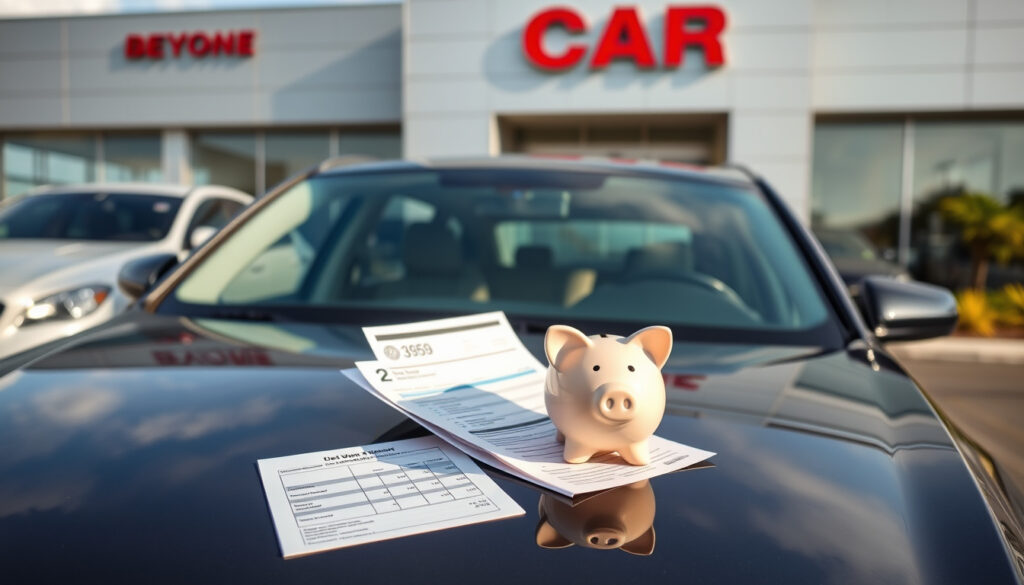
Used Car Loan Rates 2026: Average APR & How to Save
Anyone shopping for a used car in 2026 is juggling two moving parts: prices that are finally softening and loan rates that still dominate the monthly bill. The average used-car APR sits at 11.19%, according to Experian (credit bureau), so the gap between an average rate and a strong one can cost thousands over a five-year loan.
Used Car Loan Rates: 2026 Guide to Current APRs and How to Save
Average used car loan rate: 11.19% (Experian, 2026) ·
Typical used car rate range (48–60 months): 5.5%–11.5% ·
Monthly payment on $30,000 / 60 months / 7% APR: $594 ·
Average FICO score: 711 (Experian)
Quick snapshot
- Average used-car APR: 11.19% in Q2 2026 (Experian (credit bureau))
- Prime borrowers (661–780) averaged 8.81% (Experian, same report) (Experian (credit bureau))
- Navy Federal advertised used-auto APRs from 4.79% (Navy Federal Credit Union (member-owned lender))
- Whether used car prices will keep falling after Q4 2026
- Whether the Fed’s next moves push APRs lower
- Whether advertised minimum rates will apply to your credit profile
- Whether the 2025–2026 projection of easing used-car prices holds (projection, not confirmed)
- Q2 2026: average used APR 11.19%, down from 12.12% in Q2 2024 (Experian)
- Get pre-approved with a credit union or bank before visiting a dealership
- Budget for a 20% down payment and a term of 60 months or less
- Treat your credit tier’s average APR as a target to beat, not a ceiling
Ten numbers, one pattern: the APR ladder rises steeply as credit scores fall, and lender-advertised minimums apply only to the strongest applicants.
| Metric | Value | Context |
|---|---|---|
| Average used-car APR | 11.19% | Q2 2026, all borrowers |
| New-car average APR | 6.35% | Q2 2026, all borrowers |
| Used-car premium vs. new | +4.84 points | Q2 2026 |
| Super-prime APR (781–850) | 6.29% | Q2 2026 |
| Prime APR (661–780) | 8.81% | Q2 2026 |
| Near-prime APR (601–660) | 13.93% | Q2 2026 |
| Subprime APR (501–600) | 19.10% | Q2 2026 |
| Deep-subprime APR (300–500) | 21.62% | Q2 2026 |
| Credit-union advertised minimum | 4.79% | Navy Federal, 12–36 months |
| Bank advertised range | 5.65%–14.27% | Truist, secured used auto |
Data sources: Experian (credit bureau) · Bankrate (personal finance publisher) · Truist (regional bank) · Navy Federal Credit Union (member-owned lender)
What is a good interest rate for a car with a 720 credit score?
A FICO score of 720 puts you in Experian’s prime lending band, and the average used-car APR for prime borrowers was 8.81% in Q2 2026. That makes a good rate for you anything below that average — and a genuinely strong rate gets closer to the 6.29% average reserved for super-prime borrowers with scores of 781–850, according to Experian’s used-car rate data.
How rare is a 720 credit score?
- Average U.S. FICO score: 711
- Prime band: 661–780
- Super-prime band: 781–850
A 720 is not rare in the unattainable sense — it sits above the national average of 711 and lands firmly inside the prime band. Most lenders treat it as solid, mainstream credit that qualifies for standard rates. It does not unlock the very top advertised minimums: a 4.79% used-auto rate like the one Navy Federal Credit Union (member-owned lender) advertises for short terms is usually reserved for the strongest borrowers. Still, a 720 score clears the biggest hurdle: staying out of double-digit APR territory.
Can you get a $30,000 car loan with a 600 credit score?
Borrower tier: Subprime (501–600) · Average used APR: 19.10% · Estimated payment on $30,000 / 60 months: about $780
Yes, lenders will approve a $30,000 used-car loan for many borrowers with a 600 FICO score. The cost is the problem. Experian’s Q2 2026 data puts the average used-car APR for subprime borrowers at 19.10%, and on a $30,000 loan stretched over 60 months, that means a payment near $780 and total interest above $16,000. The loan is available; the price of it is what makes the buy a bad idea unless the car is essential. The implication: a 720 score gets you into the 8%–9% conversation, while a 600 score gets you approved but priced like risk. Raise your score a single band and the APR math changes faster than any dealership discount will.
Is 7% APR high for a used car?
No — 7% is a good used-car rate in 2026. The national average sits at 11.19%, and even prime borrowers average 8.81% on used-car loans, per Experian’s automotive finance data. A 7% offer lands about four points below the national average and roughly a point and a half below what a typical prime borrower pays.
What APR is considered high for a used car?
- Above the prime average of 8.81% starts to feel expensive for good credit
- Double-digit APRs are standard for near-prime and subprime borrowers
- Anything at or below your credit tier’s average is a reasonable target
Experian’s Q2 2026 numbers show how quickly “high” changes by tier: near-prime borrowers averaged 13.93%, subprime borrowers 19.10%, and deep-subprime borrowers 21.62%. By those standards, 7% is not merely acceptable — it is below every tier’s average except super-prime.
What is the average used car APR in 2026?
Average used APR (Q2 2026): 11.19% · Super-prime: 6.29% · Prime: 8.81% · Near-prime: 13.93%
The Q2 2026 average is 11.19%, down from 12.12% two years earlier, according to the same Experian report. The direction is helpful, but the movement is slow. That means a borrower comparing 7% against the market is not chasing a fantasy — the rate exists, and it is well below what the average buyer takes home.
7% is a strong offer only if your credit profile actually earns it. A prime borrower who sees 7% should sign quickly; a subprime borrower who sees double digits should not treat that as a failure — it is the market pricing real risk.
How much would I pay monthly for a $30,000 car loan for 60 months?
At the 7% APR many prime borrowers can find in 2026, a $30,000 used-car loan over 60 months costs $594 a month, with about $5,640 in total interest. The rate you actually qualify for changes those numbers sharply, so it helps to run the math before you set foot on a lot.
How to use a car loan calculator
- Loan amount: the purchase price minus your down payment and trade-in value
- APR: includes the interest rate plus certain fees, making it the truer comparison metric
- Term: 36 to 72 months is the typical used-car range
Auto loan calculators work the same way across the web: enter those three inputs and the tool produces a monthly payment and total interest. Bankrate (personal finance publisher) recommends comparing APRs rather than bare interest rates because APR folds in lender fees, so two loans with the same interest rate can carry different monthly costs. A lender prices your loan using your finances, the term, and whether the vehicle is new or used — which is why a calculator is only as accurate as the APR you type into it.
How does a down payment affect the monthly payment?
- 20% down on a $30,000 car equals $6,000 off the financed amount
- A smaller loan means a lower payment and less total interest
Two payment scenarios on a $30,000 car at 7% APR for 60 months, one with no money down and one with a $6,000 down payment:
| Scenario | Amount financed | Monthly payment | Total interest |
|---|---|---|---|
| No down payment | $30,000 | $594 | $5,640 |
| $6,000 down | $24,000 | $475 | $4,510 |
The down payment does not just shrink the monthly payment — it cuts the total interest by roughly $1,130 because you are paying interest on a smaller balance for the same term. That is the quiet power of the 20% rule.
What is the total interest paid on a $30,000 loan?
Term: 60 months · Loan amount: $30,000 · Rate scenarios: 7.00% to 19.10%
Here is how Experian’s Q2 2026 tier averages and a realistic credit-union rate stack up on the same loan:
| APR scenario | Monthly payment | Total interest over 60 months |
|---|---|---|
| 7.00% (strong credit-union deal) | $594 | $5,640 |
| 8.81% (prime average, Experian) | $620 | $7,200 |
| 11.19% (national average, Experian) | $655 | $9,300 |
| 19.10% (subprime average, Experian) | $780 | $16,800 |
Moving from 7% to the national average adds roughly $61 a month and about $3,700 in interest over the life of the loan. Moving from prime to subprime costs more than $9,000 in additional interest. The APR tier is the strongest lever on total cost — more than the car’s price tag in most cases.
The pattern: the APR tier, more than any other factor, decides whether this loan costs $5,600 or $16,800 in interest. Shop the rate before you shop the car.
Can you negotiate car loan APR?
Yes, and you should treat it as a negotiation rather than a formality. The APR on a used-car loan is set by the lender based on your credit profile, the loan term, and whether the vehicle is new or used, according to Bankrate’s auto loan guidance. Because lenders have room in how they price that risk, the first offer is rarely the final one.
How to negotiate used car loan rates
- Get pre-approved by a credit union or bank before you shop
- Let the dealer try to beat the pre-approval offer
- Compare the approved APR, not the monthly payment
- Ask what APR your credit score actually qualifies for, then request a reduction
An external pre-approval changes the conversation. Instead of being a buyer who needs financing, you become a buyer who already has financing — and the dealer has to compete with that number to earn the loan. The trap to avoid is comparing monthly payments alone, because lengthening the term can hide a higher rate inside a lower payment.
Should you negotiate with a credit union?
- Credit unions already publish some of the lowest used-car APRs
- Navy Federal advertised a 4.79% used-auto APR for 12–36 month terms
- Rates are less negotiable because the starting number is already thin
Credit unions like Navy Federal Credit Union (member-owned lender) do not leave much room to haggle, since their published minimums sit well below most banks. Truist (regional bank), by contrast, lists secured used-auto APRs from 5.65% to 14.27%, a wider band that depends heavily on your credit tier. The negotiation at a credit union is less about haggling and more about making sure your application shows the best version of your finances: stable income, low debt-to-income ratio, and a clean credit report.
The lowest advertised rates come with the shortest terms and strictest underwriting. A 4.79% rate only helps the borrower who qualifies for a 12-to-36-month loan without stretching the monthly payment.
What is the 20% rule when buying a car?
The 20% rule is the standard guardrail for used-car buying: put at least 20% down. On a $30,000 purchase, that is $6,000, and it keeps you from owing more than the car is worth during the steepest years of depreciation.
What is the $3,000 rule for cars?
- The $3,000 rule says a buyer should put at least $3,000 down, even on a cheap car
- It forces equity into the loan from day one
- It keeps a small repair bill or accident from making the loan instantly underwater
The $3,000 floor matters most for low-priced cars. Finance a $10,000 used car with $3,000 down and you are already at 30% equity, which is a healthy buffer against depreciation. The two rules work together: 20% of the price, but never less than $3,000 in cash.
What is the 8% rule when buying a car?
8% rule: keep the APR at or below 8% · Prime average (661–780): 8.81% · Typical credit-union range: 5.5%–11.5%
The 8% rule sets a ceiling: if the APR creeps above 8%, the loan is working against you. Notice the tension with the market — the average prime borrower at 8.81% is already above that threshold, per Experian. That is exactly the point of the rule: it forces you to fix the rate with a shorter term, a larger down payment, or a credit-union quote instead of accepting whatever the dealer prints. The catch: these rules assume you can control the rate. For subprime borrowers, 8% is not realistic, so the rules shift — a bigger down payment and a cheaper car do more than any rate negotiation.
Will used car prices drop in 2026?
Used car prices are projected to ease through 2025–2026 as supply catches up with demand. That is welcome news for buyers, but prices move slower than rates, and the larger savings in 2026 are still on the financing side of the deal.
Why used car prices fluctuate
- Supply of used vehicles is increasing as more cars return to the market
- New-car inventory recovery feeds more trade-ins into the used pool
- Higher rates soften demand, which pressures prices downward
Prices fall when supply grows faster than demand, and that is the direction the 2025–2026 market is heading: more inventory, more trade-ins, and buyers who are rate-sensitive. A small price drop on a $30,000 car saves a few hundred dollars — meaningful, but dwarfed by the interest difference between an 8.81% and a 19.10% APR.
How prices affect loan rates
- Lower prices mean smaller loan amounts and less interest paid
- Rates are tied to your credit tier and the lender, not the car’s price tag
- A cheaper car can also qualify for a shorter term, which lowers the APR
Price and rate are independent levers. Buyers who use the price dip to reduce their loan amount, rather than to buy a more expensive car, get the full benefit. The outlook for late 2026 expects used prices to stabilize, with potential rate reductions if the broader credit environment cooperates.
Why this matters: a softer price curve hands you a choice — buy the same car for less, or borrow less for the same car. Borrowing less is the move that compounds, because a lower loan amount cuts both the payment and the interest.
Where to find the best used car APR: credit union vs. bank vs. average
Three ways to finance a used car, one pattern: the best APR depends on who you are, not just where you look.
| Lender type | Advertised or average APR | Best fit |
|---|---|---|
| Credit union | From 4.79% for 12–36 months (Navy Federal Credit Union) | Existing members with strong credit who can handle a shorter term |
| Bank | 5.65%–14.27% depending on profile (Truist) | Borrowers who want a published rate sheet and online convenience |
| All lenders (national average) | 11.19% for used cars (Experian) | A benchmark: compare every offer against this number |
The pattern: credit unions advertise the lowest floor, banks offer the widest range, and the national average is what most borrowers actually pay. Your job is to beat your own tier’s average, not just the national one.
Financing a used car with an external lender: the trade-offs
Upsides
- Pre-approved offers set your maximum APR before you enter a dealership
- Credit unions often post lower rates than dealer-arranged financing
- You can compare offers without the pressure of a sales floor
- Focusing on APR keeps the negotiation on numbers, not monthly payment tricks
Downsides
- Multiple loan applications can trigger several credit checks on your report
- Dealers may offer promotional financing that beats your external quote
- The lowest advertised rates demand short terms and top-tier credit
- Rate shopping adds paperwork and timing pressure before the car is even picked
The trade-off: external financing wins on control and rate, while dealer financing wins on convenience and occasional promotions. Most buyers who save the most do both — get pre-approved, then let the dealer try to beat it.
How to lock in the lowest used car loan rate in 2026
- Pull your credit score and report. Know your tier before you quote rates; Experian’s data shows the used-car APR ladder running from 6.29% to 21.62% by tier.
- Set your budget with the 20% and $3,000 rules. Decide the down payment first, then the car price.
- Get pre-approved at a credit union. A used-auto APR like Navy Federal’s 4.79% for short terms resets your expectations for what a good rate looks like.
- Get a competing quote from a bank. Truist’s 5.65%–14.27% band shows how wide a single bank’s pricing can be.
- Take both offers to the dealer. Let the dealership beat the best external APR to earn your financing business.
- Run the payment math before you sign. On a $30,000, 60-month loan, 7% costs about $594 a month, 11.19% costs about $655, and 19.10% costs about $780. Choose the car that fits the first number.
The sequence matters: credit first, budget second, pre-approval third, dealership last. Buyers who follow it negotiate from a position where “no” is a complete sentence.
Used car rates and prices: 2025–2026 timeline
- Q2 2024: Average used-car APR hit 12.12%, the recent high-water mark (Experian)
- 2025–2026: Used car supply rises; prices projected to decline slightly
- Q2 2026: Average used-car APR falls to 11.19%; the spread between super-prime and deep-subprime widens to 15.33 points (Experian)
- Q4 2026: Prices expected to stabilize; potential rate reductions after that
The signals point one direction: rates are drifting down from the 12% peak, and supply is loosening. Neither move is dramatic, but together they make 2026 a better year to finance a used car than 2024 was.
What’s confirmed, what’s unclear
Used-car financing is a split screen of hard numbers from credit bureaus and open questions about where prices and rates go next.
Confirmed facts
- Average used-car APR was 11.19% in Q2 2026 (Experian)
- Super-prime averaged 6.29%, prime 8.81%, subprime 19.10% (Experian)
- New-car average was 6.35%, leaving a 4.84-point gap for used cars (Experian (credit bureau))
- Some credit unions advertise used-auto APRs from 4.79% (Navy Federal Credit Union)
What’s unclear
- How much used car prices will actually fall in 2026
- Whether rates will drop further after Q4 2026
- Whether advertised minimum rates will apply to a specific borrower’s profile
- Whether dealer promotional financing will outpace credit unions this quarter
- How wide individual bank underwriting swings within the same credit tier
The gap between the two lists is the whole game: borrow against what is confirmed, and plan around what is not.
What the rate data says
The average used-car APR reached 11.19% in Q2 2026, down from 12.12% two years earlier, and the spread between super-prime and deep-subprime borrowers is 15.33 percentage points.
Experian State of the Automotive Finance Market
Qualified members can find used-auto APRs as low as 4.79% on 12- to 36-month terms.
Navy Federal Credit Union
Secured used-auto loan APRs ran from 5.65% to 14.27%, with unsecured financing pricing higher because it lacks collateral.
Truist
The pattern: the spread between 4.79% and 21.62% is not noise — it is the same car, priced by creditworthiness. Somewhere in that range is the rate you qualify for, and it moves with preparation, not luck.
Used-car financing in 2026 is a game of tiers. The average borrower pays 11.19%, a prepared prime borrower with a credit-union quote can land in single digits, and a subprime borrower faces an APR that can come close to doubling the cost of the car. The buyers who win are not the ones who find the cheapest car — they are the ones who bring a pre-approval, put 20% down, and treat the advertised rate as a starting point rather than a verdict. For the U.S. car buyer, the choice is clear: get a credit-union quote before visiting a dealership, or accept paying thousands more in interest on the same vehicle.
Frequently asked questions
What is the current average used car loan rate?
The average used-car APR was 11.19% in Q2 2026, according to Experian. It ranged from 6.29% for super-prime borrowers to 21.62% for deep-subprime borrowers.
How do I find the best used car loan rates?
Check credit unions first — Navy Federal Credit Union advertised 4.79% used-auto APRs for short terms — then compare bank quotes like Truist’s 5.65% to 14.27% range, and bring the best offer to the dealer as leverage.
Do I need a down payment for a used car loan?
Most lenders expect a down payment on a used car, and the 20% rule is the safest target. On a $30,000 car, a $6,000 down payment cuts the monthly payment from about $594 to about $475 at 7% APR over 60 months.
How does the loan term affect my APR?
Shorter terms get lower APRs. Navy Federal’s 4.79% used-auto rate applies to 12-to-36-month terms; longer terms like 60 or 72 months carry higher rates and more total interest.
Should I get pre-approved for a used car loan?
Yes. Pre-approval turns the negotiation around: instead of accepting the dealer’s rate, you can ask the dealer to beat your external offer, which typically saves more than any showroom discount.
Are used car loan rates higher than new car rates?
Yes. Experian reported a 6.35% average for new cars and 11.19% for used cars in Q2 2026 — a 4.84 percentage point gap driven by depreciation and higher loan risk.
The takeaway: the rate you are offered matters more than the rate that is advertised, so bring a pre-approval and a down payment to the dealership — or expect to pay thousands more in interest.
More related posts
 Queen Bed Size Guide: Dimensions in Inches, Feet & CM
 Cash Money vs No Limit Verzuz: Recap, Winner, and What It Means
 Before He Cheats Lyrics: Carrie Underwood Full Text & Meaning
 Nicholas Hoult Movies and TV Shows: Complete Filmography Guide
 Mystery Saja in KPop Demon Hunters: Hidden Face Explained
 Padres vs Mets Match Player Stats: 2026 Season Series
 What Is an NPI Number? Complete Guide
 Galaxy S20 FE to Buy in Ireland 2026: Price, Specs & Value