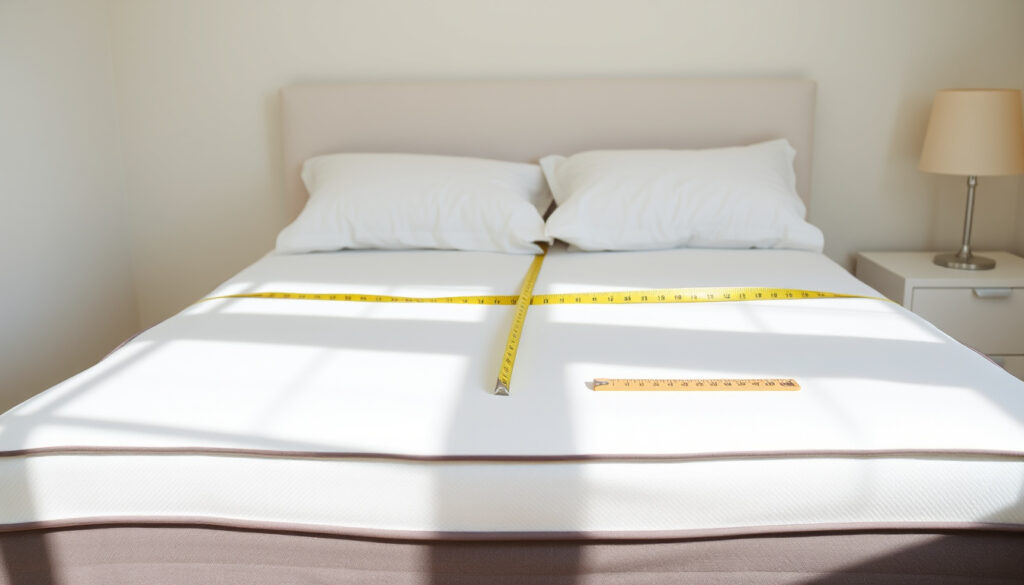
Queen Bed Size Guide: Dimensions in Inches, Feet & CM
Ask anyone who’s shopped for a mattress and the queen is usually the first size couples name — not the biggest bed in the store, but one that feels like an upgrade without taking over the room. That reputation rests on one measurement: 60 by 80 inches, the standard Bed Bath & Beyond’s bed size fact sheet applies to every U.S. queen mattress.
Queen width: 60 in / 152 cm ·
Queen length: 80 in / 203 cm ·
Surface area: 4,800 sq in / 33.3 sq ft ·
vs. full: 6 in wider, 5 in longer ·
vs. king: 16 in narrower
Quick snapshot
- Queen mattress footprint: 60 x 80 in — the number used for the U.S. queen standard (Castlery (furniture retailer’s bed-size guide))
- Full bed: 54 x 75 in; king bed: 76 x 80 in, per Castlery (furniture retailer’s bed-size guide)
- Queen surface area: 4,800 sq in / 33.3 sq ft
- Queen is reportedly the most widely purchased mattress size in the U.S.
- Conversion and review sites also place the queen first among standard mattress sizes
- Measure the room before the bed: a queen needs clearance on both sides and at the foot
- Check the frame’s outer footprint, not just the mattress size, before delivery
Ten numbers, one pattern: every queen spec traces back to the same 60-by-80 footprint, while the full and king columns follow the same published size chart used across this page.
| Measurement | Value |
|---|---|
| Queen width | 60 in / 152 cm |
| Queen length | 80 in / 203 cm |
| Queen surface area | 4,800 sq in / 33.3 sq ft |
| Full width | 54 in / 137 cm |
| Full length | 75 in / 190 cm |
| King width | 76 in / 193 cm |
| King length | 80 in / 203 cm |
| Queen vs. full | 6 in wider, 5 in longer |
| Queen vs. king | 16 in narrower, same length |
| Queen frame fit | Built around the 60 x 80 mattress footprint |
How wide is a queen size bed?
A standard U.S. queen mattress is 60 inches wide — exactly 5 feet across. That width, not the bed’s length, is the number that matters first in a bedroom, because it decides whether two sleepers have enough elbow room without the bed pressing against both walls.
Reading the width number
- 60 in across = 5 ft
- 152.4 cm across
- Queen width splits into two 30-in halves for a couple
The 30-inch-per-person figure is simple math from the 60-inch width, and it explains why couples feel the queen as a real upgrade. A full, at 54 inches, gives each sleeper only about 27 inches before elbows start crossing the center line.
Why width matters for room fit
The queen’s 60-inch width is the reason the 12-by-12 rule exists. In a 12-by-12-foot bedroom, a queen fits with clearance to spare; in a 10-by-10-foot room, it still fits, but the comfort margin shrinks to about two feet of walking space if the frame has a wide footprint.
Wayfair’s space guide puts the comfortable threshold at 11 by 10 feet and notes that a 12-by-12-foot room best accommodates a king.
The 12-by-12 bedroom rule, then, is less about the queen and more about the king: at 12 by 12, a king fits comfortably; below that, the queen is the rational default.
What are the queen size bed dimensions in inches?
The complete footprint is 60 inches wide by 80 inches long, and unlike mattress thickness or frame height, those two numbers are consistent across every U.S. queen mattress sold to the standard.
Exact width and length
- Width: 60 in
- Length: 80 in
- Length matches a king bed’s 80 in; a full bed runs 75 in
The meaning of “standard” goes beyond trivia: sheets, frames, mattress toppers, and bed skirts are all cut to 60 x 80, so a U.S. queen mattress and a U.S. queen frame line up on the sleeping surface by design.
Total surface area
A queen’s 4,800 square inches — 33.3 square feet — is about 18.5% more sleeping surface than a full’s 4,050 square inches. That extra 750 square inches is the measurable difference couples feel when they switch up.
The catch is that area doesn’t dictate room size. A queen adds area in both directions — 6 inches of width and 5 inches of length over a full — which is why it feels meaningfully larger without reaching king-sized room requirements.
The takeaway: the queen’s area advantage over a full is real but incremental; the more important number for room fit is the 60-inch width, not the square footage.
What is the size of a queen bed in centimeters?
In centimeters, the queen measures 152.4 cm wide by 203.2 cm long. That is the exact conversion of 60 and 80 inches, and it’s the figure Bed Bath & Beyond prints in its bed-size fact sheet.
Metric conversion
- Width: 152.4 cm (exact)
- Length: 203.2 cm (exact)
- Common rounded version: 153 x 203 cm — the simplification Avocado’s help center uses Avocado Green Mattress help center (mattress maker’s sizing guide)
All three versions describe the same mattress. The rounding difference — 152.4 versus 152.5 cm — comes from guides choosing to convert at different stages, which is why you’ll see 152, 152.4, and 153 cm depending on the site. In feet, the same bed is 5 feet wide by 6 feet 8 inches long.
Rounded vs exact cm
The gap between 152.4 and 153 cm is less than a centimeter — not enough to change how a mattress fits a frame, but enough to explain why spec sheets don’t always match.
Don’t let conflicting numbers on different sites confuse the purchase. Every version refers to the same 60-by-80 queen, and the rounding difference is a labeling choice, not a product difference.
The pattern: the exact value matters for documentation, the rounded value matters for shopping — neither changes the footprint.
How does a queen bed compare to a full bed?
A full bed — frequently labeled a double in older sizing charts (DreamCloud sleep guide) — measures 54 inches wide by 75 inches long.
Full size dimensions
- Full: 54 x 75 in / 137 x 190 cm
- Queen: 60 x 80 in — 6 in wider and 5 in longer Diffen (consumer comparison reference)
- Surface area: 4,050 sq in for a full vs 4,800 sq in for a queen
The 6-inch width gain is the headline difference. It’s the difference between a bed where two people sleep side by side and a bed where two people sleep with a few inches between their elbows.
Couples vs solo sleepers
A full is a generous solo bed and a tight couple’s bed. Shared evenly, a full gives each sleeper about 27 inches; the queen’s 60-inch width raises that to 30 inches per person, which is why Avocado Green Mattress help center (mattress maker’s sizing guide) describes the queen as the comfortable couple’s starting point.
For a solo sleeper, the full’s smaller footprint is an advantage: it fits smaller bedrooms and leaves more floor space. For couples, the full is a compromise that most sleepers outgrow within the first year.
What this means: the full is a size decision, not a value decision — you don’t save money so much as trade sleep quality for floor space.
How does a queen bed compare to a king bed?
Castlery’s guide lists the king at 76 by 80 inches — 16 inches wider than a queen at the same length.
King size dimensions
- King: 76 x 80 in / 193 x 203 cm
- Queen: 60 x 80 in; 16 in narrower than a king
- Both share the same 80-in length; the entire difference is width
Because the length is identical, the king decision is purely a width decision. The 16 extra inches translate to about 38 inches of personal width per sleeper when shared evenly, versus 30 inches on a queen.
Room width trade-offs
A king’s 16 extra inches carry a room-size tax: Avocado Green Mattress help center recommends at least 12 by 10 feet for a king, with 12 by 12 feet more comfortable, while a queen works in a 10-by-10 room.
The practical difference is one full foot of bedroom width — 10 feet versus 12 feet — which pushes kings out of most secondary bedrooms and into primary suites. If the room’s narrow dimension reads 11 feet or less, the queen is likely the largest bed you can live with comfortably.
The pattern: every inch of width costs a meaningful amount of room, and 16 inches is enough to change which rooms the bed fits.
What is the size of a queen bed frame?
The queen frame is built around the 60-by-80-inch mattress footprint established at the top of this guide. What varies is everything outside the mattress’s edges.
Frame vs mattress fit
- Frame inner width matches the 60-in mattress width
- Outer frame dimensions depend on headboard, side rails, and footboard design, so they can exceed the mattress footprint
- Frame height typically runs 10 to 18 in depending on platform, box-spring, or slatted-base style
Most queen frames land in that 10-to-18-inch height range, but the frame’s outer dimensions are the part shoppers forget to measure. A queen mattress is 60 by 80 inches; a queen bed frame can be several inches larger on each side once the headboard and rails are included.
Outer frame dimensions
The 60-by-80 queen measures the mattress, not the furniture. Before the delivery, measure the frame’s total width and depth, then compare that to the clear floor space in the room.
That is why the clearest shopping advice is to measure the room first and the frame second. A queen mattress needs a 10-by-10-foot room or larger; the frame you add on top can only eat into that clearance.
The implication: if a queen “doesn’t fit,” the usual culprit is the frame’s outer footprint, not the mattress. Buy the mattress to the 60-by-80 standard, but buy the frame to the room.
Three sizes, one trade-off: each step up buys width at the cost of floor space, and the source numbers are the ones already cited across this page.
| Full | Queen | King | |
|---|---|---|---|
| Width | 54 in (137 cm) | 60 in (152 cm) | 76 in (193 cm) |
| Length | 75 in (190 cm) | 80 in (203 cm) | 80 in (203 cm) |
| Surface area | 4,050 sq in | 4,800 sq in | 6,080 sq in |
| Width per sleeper (shared evenly) | ~27 in | ~30 in | ~38 in |
| Best for | Solo sleepers, small rooms | Couples, standard bedrooms | Couples with large primary suites |
The pattern: the queen is the only size that gives two sleepers a legitimate 30 inches each without demanding a 12-foot wall, which is exactly why it holds the middle of the market.
One standard, three units: the queen’s 60-by-80 footprint converts cleanly, though rounding choices create the small differences you’ll see across guides.
| Queen spec | Value |
|---|---|
| Width in inches | 60 in |
| Length in inches | 80 in |
| Width in centimeters | 152.4 cm |
| Length in centimeters | 203.2 cm |
| Rounded metric size | 153 x 203 cm |
| Size in feet | 5 ft x 6 ft 8 in |
| Surface area | 4,800 sq in / 33.3 sq ft |
| Frame footprint | Made for a 60 x 80 mattress |
| Recommended room | 10 x 10 ft minimum; 11 x 10 ft comfortable |
| Length vs king | Same 80 in |
The takeaway: whether you plan in inches, centimeters, or feet, the bed is the same 60-by-80 object — the only spec that changes between guides is how they round it.
Confirmed facts vs. what’s still unclear
The split below separates the numbers every sizing source agrees on from the variables that depend on the manufacturer.
Confirmed facts
- Standard U.S. queen mattress: 60 x 80 in
- Full mattress: 54 x 75 in
- King mattress: 76 x 80 in
- Queen is 6 in wider and 5 in longer than a full — the Diffen comparison quoted below
What’s unclear
- Whether a 12 x 12 ft room is a strict minimum or a comfort guideline — guides differ
- The exact metric rounding — 152.4 vs 153 cm — changes by source
- Outer frame dimensions and height vary by manufacturer and design
- The “most popular mattress size” claim is repeated across industry guides Size.ly (conversion reference) but is not an official statistic
- Mattress thickness is not part of the size standard and varies by model
The split matters: the confirmed column is what you can take to a store; the unclear column is what you should measure at home.
What the sizing guides keep repeating
“A full mattress is 6 inches narrower and 5 inches shorter than a queen mattress.”
— Diffen (consumer comparison reference)
“A queen fits well in an 11-by-10-foot room, while a 12-by-12-foot room best accommodates a king.”
“Queen mattresses are the most widely purchased mattress size in the U.S.”
The queen sits at the center of the U.S. mattress market for a reason: it is the widest bed that still fits a 10-by-10-foot room, it matches a king’s 80-inch length, and it runs a full 6 inches wider than the full size most couples are upgrading from. The questions that actually decide the purchase are the room’s dimensions and the frame’s outer footprint, not the mattress standard itself. For a couple shopping in the U.S., the choice is clear: choose the queen unless the bedroom measures 12 by 12 feet or more — at that size, the king’s extra width finally earns its floor space.
meltflexai.com, amerisleep.com, en.wikipedia.org, help.avocadogreenmattress.com, casper.com
Frequently asked questions
Is a queen bed big enough for two people?
Yes for most couples. The 60-inch width gives each sleeper about 30 inches when shared evenly — versus roughly 27 inches on a full and 38 inches on a king (see the comparison table above). Couples who want more separation than that typically step up to a king.
What is the minimum room size for a queen bed?
The commonly cited minimum is 10 by 10 feet, with 11 by 10 feet treated as the comfortable threshold in the room-fit guidance covered above. A 12-by-12-foot room, the size recommended for a king, leaves a queen with generous clearance.
How much space should you leave around a queen bed?
Plan for about 24 inches of walking space on the sides and at the foot of the bed, which is the benchmark several bedroom-planning guides use. In a 10-by-10 room, that means centering the bed and keeping the frame’s outer footprint as slim as possible.
Can a queen bed fit in a 10×10 room?
Yes — 10 by 10 feet is the practical minimum cited for a queen (covered in the room-fit sections above). It fits, but the room will feel fuller, so a simple platform frame without a wide headboard is the safer choice.
What is the surface area of a queen size bed?
A queen mattress covers 4,800 square inches, or about 33.3 square feet. That is roughly 750 square inches more than a full and about 1,280 square inches less than a king, using the standard dimensions in the comparison table.
How thick should a queen mattress be?
There is no standard thickness. The 60-by-80 queen standard covers width and length only, so depth varies by model and brand — most queen mattresses land between 10 and 18 inches. If you buy a deep mattress, check the frame’s rail height and use deep-pocket sheets.
Do you need a box spring for a queen bed?
It depends on the frame. A queen frame with a solid platform or closely spaced slats does not need a box spring. A traditional rail-style frame with exposed side rails and no center support is designed for a box spring or a low-profile bunkie board.
Related reading
More related posts
 Helldivers 2 Xbox Release Date: August 26, 2025
 Pancreatic Cancer Symptoms: Early Signs and Survival Rates
 Anthony Joshua Net Worth 2025: Career Earnings & Comparisons
 Symptoms of Low Iron – Early Signs and When to Act
 Scary Movies to Watch: Top Horror Films Ranked
 Marriage Counseling Near Me: Costs, Rules & Options
 Where Is Trump Today – Live Location and Schedule Update
 Super Smash Bros. Ultimate Worth It 2026? Price & Roster