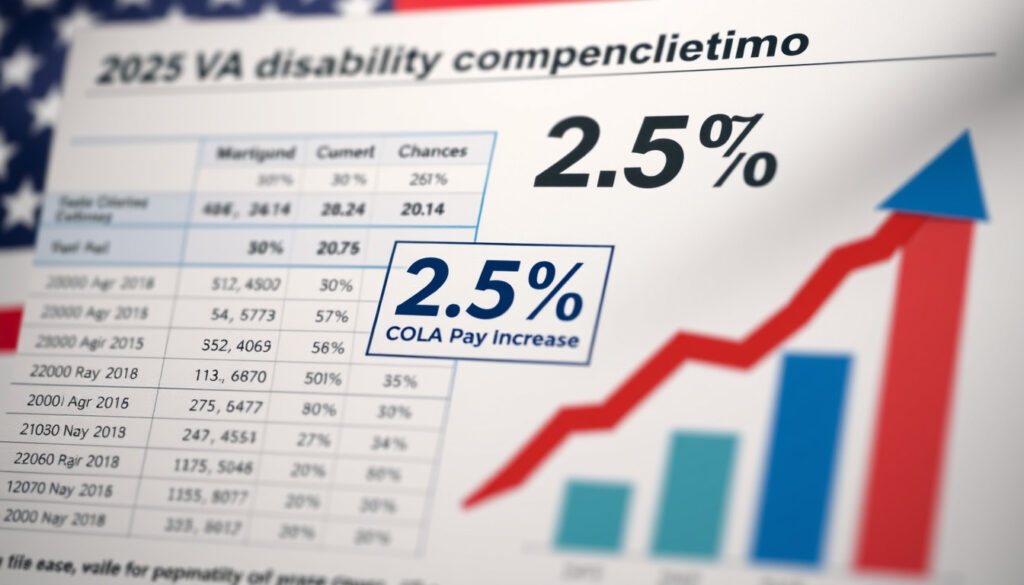
VA Disability Rates 2025: Charts & 2.5% COLA Pay Update
Veterans receiving VA disability compensation will see a 2.5% cost-of-living increase in 2025, with rates effective December 1, 2025 and the first updated payment arriving in January 2026. The SSA announced this adjustment on October 10, 2024, and veterans rated 100% with no dependents will receive $3,831.30 monthly — tax-free.
2025 COLA Increase: 2.5% ·
Effective Date: December 1, 2025 ·
Next Adjustment: December 1, 2026 ·
30% Rating (No Dependents): $537.42 ·
Tax Status: Tax-free
Quick snapshot
- 2.5% COLA for 2025 (Veterans Guardian)
- Effective Dec 1, 2025 (VA.gov)
- Tax-free payments (DAV)
- Exact 2026 increase amount pending official announcement
- Final 2026 pay tables not yet released
- Minor discrepancies in some lower rating rates across non-VA sources
| Factor | 2025 Value | Source |
|---|---|---|
| COLA 2025 | 2.5% confirmed | Veterans Guardian |
| Effective Period | Dec 1, 2025 – Nov 30, 2026 | VA.gov |
| 10% No Dependents | $180.42 | VA.gov |
| 20% No Dependents | $356.66 | VA.gov |
| 30% No Dependents | $537.42 | Disability Denials |
| 30% With Spouse | $601.42 | Disability Denials |
| 100% Veteran Alone | $3,831.30 | Disability Denials |
What is the 2025 VA disability rate?
The federal government adjusts VA disability compensation each year based on the Social Security Administration’s cost-of-living adjustment. For 2025, the COLA is 2.5% — a smaller bump than the 3.2% increase veterans received in 2024, but enough to preserve purchasing power as prices remain elevated. The SSA announced this figure on October 10, 2024, and rates took effect December 1, 2025 (Veterans Guardian).
VA disability pay is tax-free, which effectively increases the real value of compensation compared to taxable income at the same pre-tax amount. For a veteran rated at 100% with no dependents receiving $3,831.30 per month, that’s roughly $45,975 annually — all untaxed.
Effective dates
The 2025 rates apply to the benefit period running December 1, 2025 through November 30, 2026. Veterans receive their first payment reflecting the new rates in January 2026 — VA pays COLA in arrears, meaning the adjustment covers December 2025 but shows up in the January check (AAFMAA).
Base rates overview
For veterans with no dependents, the 2025 monthly rates range from $180.42 at 10% up to $3,831.30 at 100%. The official VA.gov page lists the 10% rate at $180.42 and 20% at $356.66 with no additional dependent increment for these lower ratings (VA.gov).
Ratings of 10% and 20% do not receive additional compensation for dependents — that bump only kicks in at 30% and above. This is a common point of confusion for veterans reviewing their awards for the first time.
2025 VA Disability Pay Rates & Charts | 2.5% COLA Confirmed
Beyond the bare percentage, the real question veterans ask is: how much does this add to my monthly deposit? The answer depends on two factors — your disability rating and your dependent status. The official VA pay charts break these down in detail.
Pay table for veterans alone
For a veteran with no dependents, here’s what the 2025 rates look like across common rating levels. These figures come from official and verified sources including VA.gov and veteran advocacy publications.
| Rating | Monthly Rate (No Dependents) | Source |
|---|---|---|
| 10% | $180.42 | VA.gov |
| 20% | $356.66 | VA.gov |
| 30% | $537.42 | Disability Denials |
| 40% | $774.16 | Disability Denials |
| 50% | $1,102.04 | Disability Denials |
| 60% | $1,395.93 | Disability Denials |
| 70% | $1,759.19 | Disability Denials |
| 80% | $2,044.89 | Disability Denials |
| 90% | $2,297.96 | Disability Denials |
| 100% | $3,831.30 | Disability Denials |
The gap between 10% and 100% represents a $3,650.88 monthly difference — veterans rated at the top receive nearly 21 times the compensation of those at the bottom of the scale.
Rates with dependents
Veterans with spouses or children receive additional monthly amounts. The increments vary by rating level — higher ratings get larger dependent bumps. For a veteran at 30% with a spouse, the monthly rate rises to $601.42. At 100% with a spouse and one child, the combined benefit reaches approximately $4,318.99 per month (Disability Help Group).
| 100% Rating Scenario | Monthly Rate | Source |
|---|---|---|
| Veteran only | $3,831.30 | Disability Help Group |
| + Spouse | $4,158.17 | Disability Help Group |
| + Spouse + 1 child | $4,318.99 | Disability Help Group |
Each additional child under 18 adds $74-$106.14 monthly for ratings between 70% and 100%, while spouses receiving Aid and Attendance benefits add $137-$195.92 at those higher rating levels (Disability Denials).
Adding a dependent increases your monthly check, but it also requires documentation — marriage certificates, birth certificates, school enrollment records for children over 18 still in school. Failing to report a dependent change promptly can result in overpayment debt later.
Will VA disability rates increase in 2026?
Yes — veterans can expect another increase for 2026. The SSA has announced a 2.8% COLA for 2026, which exceeds the 2.6% average seen over the past decade. The DAV reported this figure and noted that the adjustment is designed to help veterans maintain their purchasing power as inflation continues to erode what benefits buy (DAV).
“This COLA is a necessary measure to help curb how inflation has eroded the purchasing power of those earned veterans benefits.”
— DAV (Disabled American Veterans)
“Great news: If you’re a Veteran with a service-connected disability, your VA disability compensation is about to get a boost.”
— AAFMAA (Military Financial Organization)
Projected COLA factors
The COLA calculation uses the Consumer Price Index for Urban Wage Earners and Clerical Workers (CPI-W), measured by the Bureau of Labor Statistics. The Department of Labor calculates the adjustment based on third-quarter data, and the SSA formally announces the figure each October. The SSA’s 2026 announcement is expected around October 24, 2025, with rates taking effect December 1, 2026 (VetsFirst).
Some forecasters have projected a 2.7% or even 2.5% adjustment for 2026. The Senior Citizens League reportedly revised its projection from 2.2% to 2.5% based on changing economic data, though the confirmed 2.8% figure from SSA exceeds those earlier estimates. The discrepancy reflects genuine uncertainty in inflation forecasting, not any dispute about how the calculation works (VA Loan Network).
Historical increases
Looking back, the 2025 2.5% COLA follows a 3.2% increase in 2024 and 8.7% in 2023 — the latter being the largest jump in decades as inflation spiked post-pandemic. The 2026 figure of 2.8% represents a return to more moderate territory, above the decade average but well below the 2023 peak.
The 2.8% 2026 COLA adds roughly $4.91 per month at the 10% rating level and approximately $107.28 at 100% for veterans with no dependents. For those with spouses or children, the dollar increase scales accordingly — every percentage point of COLA means more money in the pocket.
How much will 100% VA disability increase in 2026?
The 100% rating is the highest compensation level for VA disability, and veterans at this tier naturally see the largest dollar increases when COLA kicks in. With the announced 2.8% adjustment for 2026, veterans at 100% with no dependents will see their monthly benefit increase by approximately $107.28 (DAV).
Current 100% rates
For 2025, the 100% veteran-only rate sits at $3,831.30 per month. With a spouse, that rises to roughly $4,158.17, and with a spouse and child, approximately $4,318.99. The 2026 rates will apply from December 1, 2026, with the first payment reflecting the increase arriving in January 2027.
Future adjustment outlook
Veterans should note that the COLA applies automatically — no claims filing, no paperwork required. If you’re rated at 10% or higher, your compensation increases without any action on your part. The VA processes the adjustment internally and issues the revised amount in your regular monthly payment (VetsFirst).
The COLA also applies to Dependency and Indemnity Compensation (DIC) for survivors and to clothing allowances, though those benefit levels are calculated separately. If you receive multiple VA benefits, each will reflect the appropriate adjustment.
What is a 90% VA rating?
A 90% VA disability rating places a veteran near the top of the compensation scale, one step below the maximum 100% rating. At 90%, veterans receive $2,297.96 per month with no dependents in 2025 — and significantly more with spouses or children factored in.
Benefits at 90%
Beyond the monthly tax-free payment, veterans rated 90% or higher qualify for several additional benefits. These include full access to VA health care (including Priority Group 1 enrollment), dental care, vision services, and eligibility for adaptive equipment grants. The 90% rating also eliminates copays for prescription medications and outpatient care.
Veterans at 90% can receive concurrent retirement and disability pay in many cases, depending on their branch and retirement date. This “CRDP” benefit gradually restores retired pay offset by VA compensation.
Path to 100%
The gap between 90% and 100% represents the difference between approximately $2,297.96 and $3,831.30 monthly for veterans without dependents — that’s nearly $1,533 more per month, or over $18,000 annually. Veterans pursuing a rating increase to 100% should focus on documenting all service-connected conditions thoroughly, including secondary conditions that may have developed from primary service-connected disabilities.
“The adjustment is above the 2.6% average for the last decade.”
— DAV (Disabled American Veterans)
The catch: achieving 100% is not automatic. It requires either a single severe condition or a combination of multiple service-connected conditions that together impair earning capacity to the maximum degree. The VA uses the Schedule for Rating Disabilities (VASRD) to evaluate each condition, and the final 100% determination depends on how those ratings combine mathematically.
Veterans should report any worsening of service-connected conditions promptly. A condition that was rated at 10% five years ago may now warrant 30% or higher — and that increase compounds with every COLA adjustment going forward. Waiting to file means leaving money on the table for every month of delay.
2025 VA Disability Pay Chart — Spec Table
The following table consolidates the official 2025 rates from VA.gov and verified secondary sources. Veterans should cross-reference their award letter against these figures to confirm accuracy.
| Rating | Veteran Only | + Spouse | + Spouse + 1 Child | Source |
|---|---|---|---|---|
| 10% | $180.42 | No bump | No bump | VA.gov |
| 20% | $356.66 | No bump | No bump | VA.gov |
| 30% | $537.42 | $601.42 | $666.47 | Disability Denials |
| 40% | $774.16 | Varies | Varies | Disability Denials |
| 50% | $1,102.04 | Varies | Varies | Disability Denials |
| 60% | $1,395.93 | Varies | Varies | Disability Denials |
| 70% | $1,759.19 | Varies | Varies | Disability Denials |
| 80% | $2,044.89 | Varies | Varies | Disability Denials |
| 90% | $2,297.96 | Varies | Varies | Disability Denials |
| 100% | $3,831.30 | $4,158.17 | $4,318.99 | Disability Help Group |
The pattern is clear: dependent additions begin at 30% and scale upward with rating level, meaning families with children see progressively larger benefits as the veteran’s rating increases.
Timeline
| Date | Event | Source |
|---|---|---|
| October 10, 2024 | SSA announces 2025 2.5% COLA | Veterans Guardian |
| December 1, 2025 | 2025 VA disability rates become effective | Disability Denials |
| January 2026 | First 2025 rate payment (in arrears for Dec 2025) | VetsFirst |
| October 24, 2025 (expected) | SSA expected to announce 2026 COLA | VetsFirst |
| December 1, 2026 | 2026 rates become effective | AAFMAA |
| January 2027 | First 2026 rate payment reflecting 2.8% COLA | VetsFirst |
Clarity on what’s confirmed and what’s rumored
Confirmed
- 2.5% COLA for 2025 rates
- Effective December 1, 2025
- Tax-free compensation
- SSA announced 2.8% COLA for 2026
- No action required for COLA adjustments
- 10-20% ratings: no dependent additions
What’s unclear
- Minor discrepancies in some lower rating rates across sources
- Exact 2026 dollar increases for all rating/dependent combinations
- Precise SSA announcement date for 2025 COLA (Oct 10 vs. Dec 5 cited)
What experts say
“This COLA is a necessary measure to help curb how inflation has eroded the purchasing power of those earned veterans benefits.”
— DAV (Disabled American Veterans)
“The adjustment is above the 2.6% average for the last decade.”
— DAV (Disabled American Veterans)
“Great news: If you’re a Veteran with a service-connected disability, your VA disability compensation is about to get a boost.”
— AAFMAA (Military Financial Organization)
Summary
For veterans relying on VA disability compensation, the 2025 2.5% COLA maintains purchasing power in a stubbornly expensive economy. The 2026 announcement of 2.8% — above the decade average — suggests the government recognizes that inflation hasn’t fully retreated, and veterans’ earned benefits deserve protection. The key variable remains each veteran’s individual rating and dependent status: the difference between 90% and 100% means nearly $1,533 more per month, and that gap widens with every COLA. Veterans at lower rating levels should review their conditions annually, because a successful rating increase compounds in value every year a veteran lives with a service-connected disability.
For those navigating the 2025 and 2026 rate environment, the most reliable resources remain the official VA.gov compensation rate tables. Veterans with tax-related questions may also benefit from reviewing IRS filing requirements for veterans to understand how their tax-free disability pay interacts with annual return obligations.
Related reading: U.S. Economy News Today: Record Spending vs Recession Risks · What Is a 1040 Form – Filing Requirements and Steps
home.army.mil, youtube.com, missionrollcall.org, youtube.com
Veterans may also note that the Social Security Administration’s 2025 SSDI pay chart mirrors the 2.5% COLA boost in VA disability rates effective December 1.
Frequently asked questions
What are the VA disability pay dates for 2025?
2025 rates take effect December 1, 2025, with the first payment reflecting the new rates arriving in January 2026. VA pays in arrears, so the adjustment covers December but appears in the January deposit.
What is the VA disability rates 2025 calculator?
The VA offers an official compensation calculator at VA.gov that allows veterans to input their rating and dependent status to estimate monthly benefits. Third-party calculators exist but should be verified against official VA rate tables.
What are 2024 VA disability rates?
2024 rates included a 3.2% COLA increase — higher than 2025’s 2.5% adjustment. The VA archives past rate tables at va.gov/disability/compensation-rates/, allowing veterans to compare year-over-year changes.
Is chronic sinusitis a VA disability?
Yes, chronic sinusitis is a compensable VA condition rated under the Schedule for Rating Disabilities. Ratings typically range from 0% to 50% depending on severity and frequency of symptoms, with surgery history factored in.
Is Parkinson’s a VA presumptive disability?
Yes, Parkinson’s disease is on the VA’s list of presumptive conditions for veterans exposed to Agent Orange and other tactical herbicides during service. This means veterans don’t need to prove a connection between their service and Parkinson’s diagnosis to receive benefits.
How hard is it to get 100 percent VA disability?
Achieving 100% requires either a single condition rated at 100% or a combination of multiple conditions that mathematically combine to 100%. It’s challenging because the VA’s rating formula has diminishing returns at higher levels — adding a 30% condition to an existing 70% rating doesn’t result in 100%, but rather a combined rating below the arithmetic sum.
What is the holy grail of VA disability?
Veterans often call 100% permanent and total (P&T) status the “holy grail” because it provides the highest monthly compensation, free VA health care with no copays, and eligibility for additional benefits like adaptive housing grants and Dependents’ Educational Assistance.
More related posts
 Nike Zoom Vomero 5: Retro Runner Turned Lifestyle Staple
 Real Madrid vs Leganés 2026: Score, Stats & Head-to-Head History
 What Do Hemorrhoids Look Like? Visual Signs & Guide
 CBS TV Schedule Tonight: What’s On & New Episodes (March 2025)
 How to Train Your Dragon Live Action: 2025 Release & Cast
 Aetna Dental Provider Login: Access & Troubleshoot
 One World Trade Center – Height, History, Observatory Guide
 NBA YoungBoy Net Worth: $60M Deal, $70M Tour, $500M