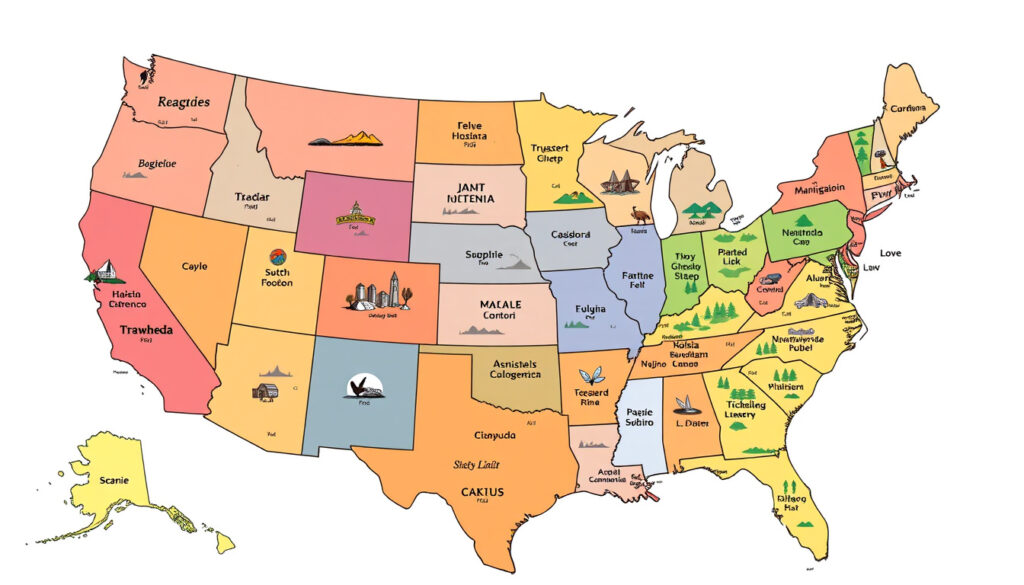
Map of the US: States, Cities, 7 Regions & Facts
Anyone who’s traced a finger across a map of the US during a road trip—hovering over states they’ve never visited—knows that something magnetic pulls us toward those unfamiliar boundaries. Each state on the map carries its own weight: a population figure, a regional identity, a reason it ranks where it does. This guide decodes the map by looking at regional divisions, state sizes, population patterns, and what Americans themselves say they love most about the country.
Number of States: 50 · Largest State by Area: Alaska · Most Loved State: Hawaii · Least Populated States: Wyoming leads · Main Regions: 7 divisions
Quick snapshot
- 50 states form the United States (Wikipedia)
- California leads with 39,538,223 residents (Wikipedia)
- Population heavily concentrated east of the Mississippi River (NASA Science)
- Exact state “friendliness” rankings vary by poll methodology and year
- Wealth concentration at granular regional and metro levels shifts with economic cycles
- 2020 Census data provides the most current state population figures available
- The US population reached 300 million on October 17, 2006 (NASA Science)
- New York City has been the most populous US city since at least 1790 (Wikipedia)
- 2020 Census data released, shifting understanding of state population rankings (NASA Science)
- Population growth continues favoring Sun Belt states (Florida, Texas, Arizona) (US Census Bureau)
- 2020 Census Demographic Data Map Viewer offers updated population visualization tools (US Census Bureau)
- Regional economic disparities shape migration patterns into the 2020s (US Census Bureau)
| Label | Value |
|---|---|
| Total States | 50 |
| Largest by Area | Alaska |
| Favorite State | Hawaii |
| 7 Regions | Defined divisions |
| Wealthiest Region | Per ITEP data |
| California Population (2020) | 39,538,223 |
| Texas Population (2020) | 29,145,505 |
| Florida Population (2020) | 21,538,187 |
| Urbanization Rate | 83.3% |
| US World Population Rank | Third |
What are the 7 regions of the United States?
Most official and educational sources divide the United States into seven distinct regions, each grouping states by shared geography, climate, culture, and economic activity. Regional maps serve as the backbone for understanding the country’s internal diversity—arguably more useful than simply memorizing state names on a blank outline.
Northeast
The Northeast encompasses New York City, New England (Connecticut, Maine, Massachusetts, New Hampshire, Rhode Island, Vermont) and the Mid-Atlantic states (New Jersey, New York, Pennsylvania). This is the most densely populated corridor in the country, anchored by the major metropolitan areas of New York City, Philadelphia, and Boston. According to NASA Science, major urban centers on the East Coast including New York, Philadelphia, and Washington feature rings of decreasing population density radiating outward from the urban cores.
Midwest
The Midwest region typically includes the East North Central states (Illinois, Indiana, Michigan, Ohio, Wisconsin) and the West North Central states (Iowa, Kansas, Minnesota, Missouri, Nebraska, North Dakota, South Dakota). The Great Lakes define much of the region’s identity, and large urban clusters spread throughout the area as noted in demographics research from Wikipedia. Agriculture and manufacturing have historically driven the regional economy, though tech and service sectors have grown in major metros like Chicago and Minneapolis.
South
The South encompasses the largest number of states, ranging from the South Atlantic division (Delaware, Florida, Georgia, Maryland, North Carolina, South Carolina, Virginia, West Virginia, plus Washington D.C.) through the East South Central (Alabama, Kentucky, Mississippi, Tennessee) and West South Central (Arkansas, Louisiana, Oklahoma, Texas). Florida stands out with 21,538,187 residents according to the 2020 Census and is among the fastest-growing states, with a 14.6% population increase between 2010 and 2020.
West
The West splits into the Mountain West (Arizona, Colorado, Idaho, Montana, Nevada, New Mexico, Utah, Wyoming) and the Pacific division (Alaska, California, Hawaii, Oregon, Washington). According to NASA Earth Observatory data, the western United States remains lightly populated except for clearly defined urban regions, with major cities including San Diego, Los Angeles, San Francisco, Oakland, and San Jose concentrated along the coast. Portland, Seattle, Phoenix, and Denver represent significant interior population centers.
Other divisions
Some sources use alternative regional groupings—particularly for the Pacific territories and overseas areas. The Census Bureau recognizes Puerto Rico and US territories separately, with a combined population of approximately 3,600,000 residents. These territories are not typically included on standard 50-state maps but represent important components of US territorial extent.
Which is the biggest state in the USA?
When people ask about the “biggest” state, they’re asking one of two questions: which state covers the most land area, or which has the most residents. Both rankings tell different stories about American geography and demography.
By area
Alaska dominates any conversation about state size by area, covering approximately 663,300 square miles. To put that in perspective, Alaska is larger than Texas, California, and Montana combined—and still less densely populated than any other state, with most residents concentrated along the southern coast, particularly around Anchorage. According to Wikipedia’s demographics data, Alaska’s population concentrates along its southern coast with particular emphasis on Anchorage.
Texas ranks second by area at roughly 268,600 square miles, followed by California (163,696), Montana (147,040), New Mexico (121,590), and Arizona (113,990). The top six states by area account for roughly 40% of total US land area, yet house a relatively small share of the population.
By population
By residents, the rankings flip dramatically. California leads with 39,538,223 residents according to 2020 Census data, followed by Texas with 29,145,505. Florida comes third with 21,538,187, having grown 14.6% over the previous decade. New York holds fourth place with 20,201,249 residents, and Pennsylvania rounds out the top five with 13,002,700.
As noted by World Atlas, California, Texas, and Florida together account for over a quarter of the total US population. This concentration reflects the pull of job markets, climate preferences, and urban amenities that draw Americans to the coasts and Sun Belt.
Alaska spans more land than the next three largest states combined, yet holds fewer than 750,000 people. Meanwhile, California fits into a fraction of that space but houses nearly 40 million residents. The gap between geographic size and population creates fundamentally different experiences of American space depending on which state you call home.
What is the least popular state?
“Least popular” can mean two things in the context of US states: the state with the smallest population, or the state that ranks lowest in public favorability polls. Both angles reveal something about American geography and psychology.
Least populated
Wyoming holds the title of least populous state with approximately 581,381 residents, according to World Atlas data. Vermont follows, then Alaska, North Dakota, South Dakota, and Delaware round out the bottom tier. According to Wikipedia’s analysis of census data, the 25 least populous states contain less than one-sixth of the total US population combined.
These states share common characteristics: smaller economies, limited urban density, vast rural areas, and geographic features (mountains, plains, cold climates) that don’t attract the same migration flows as coastal and Sun Belt locations. Wyoming’s economy leans heavily on energy extraction, agriculture, and tourism—industries that don’t drive population growth the way tech and service sectors do in larger metros.
Least favored
Polls measuring state favorability show different patterns than pure population counts. According to YouGov surveys, Hawaii emerges as Americans’ favorite state, while Illinois and Mississippi frequently rank near the bottom of favorability ratings. Economic struggles, weather extremes, and political perceptions all influence how Americans rate states they’ve often never visited.
The gap between “least populated” and “least favored” reveals how perception differs from demographic reality. Wyoming’s sparse population isn’t a choice Americans regret—it’s a function of geography and economics. Illinois, despite its population size, struggles with favorability tied to taxation policies and political reputation. A state can have millions of residents and still be “unpopular” in the court of public opinion.
Which state is the most loved?
Americans’ favorite state consistently emerges in favorability polls, and the results might surprise those who assume population centers or economic powerhouses would rank highest. According to YouGov polling data, Hawaii stands out as the state Americans most want to visit—and in some surveys, the state they’d most want to live in if they could afford it.
Popularity polls
YouGov’s annual favorability surveys ask Americans to rate each state, and Hawaii consistently achieves the highest net favorability score. Colorado, the Pacific Northwest states, and New England also score well. Meanwhile, states with large populations like California, Texas, and Florida often split public opinion more evenly—beloved by some, viewed critically by others.
The pattern suggests that smaller, geographically distinct states with strong natural amenities (beaches, mountains, pleasant climate) tend to score highest in love rankings. Hawaii’s tropical isolation, Colorado’s mountain recreation, and Minnesota’s “Minnesota Nice” reputation all generate positive associations disproportionate to population or economic output.
Tourist favorites
Beyond polls, tourism data tells a similar story. Las Vegas, Orlando, New York City, and Honolulu rank among the most-visited domestic destinations by international and domestic travelers. These tourist magnets don’t always match population rankings—they’re places people want to visit briefly rather than relocate permanently, which creates a different relationship between geography and popularity.
Which U.S. region is the wealthiest?
Wealth concentration in the United States varies dramatically by geography, and understanding regional wealth patterns requires looking beyond simple state-level averages to examine metropolitan areas, county concentrations, and the distribution of extreme wealth.
Wealth distribution
According to research from the Institute for Policy Studies through the “Geographic Distribution of Extreme Wealth in the U.S.” project, extreme wealth (typically defined as the top 1% or top 0.1% of earners) concentrates in specific metropolitan areas rather than spreading evenly across regions. The Northeast and West Coast hold disproportionate shares of the country’s wealthiest zip codes, with New York, San Francisco, Boston, and Los Angeles metro areas leading in wealth concentration.
However, median household income tells a different story. The Northeast and Mid-Atlantic states often lead in median wealth, but the Mountain West and Pacific Northwest also show strong median income levels. Raw regional averages can mask significant inequality within regions—wealthy coastal counties coexist with economically struggling rural areas in virtually every region.
Key metrics
The US Census Bureau’s 2020 data and the Demographic Data Map Viewer provide population-level information that intersects with wealth patterns. As noted in NASA’s population density analysis, large urban clusters are spread throughout the eastern half of the United States, particularly in the Great Lakes area, northeast, east, and southeast. This population density correlates with economic activity, though causality runs both ways—people move to where jobs are, and jobs concentrate where people already live.
The mean center of US population has consistently shifted westward and southward over census history, according to Wikipedia demographic data. This movement reflects migration patterns that concentrate economic activity in new regions, particularly the Sun Belt, where states like Texas, Florida, and Arizona have seen rapid economic growth alongside population increases.
Wealth concentration in coastal metros creates opportunity but also drives extreme cost of living. The South and Mountain West regions offer lower costs and growing economies, but their wealth accumulation trails the established coastal corridors. For Americans choosing where to live, the calculus between earning potential and quality of life varies by region in ways that simple wealth rankings can’t capture.
Related reading: One World Trade Center · U.S. Economy News
Our overview of the seven US regions pairs well with an interactive USA states map that details all 50 states alongside major cities and essential geography facts.
Frequently asked questions
How many states are shown on a map of the US?
A standard map of the US displays all 50 states. Some maps also include Alaska and Hawaii in smaller “inset” boxes positioned in the corner, since their geographic distance from the contiguous 48 states makes them difficult to include at the same scale.
What cities are on a USA map with states?
Major cities marked on standard US state maps typically include New York City, Los Angeles, Chicago, Houston, Phoenix, Philadelphia, San Antonio, San Diego, Dallas, San Jose, Austin, Jacksonville, Fort Worth, Columbus, and Charlotte, among others. Detailed maps may include state capitals and smaller metropolitan areas.
Where can I find a printable USA map with states and cities PDF?
The US Census Bureau offers printable demographic maps through their map viewer tool. Educational sites like Fla-shop.com provide region-specific maps, while the USGS provides geological and topographical maps of individual states and regions.
What is a Google map of USA?
Google Maps provides an interactive, zooming map of the United States that layers roads, satellite imagery, terrain data, and points of interest. Users can click on any location to see surrounding features, get directions, or explore street-level views.
How is North America mapped relative to the US?
North America maps show the continental landmass including Canada, the United States, Mexico, Central America, and the Caribbean. The US occupies the central portion of the continent, bordered by Canada to the north, Mexico to the south, and with coastlines on the Atlantic and Pacific Oceans.
What are major features on a large map of USA?
Large-scale US maps typically display major geographic features including mountain ranges (Rockies, Appalachians, Sierra Nevada, Cascades), rivers (Mississippi, Missouri, Colorado, Rio Grande), lakes (Great Lakes), coastlines, major metropolitan areas, state boundaries, interstate highways, and national parks.
California, Texas, and Florida are the three most populated states, accounting for over a quarter of the total US population. — World Atlas
The population is highly urbanized, with 83.3% of the population residing in cities and suburbs. — Wikipedia Demographics of the United States
For travelers planning cross-country routes, the choice between regions matters as much as the choice between states. The 50 states on any US map represent seven distinct regional identities, each with its own economic character, cultural markers, and demographic trajectory. A map of the US becomes more meaningful when read as a story of where Americans have concentrated, where they’re moving, and which places they dream about returning to.
More related posts
 Hootie & the Blowfish: Biggest Hit, Name Origin, Legal Facts
 Best Stainless Steel Cookware 2026: Expert Picks, Grades & Pro Tips
 $697 Social Security Checks: April 2025 Schedule & COLA
 Loan for Bad Credit: Complete Guide to Getting Approved
 How to Unzip a File on Windows, Mac, Android, and iPhone (Free)
 This Land Is Your Land: Meaning, Controversy, and Lost Verses
 How Tall Is Shaquille O’Neal? Official Height
 St. Louis Cardinals News: Latest Rumors, Trades, Schedule