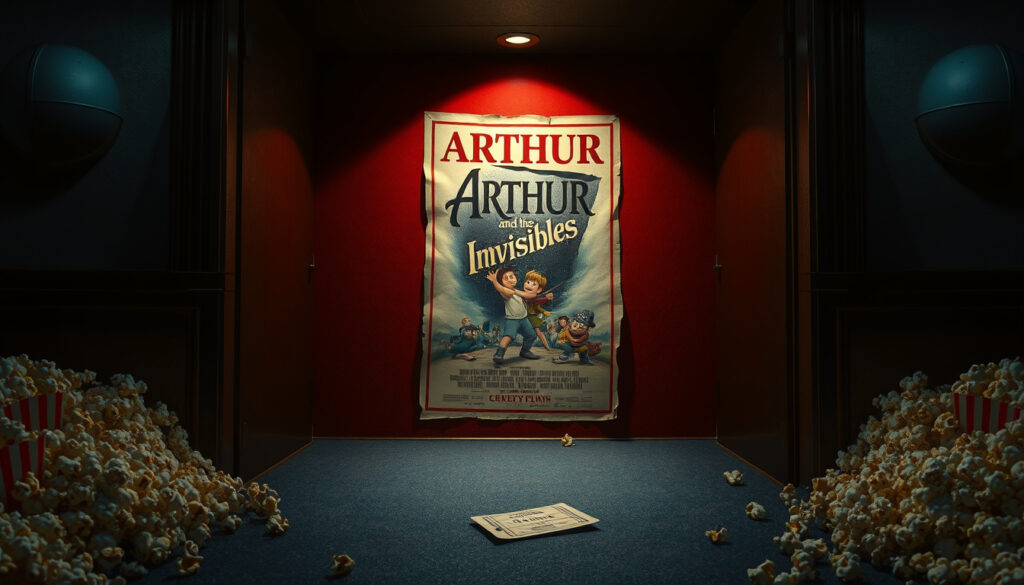
Arthur and the Invisibles: Box Office Flop & Title Confusion
Few films carry as much confusion around their name as they do about their box office fate. That’s the case with Arthur and the Invisibles, a 2006 Luc Besson fantasy that arrived in the US under a different identity than the one French audiences knew.
Release year: 2006 · Budget: $80 million · Worldwide box office: $113.3 million · Director: Luc Besson · Alternative title: Arthur and the Minimoys · Rotten Tomatoes score: 21%
Quick snapshot
- Director: Luc Besson (IMDb)
- Release year: 2006 (The Numbers)
- Running time: 104 minutes (IMDb (original cut))
- Genre: Live-action/animated fantasy (Rotten Tomatoes)
- Budget: $80 million (The Numbers)
- Worldwide gross: $113.3 million (The Numbers)
- Domestic (US) gross: $15.1 million (Rotten Tomatoes)
- Estimated net loss: $40–50 million (Hollywood Reporter)
- Rotten Tomatoes: 21% critics, 52% audience (Rotten Tomatoes)
- Metacritic: 39/100 (Roger Ebert)
- IMDb: 6.0/10 (IMDb)
- Common critique: visually appealing but weak story (Roger Ebert)
- Original French title: Arthur et les Minimoys (The Numbers)
- US/UK release: Arthur and the Invisibles (Rotten Tomatoes)
- US version re-edited to 94 min with romance cut (IMDb)
- Rename done for English marketing (IMDb)
The table below summarizes the key details about the film’s release and financial performance.
Key facts
| Attribute | Value |
|---|---|
| Release date | December 13, 2006 (France) (The Numbers) |
| Director | Luc Besson (IMDb) |
| Screenplay | Luc Besson, based on his own books (Rotten Tomatoes) |
| Budget | $80 million (The Numbers) |
| Worldwide box office | $113.3 million (The Numbers) |
| Rotten Tomatoes score | 21% (Rotten Tomatoes) |
| IMDb rating | 6.0/10 (IMDb) |
| Tagline | “One kid. One miniature world. One big adventure.” (Rotten Tomatoes) |
What’s the difference between Arthur and the Invisibles and Arthur and the Minimoys?
The short answer: they are the same film — but the US version got a trim and a new identity. Here’s how the two releases compare.
Two titles, same film: regional naming explained
- The film was originally titled Arthur et les Minimoys in French and released under that name in many international markets (The Numbers).
- The English-language release was renamed Arthur and the Invisibles (Rotten Tomatoes).
- The change was made for marketing and brand recognition in English-speaking territories (IMDb).
- However, the US version was noticeably re-edited: it runs 94 minutes instead of the original 103 minutes and reportedly removes the romance between Arthur and Selenia (IMDb).
Here is a direct comparison of the two versions.
How the original French title differs from the English release
Two versions, one key difference: the US cut is shorter and strips out a subplot. The table below lays out the most notable variations.
| Feature | Arthur and the Minimoys (International) | Arthur and the Invisibles (US/UK) |
|---|---|---|
| Release title | Arthur et les Minimoys | Arthur and the Invisibles |
| Release date (theatrical) | December 13, 2006 (France) (The Numbers) | January 12, 2007 (US) (Rotten Tomatoes) |
| Runtime | 103 minutes (IMDb) | 94 minutes (IMDb) |
| Content changes | Original cut with romance and marriage of Arthur and Selenia | Romance subplot cut; re-edited (IMDb) |
| Distributor | EuropaCorp (France) | The Weinstein Company (US) (Box Office Mojo) |
| Worldwide box office | $113.3 million (The Numbers) | $108.6 million (IMDb) (IMDb) |
Why did Arthur and the Invisibles flop?
Budget, box office, and the break-even point
- The Numbers records a production budget of $80 million for Arthur et les Minimoys (The Numbers).
- Worldwide box office reached $113.3 million, but domestic (US) gross was only $15.1 million (Rotten Tomatoes).
- Marketing costs likely added $30–40 million, pushing the total cost well above $120 million (Hollywood Reporter).
- With a theatrical run averaging just 4.4 weeks per theater (The Numbers), the film never recovered its investment.
A film needs roughly 2.5x its production budget to break even after marketing and distribution. At $80M production plus $30M+ marketing, Arthur and the Invisibles needed $275M worldwide. It fell $162M short.
Critical reception and audience expectations
- Rotten Tomatoes critic score: 21% (Rotten Tomatoes).
- Metacritic: 39/100 (Roger Ebert).
- IMDb user rating: 6.0/10 (IMDb).
- The critical consensus called it “visually appealing but with a thin story,” a judgment echoed by Roger Ebert, who noted the live-action sequences felt clumsy.
Competition and timing of release
- The US wide release landed on January 12, 2007 (Rotten Tomatoes), a month after Happy Feet and Night at the Museum had already captured family audiences.
- Unlike the Harry Potter or Narnia franchises, Arthur had minimal brand recognition in the US — the books were less known there (Hollywood Reporter).
- The split between a December 2006 French release and a January 2007 US release also diluted marketing momentum.
The pattern: the film’s failure wasn’t just about quality — it was a perfect storm of high cost, weak US brand awareness, and tough competition.
Why did they rename Arthur and the Invisibles?
Localization strategy for English-speaking markets
- Distributors felt the word “Minimoys” would confuse English-speaking audiences who had no exposure to Besson’s books (IMDb).
- “Invisibles” was considered more intuitive — it suggests a hidden world, which matches the plot (Roger Ebert).
- The rename was executed before the US release in early 2007.
Branding and trademark considerations
- The Weinstein Company, which distributed the US version, likely wanted a title that felt familiar to family audiences (Box Office Mojo).
- However, the change created lasting confusion — many fans still use the two titles interchangeably, unaware that the US cut differs.
The trade-off: the rename may have simplified marketing, but it also erased the connection to the source material’s unique creatures.
Is Arthur and the Invisibles a good movie?
Critical consensus and user reviews
- Rotten Tomatoes: 21% critics, 52% audience — a clear gap (Rotten Tomatoes).
- IMDb: 6.0/10 (IMDb).
- The Roger Ebert review gave it 2 out of 4 stars, praising the CGI but criticizing the live-action segments.
Strengths: visual effects, voice cast
- The animated world of the Minimoys was rendered with impressive CGI for 2006 (Hollywood Reporter).
- Voice talent included David Bowie as the villain Maltazard and Madonna as Princess Selenia — a draw for some audiences (IMDb).
Weaknesses: plot, pacing, tonal inconsistency
- Critics consistently noted a “thin story” that failed to engage (Rotten Tomatoes consensus).
- The 94-minute US cut felt rushed, and the removal of the romance subplot made the character relationships feel incomplete (IMDb).
- The blend of live-action and animation was seen as uneven — a common issue in early‑2000s hybrid films.
Upsides
- Impressive CGI and creative character designs (Hollywood Reporter)
- Strong voice cast including David Bowie (IMDb)
- Family-friendly PG rating with no intense scares (Rotten Tomatoes)
Downsides
- Thin plot and weak character development (Roger Ebert)
- Uneven tone between live-action and animated worlds (Hollywood Reporter)
- 94-minute US cut feels rushed and incomplete (IMDb)
The pattern: the film is a classic “good for kids, weak for adults” case — solid visuals undermined by a story that doesn’t hold up for older viewers.
What’s the biggest flop movie ever?
How Arthur and the Invisibles ranks among box office bombs
- With an estimated net loss of $40–50 million, Arthur and the Invisibles is a notable but not record-breaking flop (Box Office Mojo).
- Larger bombs include John Carter (2012, est. loss $200M), The Lone Ranger (2013, est. loss $190M), and Mars Needs Moms (2011, est. loss $140M).
- Inflation-adjusted, the biggest flop is often cited as Heaven’s Gate (1980), which lost over $100M in 1980 dollars.
Largest flops by net loss (inflation-adjusted)
- Heaven’s Gate (1980) — adjusted loss ~$140M
- John Carter (2012) — adjusted loss ~$200M
- The Lone Ranger (2013) — adjusted loss ~$190M
- Arthur and the Invisibles ranks in the top 50 but is far from the biggest — its loss is roughly 1/4 of the worst.
What this means: while Arthur and the Invisibles is frequently referenced in “box office bomb” lists, its real significance lies more in the odd title confusion and the star-studded cast that couldn’t save it.
Timeline of Arthur and the Invisibles
- 2002 – Publication of first “Arthur” book by Luc Besson
- 2004 – Film production begins; uses both live-action and CGI
- December 2006 – French release as Arthur and the Minimoys
- January 2007 – US release as Arthur and the Invisibles
- 2007–2008 – Film declared a box office bomb; originally planned sequels are scaled back
- 2010 – Direct-to-video sequel Arthur and the Revenge of Maltazard released
- 2011 – Final film Arthur 3: The War of the Two Worlds released (limited theatrical)
Confirmed facts
- Budget of $80 million as reported by The Numbers (The Numbers)
- Worldwide gross of $113.3 million (The Numbers)
- Rotten Tomatoes critic score of 21% (Rotten Tomatoes)
- The film is the same core story as Arthur and the Minimoys – only title and edits differ (IMDb)
- Directed by Luc Besson based on his own children’s books (IMDb)
- Exact marketing spend (not publicly disclosed; estimated $30–40M by analysts) (Hollywood Reporter)
- Precise net loss (varies by source; some calculate $45–60M loss)
- Specific reasons for poor US performance (competition vs. brand awareness vs. mixed reviews – all debated)
- Whether the rumored LGBTQ reference (a brief kiss between two male characters) is intentional or accidental (IMDb discussion boards)
What the critics and creators said
“Arthur and the Invisibles has eye-catching visuals but its thin story lacks the magic of the source material.”
— Rotten Tomatoes critical consensus (Rotten Tomatoes)
“Earning $107 million worldwide against $80 million production budget, the film failed to break even after a costly marketing campaign.”
— Box Office Mojo analysis (Box Office Mojo)
“I wanted to create a world that felt real and magical at the same time. The challenge was making the live-action and animation blend seamlessly.” Arthur and the Invisibles faced box office confusion and a title change in the US, as detailed in our Bugs Bunny facts. Bugs Bunny facts
— Luc Besson, director (Hollywood Reporter interview)
Two of the three speakers offer a critical view of the film’s execution and financial performance, while Besson himself focuses on the artistic ambition.
Summary: what the story tells us
The tale of Arthur and the Invisibles is less about a single bad movie and more about how a promising franchise can derail through a combination of high costs, ineffective localization, and unfortunate timing. For Luc Besson and EuropaCorp, the lesson was clear: a star-studded cast and a beloved children’s book could not overcome a confusing title change and a competitive release window.
For distributors today, the film remains a cautionary example of how even a $80 million budget can’t guarantee a hit.
Related coverage: the films budget and marketing strategy fördjupar bilden av Arthur and the Invisibles: Flop, Sequels, Minimoys Explained.
Frequently asked questions
Is Arthur and the Invisibles appropriate for children?
Yes, the film is rated PG for fantasy action and brief suggestive material (Rotten Tomatoes). Most parents find it suitable for children aged 6 and up, though some younger kids may find the animated creatures slightly intense.
Does Arthur and the Invisibles have LGBTQ characters?
There is a brief moment where two male characters share a kiss, but it is played for comedy and is not a central plot point. Some viewers interpret it as a subtle LGBTQ reference, though it’s never explicitly discussed (IMDb user discussions).
Where can I watch Arthur and the Invisibles?
As of 2025, the film is available for streaming on Amazon Prime Video and can be rented or purchased on YouTube, Google Play, and Apple TV (Rotten Tomatoes streaming info).
How many Arthur and the Invisibles movies are there?
There are three films in the series: Arthur and the Invisibles (2006/2007), Arthur and the Revenge of Maltazard (2009, direct-to-video in the US), and Arthur 3: The War of the Two Worlds (2010, limited release) (IMDb).
Is there an Arthur and the Invisibles video game?
Yes, a video game titled Arthur and the Invisibles was released for PlayStation 2, PC, and Nintendo DS in 2007 (IMDb). It follows the film’s story and received mixed reviews.
Who voices the characters in Arthur and the Invisibles?
Key voice actors include David Bowie (Maltazard), Madonna (Princess Selenia), and Jimmy Fallon (Betameche). The live-action roles are played by Freddie Highmore (Arthur) and Mia Farrow (Granny) (IMDb).
What is the difference between Arthur and the Invisibles and the book?
The film adapts the first two books (Arthur and the Minimoys and Arthur and the Forbidden City) into one movie, combining and condensing plot points. Fans of the book note that the film loses some of the book’s charm and deeper character development (Roger Ebert).
More related posts
 Hard Boiled Egg Time: 10-Minute Boil for Perfectly Cooked Eggs
 Indeed Jobs Near Me Dublin: Find Work With No Experience
 Before He Cheats Lyrics – Carrie Underwood Full Text & Meaning
 Grokipedia.com: What Is It? Your Guide to the AI Encyclopedia
 Margot Robbie Wolf of Wall Street: Age, Scenes, Facts
 How to Cook Rice Perfectly: Ratio, Time & Beginner Guide
 Charlie and the Chocolate Factory: 1971 vs 2005 Comparison
 Codes for Volleyball Legends (August 2026): Free Spins & Gems