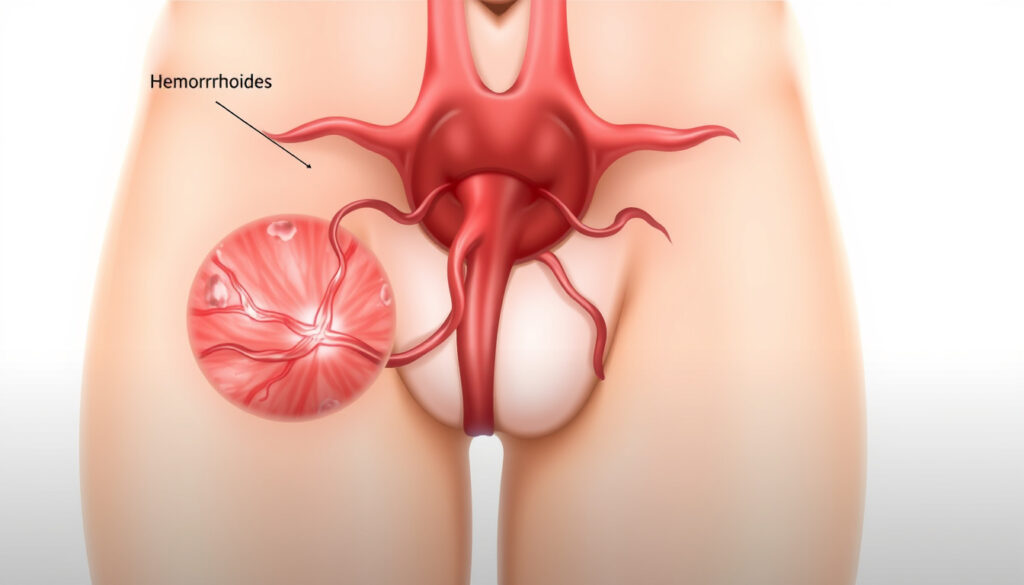
What Do Hemorrhoids Look Like? Visual Signs & Guide
Hemorrhoids are common, but telling them apart from other anal lumps is not always straightforward. Up to 50% of adults experience hemorrhoids by age 50, and this guide walks through the visual signs of each type and how to tell them apart from look-alike conditions like anal fissures or warts.
Adults affected globally: 50% by age 50 ·
Hemorrhoid types: internal, external, thrombosed ·
Common symptom: bleeding: painless during bowel movements ·
Self-resolution rate: often within a few days to 1 week
Quick snapshot
- Hemorrhoids are swollen veins in the rectum or anus (Mayo Clinic (leading medical research center))
- External hemorrhoids appear as small lumps around the anus, often skin-colored or pink (Cleveland Clinic (world-renowned healthcare system))
- Thrombosed hemorrhoids look like hard, blue or purple lumps (Mayo Clinic)
- Whether a lump is a hemorrhoid or another condition (e.g., wart, polyp) cannot be confirmed without professional exam (NIDDK (U.S. government health institute))
- The exact cause of hemorrhoids is not fully understood (Mayo Clinic)
- Mild hemorrhoids often resolve in a few days to a week without treatment (Mayo Clinic)
- Thrombosed hemorrhoids may cause severe pain that peaks in 48 hours (Merck Manual (medical reference for professionals))
- Home remedies like sitz baths and cold compresses can reduce symptoms (Mayo Clinic)
- Persistent symptoms may require medical procedures such as rubber band ligation (NIDDK)
Four key facts, one pattern: each type of hemorrhoid has a distinct visual signature that changes how it feels and what treatment fits.
| Fact | Value |
|---|---|
| Most common age group | 45-65 years |
| Pregnancy incidence | Up to 50% of pregnant women |
| Self-resolution timeframe | Few days to 1 week without complications |
| Bleeding as symptom | Bright red blood on toilet paper or in bowl |
How do you know if it’s hemorrhoids or not?
Common visual signs of hemorrhoids
- External hemorrhoids appear as small lumps outside the anus, often pink or purple (Cleveland Clinic (world-renowned healthcare system)).
- Internal hemorrhoids are not visible from the outside unless they prolapse (American Family Physician (AAFP) (peer-reviewed medical journal)).
- Thrombosed hemorrhoids look like a hard, blue or purple lump (Mayo Clinic (leading medical research center)).
The implication: if you see a lump that’s soft and skin-colored, it’s likely an external hemorrhoid. A hard, discolored lump suggests a thrombosed one — and that’s the type that hurts most.
Differences between internal and external hemorrhoids
- Internal hemorrhoids above the dentate line usually can’t be seen externally (AAFP).
- When they prolapse, internal hemorrhoids appear as dark pink, glistening, sometimes tender masses at the anal margin (AAFP).
- External hemorrhoids are usually visible or palpable, while internal ones are not visible unless they prolapse (Cleveland Clinic).
The pattern: internal hemorrhoids stay hidden until they push out — then they look like a grape-like bulge. External ones are always on show.
A non-thrombosed external hemorrhoid is soft and can’t be pushed back in, while a prolapsed internal one can be manually reduced. That distinction matters for home care decisions.
Bottom line: External hemorrhoids are visible lumps; internal ones are hidden until they prolapse. Thrombosed ones are hard and discolored. If you are unsure, see a doctor.
What can be mistaken for a hemorrhoid?
Anal fissures
- Anal fissures cause sharp pain and bleeding but no external lump (NIDDK (U.S. government health institute)).
Anal warts
- Anal warts are caused by HPV and appear as cauliflower-like growths (Merck Manual (medical reference for professionals)).
Skin tags
- Skin tags are soft, painless flaps of skin (Cleveland Clinic).
Abscesses
- Abscesses produce painful swelling with pus (Merck Manual).
Polyps or tumors
- Polyps or tumors may mimic hemorrhoids but require biopsy for diagnosis (Mayo Clinic (leading medical research center)).
Why this matters: a lump that is painful, firm, or irregular should raise suspicion for something beyond hemorrhoids. A healthcare professional can differentiate using a simple exam.
Bottom line: Fissures cause pain without a lump; warts have a cauliflower texture; skin tags are painless flaps; abscesses are pus-filled; polyps require biopsy. Any persistent or hard lump warrants a doctor visit.
What do external hemorrhoids look like?
Appearance on a woman
- External hemorrhoids look like small, soft lumps around the anus, often skin-colored or slightly pink (Cleveland Clinic).
Appearance during pregnancy
- During pregnancy, they may appear larger and more swollen due to increased pressure (Mayo Clinic).
Appearance outside the anus
- When thrombosed, they turn dark blue or purple and feel hard (Mayo Clinic).
The trade-off: external hemorrhoids are easy to see but tricky to distinguish from skin tags. The key difference? Hemorrhoids cause pain or bleeding during bowel movements; skin tags do not.
For a pregnant woman, hemorrhoids are common — up to 50% experience them. But the visual changes are temporary and usually resolve after delivery.
Do hemorrhoids go away on their own?
Mild hemorrhoids often resolve without treatment in a few days to a week, according to Mayo Clinic. However, thrombosed hemorrhoids may cause severe pain and require medical attention to relieve symptoms.
- Self-resolution timeline: typically 3–7 days for mild cases (Mayo Clinic).
- Signs that require medical attention: bleeding or pain that persists beyond a week, or a hard lump that does not resolve (NIDDK).
- Thrombosed hemorrhoids often need medical treatment to relieve pain (Merck Manual).
The pattern: most mild hemorrhoids resolve on their own, but if you have a thrombosed one or persistent symptoms, professional care is necessary.
Pros and cons of home identification vs. professional diagnosis
Upsides
- You can often spot external hemorrhoids yourself using a mirror (NIDDK)
- Self-care like sitz baths and OTC creams can relieve mild symptoms (Mayo Clinic)
Downsides
- You can’t see internal hemorrhoids without a scope (AAFP)
- Look-alike conditions like warts or polyps can be misidentified (Merck Manual)
- Delayed diagnosis of a serious condition like anal cancer is possible (Mayo Clinic)
The implication: home identification works for external lumps, but any doubt or persistent symptoms require a professional exam to rule out serious conditions.
How to get rid of hemorrhoids: step-by-step
- Home remedies for immediate relief. Apply ice packs for 10-15 minutes to reduce swelling quickly. Take warm sitz baths three times a day (Mayo Clinic; NIDDK).
- Over-the-counter treatments. Topical creams with hydrocortisone or witch hazel soothe itching. Suppositories containing phenylephrine help constrict blood vessels (NIDDK; Mayo Clinic).
- Medical procedures for severe cases. Rubber band ligation is effective for grade II and III internal hemorrhoids. Hemorrhoidectomy is reserved for large or thrombosed hemorrhoids that don’t respond to other treatments (AAFP; Merck Manual).
The pattern: home care works for mild cases, but persistent or severe symptoms need a doctor’s evaluation.
What shrinks a hemorrhoid quickly?
Fast remedies
- Ice packs applied for 10-15 minutes can reduce swelling quickly (Mayo Clinic).
- Over-the-counter suppositories containing phenylephrine help constrict blood vessels (Mayo Clinic).
- High-fiber diet and hydration prevent straining, aiding faster reduction (NIDDK).
The catch: quick relief doesn’t mean the hemorrhoid is gone — it only reduces swelling. Long-term management requires diet changes and avoiding straining. For additional digestive support, some people find probiotics helpful; see our Garden of Life Probiotics Review.
Confirmed facts vs. what remains unclear
Confirmed facts
- Hemorrhoids are swollen veins in the rectum or anus (Mayo Clinic)
- External hemorrhoids are visible lumps outside the anus (Cleveland Clinic)
- Internal hemorrhoids may prolapse and become visible (AAFP)
- Thrombosed hemorrhoids appear as hard blue-purple lumps (Mayo Clinic)
What remains unclear
- Whether a lump is a hemorrhoid or another condition (e.g., wart, polyp) cannot be confirmed without professional exam (NIDDK)
- The exact cause of hemorrhoids is not fully understood (Mayo Clinic)
The pattern: much is known about hemorrhoid appearance, but definite diagnosis and cause remain areas where professional input is essential.
What experts say
“Blood can pool in an external hemorrhoid and form a clot called a thrombus, producing severe pain, swelling, inflammation, and a hard discolored lump near the anus.”
— Mayo Clinic (leading medical research center)
“Internal hemorrhoids on anoscopy can appear as dilated purplish-blue veins.”
— American Family Physician (AAFP) (peer-reviewed medical journal)
“External hemorrhoids are usually visible or palpable, while internal hemorrhoids are not visible from the outside unless they prolapse.”
— Cleveland Clinic (world-renowned healthcare system)
For anyone noticing a lump or bleeding, the decision is clear: if symptoms persist beyond a week or the lump is hard and painful, see a doctor. Self-care works for mild cases, but a professional exam is the only way to rule out something more serious. For sourcing safe health products, check our Supplement Store Near Me: Where to Buy Safely in Ireland guide.
crsurgeryoc.com, uhd.nhs.uk, healthline.com, medicalnewstoday.com, medicinenet.com, mayoclinic.org, ncbi.nlm.nih.gov
Frequently asked questions
Can hemorrhoids become cancerous?
No, hemorrhoids are not cancerous. However, symptoms like bleeding can also be caused by colorectal cancer, so any persistent bleeding should be evaluated by a doctor (Mayo Clinic).
Do hemorrhoids itch?
Yes, itching is a common symptom, especially with external hemorrhoids. Skin irritation from mucus or cleaning can worsen the itch (Cleveland Clinic).
Is it safe to push a hemorrhoid back in?
Only prolapsed internal hemorrhoids should be gently pushed back. External hemorrhoids cannot be pushed back in and doing so may cause pain (AAFP).
Can diet help prevent hemorrhoids?
Yes, a high-fiber diet with plenty of water helps prevent constipation and straining, a major cause of hemorrhoids (NIDDK).
What is the fastest way to stop hemorrhoid bleeding?
Apply direct pressure with a clean cloth for a few minutes. If bleeding continues, seek medical attention (Mayo Clinic).
Are hemorrhoids contagious?
No, hemorrhoids are not contagious. They result from increased pressure on the veins in the anal area (Cleveland Clinic).
When should you see a doctor for hemorrhoids?
See a doctor if bleeding persists, pain is severe, or you have a hard lump that doesn’t resolve within a week (NIDDK).
More related posts
 How to Manage Stress – Effective Research-Backed Guide
 Anthony Joshua Net Worth 2025: Career Earnings & Comparisons
 How Long Has Putin Been President? Full Timeline & Term Limits
 COVID-19 Symptoms: Current Signs, Duration, and Contagious Period
 Grokipedia.com: What Is It? Your Guide to the AI Encyclopedia
 Queen Bed Size Guide: Dimensions in Inches, Feet & CM
 How to Change Signature in Outlook: Desktop, Web, Mobile
 Special Forces World’s Toughest Test: Streaming Guide US & UK