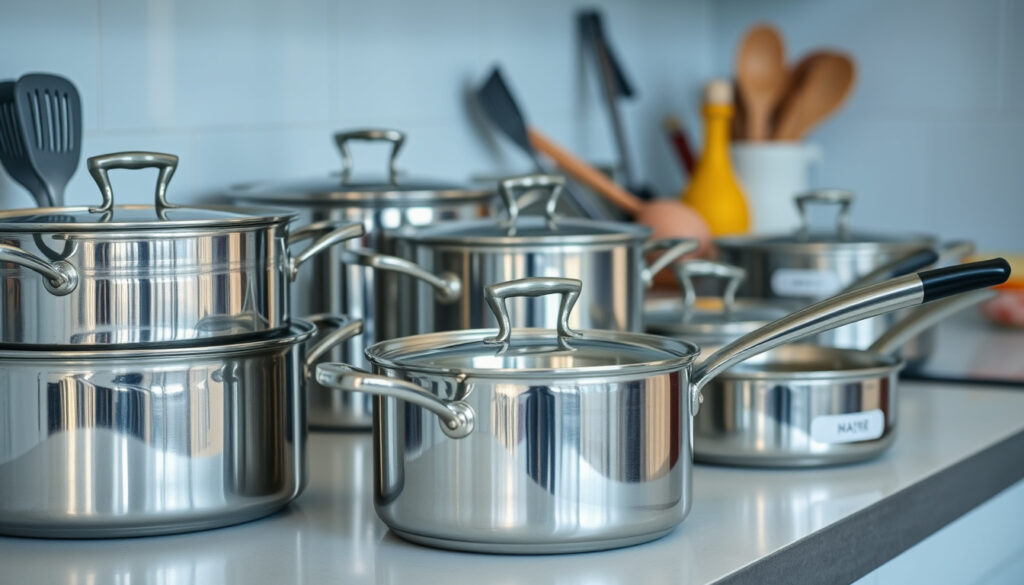
Best Stainless Steel Cookware 2026: Expert Picks, Grades & Pro Tips
Anyone who has watched a chef slide a perfectly seared fish fillet out of a stainless steel pan knows the payoff is worth the practice. The same pan that mercilessly sticks a scrambled egg becomes the tool for restaurant-quality sauces and caramelized crusts once you learn its language — and this guide weighs the brands, grades, and real-world trade-offs that separate the best stainless steel cookware from the rest, drawing on expert tests and the habits of Michelin-level kitchens.
Top-rated set (Serious Eats 2026): All-Clad D3 Stainless ·
Best value per BBC Good Food: Zwilling Pro frying pan ·
Common steel grade in premium sets: 304 (18/10) ·
Downside cited most: Food sticks without oil/fat ·
Professional chef adoption: Nearly universal in Michelin kitchens
Quick snapshot
- All-Clad D3 is the most recommended set by editorial experts (Serious Eats)
- 304 (18/10) grade is the standard for home cookware (Stainless Steel Pan)
- Stainless steel does not leach chemicals into food (Stainless Steel Guide)
- Exact longevity difference between 304 and 316 in home kitchens — data comes from industrial use (Gnee Stainless)
- Gordon Ramsay’s specific pan brand varies by source (All-Clad vs Scanpan)
- The 15–30% premium for 316 is a rough estimate — pricing varies by brand and market (Alibaba B2B guide)
- 1913: Harry Brearley invents stainless steel in Sheffield, UK (Britannica)
- 1970s: All-Clad pioneers tri-ply bonded stainless cookware (All-Clad)
- 2020s: Home gourmet cooking drives a stainless steel comeback (BBC Good Food)
- Demand for 316 stainless steel cookware rises as home cooks experiment with acidic and briny recipes (Cupindy)
- Manufacturers focus on lighter multi-ply constructions to address weight complaints (DS Kitchenware)
304 stainless steel is the smart choice for 95% of home cooks. The premium for 316 — about 15–30% more per Gnee Stainless — only pays off if you regularly simmer salted brines or leave tomato sauce overnight.
Here are the key numbers that keep surfacing in expert reviews.
| Fact | Value |
|---|---|
| Top set (Serious Eats 2026) | All-Clad D3 Stainless 10-piece set |
| Best frying pan (BBC Good Food 2026) | Zwilling Pro 28cm frying pan |
| Standard steel grade | 304 (18/10) stainless steel |
| Common downside | Food sticks if not preheated |
| Professional adoption | Nearly all Michelin kitchens |
| Budget pick (Wirecutter) | Cuisinart MultiClad Pro |
What is considered the best stainless steel cookware?
Top-rated sets from expert tests
Five sets, one pattern: the winning ones use tri-ply construction with an aluminum core sandwiched between stainless steel layers. Serious Eats named the All-Clad D3 Stainless 10-piece set its top pick in 2026, citing even heating and lasting durability. Meanwhile, BBC Good Food chose the Zwilling Pro 28cm frying pan as best all-rounder, praising its balance of weight and heat control.
Key features that define best in class
- Tri-ply or multi-ply construction with an aluminum core for heat conductivity — the standard across all top-rated sets according to Wirecutter
- Riveted, stay-cool handles made of stainless steel that resist oven heat up to 500°F
- Tight-fitting lids that trap steam for braising and deglazing
- Oven-safe to at least 500°F — a requirement for finishing dishes in the oven
The pattern: the best sets balance heat distribution and weight. All-Clad’s D3 hits that sweet spot; heavier sets like Demeyere sacrifice maneuverability for marginally better heat retention.
Which is the best brand of stainless steel cookware?
All-Clad
The gold standard, built in Pennsylvania since the 1970s. Serious Eats calls All-Clad D3 “the set we’d buy with our own money.” Its tri-ply bonding — stainless-aluminum-stainless — heats evenly across the pan surface, eliminating hot spots that burn food.
Zwilling
German engineering meets practical value. BBC Good Food picked the Zwilling Pro frying pan as its best buy, noting the thick aluminum core delivers performance close to All-Clad at roughly 30% less.
Cuisinart
Best affordable reliable set. The Cuisinart MultiClad Pro (MCP) line uses tri-ply construction and 18/10 stainless steel. Wirecutter recommends it as a budget-friendly entry point for home cooks.
Demeyere
Belgian high-end brand owned by Zwilling. Its Atlantis and Industry lines use seven-layer construction (silver and copper cores) for extreme heat uniformity. Professional chefs in Michelin kitchens often choose Demeyere for saucepans and sauté pans.
Fissler
German brand known for the Original-Profi line — used in many European professional kitchens. Fissler uses 304-grade steel and a thick aluminum base for induction compatibility.
The brand you choose determines your cookware’s usable life. All-Clad D3 is often passed down for decades — Reddit’s BuyItForLife community regularly reports sets lasting 20+ years with proper care.
The trade-off: All-Clad for proven durability, Zwilling for value, Cuisinart to keep the budget under $300. For most home cooks, paying more than All-Clad prices buys marginal gains in heat retention at the cost of weight.
What is the best stainless steel cookware 304 or 316?
Differences in composition
Three numbers, one critical distinction. 304 stainless steel — the grade used in nearly all cookware sold in the US and UK — contains 18% chromium and 8% nickel, giving it excellent corrosion resistance for everyday cooking, per Stainless Steel Pan. 316 stainless steel adds 2–3% molybdenum, which significantly boosts resistance to chloride corrosion from salt, brines, and acidic foods, as documented by AZoM. For a side-by-side look at corrosion behavior and costs, see our 304 vs 316 stainless steel cookware comparison.
The corrosion gap comes down to composition.
| Property | 304 (18/10) | 316 |
|---|---|---|
| Chromium content | 18% | 16% |
| Nickel content | 8–10% | 10% |
| Molybdenum | 0% | 2–3% |
| Typical cost premium | Baseline | 15–30% more (Gnee Stainless) |
| Best for | General home cooking | Salty/acidic foods, marine environments |
When 316 is worth the extra cost
- You live in a coastal area with salt air that can pit standard stainless over time — Stainless Steel Guide notes 316 is favored where chloride-heavy conditions exist
- You frequently simmer brines, salt-cured foods, or highly acidic tomato sauces for extended periods
- You want the pan to retain its mirror-like shine with less maintenance — CharmsCook reports 316 retains finish longer in harsh conditions
The catch: for 95% of home cooking, 304 outperforms 316 on cost and formability — Alibaba’s B2B guide notes 304 is easier to manufacture, which keeps prices lower. Only upgrade to 316 if your cooking routinely pushes the chloride envelope.
What should not be cooked in stainless steel and why?
Acidic foods and prolonged simmering
Tomato sauces, wine reductions, and citrus-heavy dishes can discolor 304 stainless steel if simmered for hours. The discoloration is cosmetic, not chemical — Stainless Steel Guide confirms the material does not leach into food. Short cook times (under 30 minutes) pose no issue.
Delicate foods that stick
- Fish fillets — without proper preheating and fat, the skin bonds to the pan
- Eggs — scrambled or fried eggs require more oil and lower heat than nonstick
- Pancakes — the batter releases only when it’s fully set and caramelized
Best practices to avoid damage
- Preheat the pan on medium for 2–3 minutes until water droplets bead and skitter across the surface (the Leidenfrost effect)
- Use enough oil or fat to coat the cooking surface — about 1–2 tablespoons for a 10-inch pan
- Avoid thermal shock: never plunge a hot pan into cold water, which can warp the base
- Clean stuck food with a simmer of water and dish soap, then scrape with a wooden spoon or stainless scrubber
What this means: stainless steel rewards patience. The learning curve is real — but once you master preheating, you gain a pan that sears, deglazes, and lasts a generation.
Do professional chefs cook with stainless steel?
Why Michelin kitchens prefer stainless
Walk into nearly any professional kitchen and you’ll find rows of stainless steel pans. The reason is threefold: heat control, durability, and the ability to deglaze. A stainless pan lets a chef build pan sauces from browned bits (fond) that would stick to nonstick and degrade a cast iron’s seasoning. Serious Eats contributor J. Kenji López-Alt explains that stainless steel’s neutral reactivity means you can deglaze with wine or vinegar without affecting flavor.
The same quality that pro chefs love — heat responsiveness — frustrates beginners. Stainless cools quickly when food is added, so you need to preheat more aggressively than with cast iron. Once learned, it’s irreplaceable.
Gordon Ramsay’s brand choices
Sources vary on which pans Gordon Ramsay uses. The celebrity chef has been filmed using both All-Clad in his Hell’s Kitchen sets and Scanpan (a Danish brand) in some MasterClass segments. The common thread: both are tri-ply stainless steel. Ramsay prioritizes pans that conduct heat evenly and survive the punishment of a professional kitchen.
Professional chefs sacrifice nonstick convenience for searing and saucing ability. For home cooks, keeping one nonstick pan for eggs alongside a stainless set is the pragmatic middle ground — recommended by BBC Good Food.
The implication: if Michelin kitchens trust stainless steel for 10-hour service days, the material is capable. The variable is the cook’s technique, not the cookware.
What is the downside of stainless steel cookware?
Sticking and learning curve
The single most common complaint: food sticks. Stainless steel is not naturally nonstick — it requires proper preheating and sufficient fat. Reddit’s cooking community frequently posts “what am I doing wrong?” threads from new stainless users. The answer is almost always: the pan wasn’t hot enough before adding food.
Weight and cost
- Tri-ply stainless sets weigh significantly more than nonstick — a 12-inch All-Clad D3 frying pan weighs about 2.5 lbs, compared to 1.5 lbs for a comparable nonstick
- Entry-level quality (Cuisinart MCP) starts around $250 for a set; premium brands like All-Clad run $600+
- High-end 316 sets from Demeyere can exceed $1,200
Upsides
- Nearly indestructible — lasts 20+ years
- Oven-safe to 500°F+
- Non-reactive — safe for all foods
- Deglazable for pan sauces
- Better heat control than nonstick
Downsides
- Steep learning curve for sticking
- Heavier than nonstick
- Higher upfront cost
- Poor heat conductor alone — needs aluminum or copper core
- Can discolor with high heat or acidic foods
Comparison with nonstick
Two materials, two philosophies. Nonstick excels at delicate foods with minimal oil but degrades after 1–3 years. Stainless steel requires more technique but lasts a human lifetime. The most practical kitchen, per Wirecutter, contains one nonstick frying pan for eggs and a stainless set for everything else.
“Stainless steel pans are the most versatile in the kitchen. They can go from stovetop to oven, they sear beautifully, and they make great pan sauces. The key is learning to control the heat.”
— J. Kenji López-Alt, Serious Eats contributor and author of The Food Lab
“The Zwilling Pro frying pan delivers professional-level performance at a price that won’t make home cooks wince. It’s our top pick for best all-rounder.”
— BBC Good Food test kitchen
“Switching from Teflon to stainless was frustrating for the first month. Now I’d never go back. The crust I get on steak is night and day, and my pans still look new after five years.”
— Reddit r/BuyItForLife commenter
Summary
304 stainless steel is the logical choice for home cooks: it’s affordable, durable, and safe. 316 only justifies its premium for those who regularly cook with brines or live near salt water. The best stainless steel cookware — All-Clad D3 for commitment, Zwilling Pro for value, Cuisinart for entry — shares one trait: tri-ply construction with an aluminum core. For the home cook in the UK or US, the choice is clear: start with a single 10-inch frying pan, master the preheat, then add pieces as your technique grows. Our best stainless steel cookware sets guide ranks the strongest set options by budget. For home cooks, choosing anything less than tri-ply — or swapping in nonstick for searing — compromises both longevity and performance.
healthcraft.com, acs.studentorg.berkeley.edu, elitecomparison.com, charmscook.com
Frequently asked questions
Is stainless steel cookware safe for health?
Yes. Stainless steel does not leach chemicals into food, even at high heat. Stainless Steel Guide confirms the material is non-reactive and free of PFOA, PTFE, and other coatings found in nonstick cookware.
Can you use metal utensils on stainless steel pans?
Yes. Unlike nonstick, stainless steel pans can withstand metal spatulas, tongs, and whisks without damage. The surface may develop minor scratches over time, but they do not affect performance.
How do you clean stuck food from stainless steel?
Fill the pan with water and a splash of dish soap, bring to a simmer for 5 minutes, then scrape with a wooden spoon. For stubborn residue, use a stainless steel scrubber or a paste of baking soda and water.
Is 304 stainless steel better than 316 for home cooking?
For most home cooking, yes. 304 (18/10) is sufficient, more affordable, and widely available. 316 adds molybdenum for extra corrosion resistance — worth it only if you frequently cook salty brines or acidic foods for long periods, per Stainless Steel Pan.
What is the best stainless steel cookware for induction cooktops?
Any stainless steel set with a magnetic base works on induction. All-Clad D3, Zwilling Pro, Cuisinart MCP, and Demeyere are all induction-compatible. Check the base with a magnet before buying.
Do I need to season stainless steel pans?
No. Unlike cast iron, stainless steel does not require seasoning. However, heating oil until it shimmers creates a temporary nonstick layer — a technique known as “oiling the pan” before adding food.
How long does a stainless steel cookware set last?
With proper care, 20 years or more. All-Clad and Zwilling sets are often passed down. BuyItForLife community members report sets lasting decades with no functional degradation.
More related posts
 Jeon Jong-seo – Age, Height, Movies, Boyfriend
 Hoka Shoes for Women: What Makes Them Special and Which to Choose
 Strawberry Shortcake Ice Cream: History, Ingredients & Recipes
 Cast of Alert Missing Persons Unit – Actors Characters Seasons 1-3
 Jelly Roll Hard Fought Hallelujah: Lyrics, Meaning & Backstory
 Electrical Supply Near Me: Wholesale & Retail in Dublin
 Ulta Credit Card Payment: Pay Online, by Phone, or Mail
 Beauty in Black Cast: Full Actors List & Characters