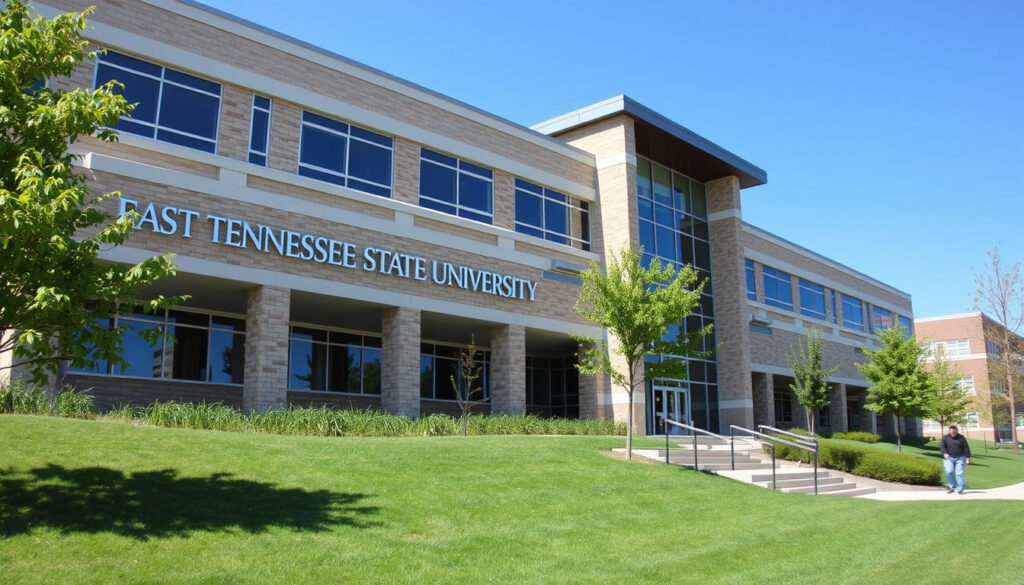
East Tennessee State University: Rankings, Tuition, Sports & More
Few universities manage to feel both like a tight-knit community and a rising national contender, but East Tennessee State University (ETSU) in Johnson City, Tennessee, comes close. With roughly 14,000 students and 160-plus academic programs spread across a 366-acre Appalachian campus, ETSU has quietly built a reputation that goes far beyond its regional roots.
Founded: 1911 ·
Location: Johnson City, Tennessee, USA ·
Type: Public research university ·
Enrollment: Approximately 14,000 ·
NCAA Division: Division I (Buccaneers) ·
Campus Size: 366 acres
Quick snapshot
- Public research university in Johnson City, TN (BestColleges college data publisher)
- Founded in 1911 (BestColleges college data publisher)
- NCAA Division I member (Tips for Students college resource)
- Exact yearly acceptance rate varies (typically ~85–87%)
- Money Magazine top-value ranking changes annually
- Alumni earnings data may be outdated
- 1911: Founded as teacher training school
- 1940s: Expanded to four-year college
- 1990s: Joined NCAA Division I and Southern Conference
- Continued expansion in health sciences and research
- Growing national recognition beyond Appalachian region
Nine key facts about ETSU, one pattern: a mid-sized public research university that punches above its weight in health sciences and athletics.
| Attribute | Value |
|---|---|
| Founded | 1911 |
| Location | Johnson City, Tennessee |
| Type | Public research university |
| Enrollment | ~14,000 |
| Campus Size | 366 acres |
| NCAA Division | Division I |
| Mascot | Buccaneers |
| Tuition (In-State) | ~$9,000/year |
| Tuition (Out-of-State) | ~$26,000/year |
Is East Tennessee State University a prestigious school?
Prestige is subjective, but the numbers offer a starting point. ETSU is ranked #301 in National Universities by U.S. News & World Report higher education rankings authority, placing it solidly in the middle tier of American four-year institutions. That rank puts it ahead of smaller regional publics but behind flagship state universities like the University of Tennessee–Knoxville.
How does ETSU rank nationally?
- Ranked #301 in National Universities by U.S. News & World Report
- Named a top value university by Money Magazine
- Accredited by the Southern Association of Colleges and Schools Commission on Colleges (SACSCOC regional accreditation body)
What is ETSU’s reputation in the region?
Within Tennessee and the broader Appalachian region, ETSU is recognized as a solid public research university with particular strength in health professions and applied sciences. Its reputation is strongest among in-state students and those from neighboring Virginia, North Carolina, and Kentucky who seek an affordable, accredited education close to home.
The implication: ETSU’s ranking suggests a pragmatic choice for cost-conscious students rather than brand-seekers.
How hard is it to get into ETSU?
ETSU is not a selective school by national standards—and that’s by design. The university has maintained a relatively open admissions policy to serve its regional mission.
What is the acceptance rate at ETSU?
According to multiple sources, ETSU’s acceptance rate hovers around 85–87%. Niche college review platform reports an acceptance rate of 86%, while BestColleges college data publisher lists it at 87%. Peterson’s college admissions data provider data shows 10,050 applicants and 8,662 admitted, consistent with the high-80s range.
What are the average GPA and test scores for admitted students?
- Average high school GPA: approximately 3.4 (Niche college review platform)
- SAT and ACT scores are considered but not required for all applicants
A high acceptance rate (85–87%) means easier entry, but it also means ETSU competes less for top-tier academic talent than more selective publics. For students with average GPAs and test scores, this is an advantage. For students seeking ultra-competitive academic peers, it is a limitation.
The catch: ETSU’s open door works best for students who value access over exclusivity.
What is ETSU best known for?
ETSU’s strongest cards are in health sciences—and the university leans into them.
What are the most popular majors at East Tennessee State University?
According to Niche college review platform, ETSU’s most popular majors by number of graduates are:
- Nursing: 443 graduates
- Psychology: 141 graduates
- Kinesiology and Exercise Science: 98 graduates
- Business: 95 graduates
- Marketing: 80 graduates
- Information Science: 78 graduates
- Education: 76 graduates
- Health Professions: 76 graduates
- Liberal Arts and Humanities: 75 graduates
What academic programs are ETSU’s strengths?
Beyond individual majors, ETSU is known for its strong programs in:
- Health sciences, including nursing, medicine, and public health
- Business and management
- Education and teacher preparation
- Arts and humanities
Prospective students interested in healthcare careers face a clear trade-off: ETSU offers strong, well-enrolled health programs in a region with growing demand for healthcare professionals—but the university competes with larger health science centers in Knoxville and Nashville for top clinical placements.
The pattern: health programs dominate enrollment, signaling a clear institutional focus.
Who famous went to ETSU?
ETSU’s alumni list includes a mix of athletes, entertainers, and political figures—though none are household names on the level of, say, a Harvard or UCLA grad.
Which notable alumni attended ETSU?
- Robert White: former NFL player
- Kenny Chesney: country musician and singer (attended but did not graduate)
- Bill Brock: former U.S. Senator from Tennessee
Are there any famous athletes or entertainers from ETSU?
Kenny Chesney is the most recognizable name associated with ETSU. The country music superstar attended the university but left before completing his degree—a fact ETSU acknowledges on its official university website. In athletics, several former Buccaneers have played in the NFL, though none have achieved Pro Bowl fame.
What this means: ETSU’s graduate network provides regional connections rather than national star power.
Is East Tennessee State University a D1 school?
Yes—and this is one of ETSU’s more distinctive features given its size.
What sports does ETSU compete in?
ETSU is an NCAA Division I institution and competes in the Southern Conference (Tips for Students college resource). The Buccaneers field teams in:
- Football (FCS level)
- Basketball
- Baseball
- Acro and tumbling (a women’s sport gaining popularity)
- Other sports across men’s and women’s athletics
What is the mascot of ETSU?
The ETSU mascot is the Buccaneers—often represented by Bucky the Buccaneer. The pirate theme is distinctive and memorable, though it has faced occasional criticism for its historical associations.
The implication: D1 status enhances campus life without the price tag of top-tier athletic programs.
What is the tuition cost at ETSU?
Tuition varies by source and residency status, but the pattern is consistent: ETSU is affordable by national standards, especially for in-state students.
Is ETSU affordable?
ETSU’s in-state tuition ranges from approximately $7,706 per year (BestColleges college data publisher) to $10,994 per year (Niche college review platform). Out-of-state tuition ranges from approximately $11,034 per year (BestColleges) to $15,194 per year (Niche). Appily college search platform reports in-state tuition at $10,216 and out-of-state at $13,726.
When including fees, room, and board, the total cost of attendance is roughly $22,000 per year for in-state students and $39,000 per year for out-of-state students.
Tuition figures from different sources vary by up to $3,000 for in-state and $4,000 for out-of-state. Students should verify the official ETSU tuition page for the current year’s rates before budgeting.
The pattern: tuition variability across sources means students must confirm current rates independently.
acely.com, findcollegedegreesonline.com, collegedunia.com, edurank.org, collegexpress.com, collegetuitioncompare.com, sallie.com
Frequently asked questions
What is the student-to-faculty ratio at ETSU?
ETSU has a student-to-faculty ratio of approximately 16:1, according to Niche college review platform.
Does ETSU offer online degree programs?
Yes, ETSU offers several fully online degree programs, primarily at the graduate level and in fields like nursing and education.
What is the average class size at ETSU?
Average class sizes vary by program, but ETSU reports that approximately 40% of its classes have fewer than 20 students.
Is ETSU considered a party school?
ETSU is not typically ranked as a top party school. The campus culture is more academically and community-focused, consistent with its Appalachian regional identity.
What is the campus like at ETSU?
The 366-acre campus is located in Johnson City, Tennessee, near the Appalachian Mountains. Facilities include modern classroom buildings, a student recreation center, and athletic venues.
Does ETSU have a medical school?
Yes, ETSU is home to the James H. Quillen College of Medicine, a fully accredited medical school that serves the Appalachian region.
For prospective students weighing a mid-sized public university with strong health science programs and Division I athletics, the choice comes down to priorities. If affordability, regional fit, and health professions matter most, ETSU is a strong option. If national brand recognition or a hyper-competitive academic environment are non-negotiable, larger flagships may serve better. For students in Tennessee and nearby states, ETSU offers a clear value proposition: a solid education at a reasonable cost, with a growing national profile that still carries meaning close to home.
More related posts
 2025 Chevy Silverado 2500HD Review: Price, Problems, Duramax Reliability
 NFL Games on TV Today – No Games, Upcoming Schedule
 Beauty in Black Cast: Full Actors List & Characters
 American Idol Katy Perry: Why She Left After 7 Seasons
 Pacific Rim Movies in Order: Watch Guide
 Aspen Dental Savings Plan: Costs, Discounts & Worth It
 Slow Cooker Pot Roast: Time, Liquid, Mistakes & Tips
 How to Watch the Super Bowl – Channel, Streams & Free Options