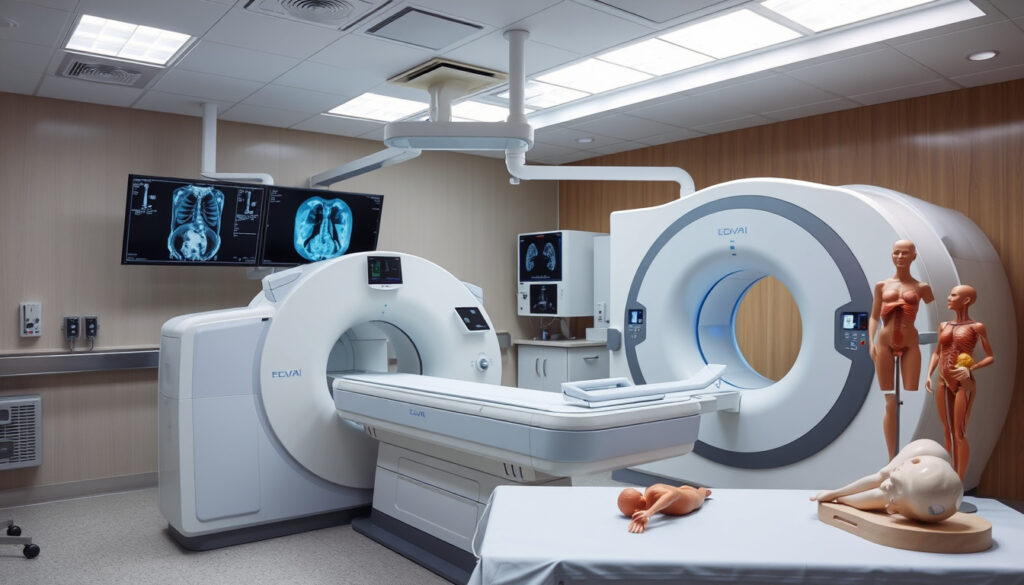
MRI vs CT Scan: Key Differences, Safety, and When to Use Each
CT and MRI both create detailed images of the inside of your body, but they use fundamentally different technologies — X-rays versus magnetic fields — and excel in different clinical scenarios. Choosing the right one affects how quickly you get answers, how safe the exam is, and how well it shows the problem, which is why radiologists and referring physicians weigh speed, safety, and tissue contrast.
Duration of a CT scan: about 10 minutes ·
Duration of an MRI scan: 30 to 60 minutes ·
Radiation exposure from CT: 2 to 10 mSv per scan ·
Radiation exposure from MRI: none (uses magnetic fields) ·
MRI magnet strength (typical): 1.5 to 3 Tesla
Quick snapshot
- CT uses X-rays; MRI uses strong magnetic fields and radio waves (Memorial Sloan Kettering Cancer Center)
- MRI provides better soft tissue contrast than CT (Johns Hopkins Medicine)
- CT is faster and more accessible than MRI (Cleveland Clinic)
- Whether pineapple juice significantly reduces MRI artifacts is not firmly established (Memorial Sloan Kettering Cancer Center)
- The exact cost difference varies widely by facility and insurance (Healthline)
- Long-term effects of repeated low-dose CT are still being studied (Cleveland Clinic)
- MRI is contraindicated in patients with certain metal implants (Cleveland Clinic)
- CT is often completed in minutes, making it the default for trauma and emergency assessment (MD Anderson Cancer Center)
- MRI can take 30 to 90 minutes, limiting its use in acute settings (Cleveland Clinic)
- Patients with claustrophobia or metal implants may choose CT over MRI (MD Anderson Cancer Center)
- For repeated imaging, MRI is preferred to avoid cumulative radiation (Cleveland Clinic)
Seven facts that frame the differences between these two imaging workhorses:
| Label | Value |
|---|---|
| CT scan full name | Computed Tomography |
| MRI full name | Magnetic Resonance Imaging |
| Year CT introduced | 1971 |
| Year MRI introduced | 1977 |
| Average CT scan radiation | 2–10 mSv |
| Average MRI scan time | 30–60 minutes |
| MRI magnet strength (clinical) | 1.5–3 Tesla |
Which is more accurate, a CT scan or an MRI?
Accuracy depends entirely on what the doctor is trying to see. There is no single winner. The choice hinges on the body part, the clinical suspicion, and how quickly results are needed.
Which is better: MRI or CT scan for brain?
- MRI is the gold standard for brain tumors, multiple sclerosis, and subtle tissue changes (Memorial Sloan Kettering Cancer Center)
- CT is preferred for acute hemorrhage and skull fractures because it’s fast and sensitive to blood (Johns Hopkins Medicine)
Which is better MRI or CT scan for kidney?
- MRI with contrast can better characterize renal cysts and solid masses (MD Anderson Cancer Center)
- CT is faster and excellent for detecting kidney stones and assessing acute hydronephrosis (Cleveland Clinic)
Which is better MRI or CT scan for liver?
- MRI with gadolinium contrast is often superior for characterizing liver lesions, thanks to its soft tissue contrast (Memorial Sloan Kettering Cancer Center)
- CT is widely used for initial staging and surveillance of colorectal cancer metastases because speed and availability matter (MD Anderson Cancer Center)
MRI vs CT scan for cancer?
- MRI generally outperforms CT for soft tissue tumors (brain, liver, prostate, sarcomas) because it delineates tumor boundaries more clearly (Memorial Sloan Kettering Cancer Center)
- CT is standard for lung cancer, colorectal cancer, and acute abdomen evaluation (MD Anderson Cancer Center)
- Cheaper and faster than MRI, CT remains the first-line cancer staging tool in many protocols (Healthline)
MRI or CT scan for nerve damage?
- MRI with contrast is the preferred imaging modality for evaluating nerve roots, spinal cord injury, and peripheral nerve disorders because it shows soft tissue detail (Johns Hopkins Medicine)
- CT is less useful for nerves but can help exclude bony impingement or fracture compressing a nerve (Memorial Sloan Kettering Cancer Center)
The implication: matching the scan to the clinical question is more important than choosing a universally “better” technology.
Why do doctors prefer CT scan over MRI?
In many emergency and outpatient scenarios, CT gets the nod for three reasons: speed, availability, and fewer contraindications.
- 1. Speed: CT scans take minutes, MRI can take 30–60 min during which the patient must stay perfectly still (Cleveland Clinic)
- 2. Availability: CT machines are more numerous, especially after hours and in smaller hospitals (Johns Hopkins Medicine)
- 3. Fewer exclusion: Patients with pacemakers, cochlear implants, or severe claustrophobia can often get a CT but not an MRI (Cleveland Clinic)
What are the two major disadvantages of MRI?
- Long scan times: 30–90 minutes of lying still makes it impractical for claustrophobic or uncooperative patients (Memorial Sloan Kettering Cancer Center)
- Strict safety screening: Many implanted devices (older pacemakers, insulin pumps, certain aneurysm clips) are contraindicated for MRI (Johns Hopkins Medicine)
One more factor: the cost. MRI remains more expensive than CT in most U.S. settings, which influences insurance prior authorization and patient choice (Healthline).
What does an MRI show that a CT scan does not?
This is where the two truly diverge. MRI’s superpower is soft tissue contrast. It can distinguish subtle differences in water and fat content, which makes it ideal for visualizing structures that CT sees as a blur.
- Brain: MRI detects early strokes, multiple sclerosis plaques, and subtle tumors that may be invisible on CT (Memorial Sloan Kettering Cancer Center)
- Spine: MRI shows herniated discs, spinal cord compression, and nerve root inflammation (Johns Hopkins Medicine)
- Joints: MRI reveals torn ligaments, tendons, cartilage damage, and joint effusions (MD Anderson Cancer Center)
- Pelvis and prostate: MRI is the standard for prostate cancer localization and staging (Memorial Sloan Kettering Cancer Center)
What can a CT scan show that an MRI cannot?
- Bone detail: CT is unparalleled for cortical bone, calcifications, and fractures (Johns Hopkins Medicine)
- Lung parenchyma: CT is fast and captures lung nodules, pneumonia, and interstitial disease with high resolution (MD Anderson Cancer Center)
- Acute hemorrhage: CT detects fresh bleeding within seconds, critical in stroke and trauma workup (Cleveland Clinic)
- Kidney stones: Non-contrast CT urogram is the gold standard for stone detection (Cleveland Clinic)
A patient with sudden chest pain and suspected aortic dissection needs a CT in minutes, not an MRI in an hour. Conversely, a patient with chronic joint pain and suspicion of a labral tear gets a better answer from MRI. The right tool depends on the clinical clock and the tissue type.
The pattern: MRI is for soft tissue, CT is for hard tissue and speed.
CT scan vs MRI which is safer?
Both are safe when used appropriately, but their risk profiles are different. CT uses ionizing radiation; MRI does not. That fundamental difference drives many clinical choices.
- Radiation: CT delivers 2-10 mSv per exam, comparable to 1–3 years of natural background radiation. The risk of cancer is low but real, especially in children and frequent scans (Cleveland Clinic)
- No radiation: MRI uses magnetism and radio waves, so no ionizing radiation exposure. That makes it the safer option for repeated imaging and for children (Memorial Sloan Kettering Cancer Center)
When should MRI be avoided?
- Implant contraindications: Pacemakers, defibrillators, cochlear implants, and some vascular clips can be displaced or heated by the magnetic field (Cleveland Clinic)
- Gadolinium contrast concerns: MRI contrast (gadolinium) carries a risk of nephrogenic systemic fibrosis in patients with severe kidney disease (MD Anderson Cancer Center)
- Claustrophobia: Many patients cannot tolerate the enclosed bore of an MRI for 30+ minutes (Cancer Treatment Centers of America)
CT safety: radiation risk over time. MRI safety: risk from implants and gadolinium. For most single scans in healthy adults, both are very safe. The decision often comes down to the specific clinical context.
What this means: the “safer” scan depends on the patient’s history and the urgency of the situation.
What not to eat night before MRI?
Most routine MRI scans do not require fasting. There are a few important nuances, especially for abdomen and pelvis scans or when contrast is planned.
- Standard pre-MRI instructions: Unless sedated or having an abdominal scan, patients can eat normally (Memorial Sloan Kettering Cancer Center)
- Pineapple juice claim: Some sources suggest pineapple juice (bromelain) reduces bowel gas artifact, but evidence is limited (Memorial Sloan Kettering Cancer Center)
- Bladder: Empty your bladder before the scan because you must lie still for 30-60 minutes (Cleveland Clinic)
- After contrast: Drink plenty of water to flush gadolinium from the system (MD Anderson Cancer Center)
- Medications: Inform your radiologist about all medications. MRI has fewer drug restrictions than CT (which requires metformin adjustment for some), but always follow the facility’s guidelines (Johns Hopkins Medicine)
Most patients can eat and drink normally before an MRI. The largest preparation issues are metal screening and bladder comfort — not food. If your facility tells you to fast, it’s likely for a specific reason (abdominal study or sedation).
The catch: preparation instructions vary by facility, so patients should always confirm directly.
CT vs MRI: side-by-side comparison
Six key dimensions, one clear pattern: CT wins on speed and access; MRI wins on tissue detail and safety from radiation.
| Dimension | CT Scan | MRI Scan |
|---|---|---|
| Imaging technology | X-rays (ionizing radiation) | Strong magnetic fields + radio waves |
| Scan duration | ~10 minutes | 30–60 minutes |
| Radiation exposure | 2–10 mSv per scan | None |
| Best for | Bones, lungs, acute bleeding, trauma | Brain, spinal cord, joints, soft tissue tumors |
| Contrast agent | Iodinated contrast (allergy risk) | Gadolinium-based (risk in kidney disease) |
| Cost (US average) | $270–$4,800 | $400–$8,000 |
Upsides of CT
- Fast – ideal for emergency and trauma
- Widely available, even in smaller hospitals
- Excellent for bone detail, lung imaging, and stone detection
- Fewer device contraindications than MRI
Upsides of MRI
- No radiation exposure – safer for repeated imaging
- Superior soft tissue contrast – best for brain, spine, joints
- Better characterization of many tumors and cysts
- Can be repeated without cumulative radiation risk
What’s clear and what’s not in the CT vs MRI debate
Confirmed facts
- CT uses ionizing radiation; MRI does not (Cleveland Clinic)
- MRI provides better soft tissue contrast than CT (Johns Hopkins Medicine)
- CT is faster and more accessible than MRI (MD Anderson Cancer Center)
What remains uncertain
- Whether pineapple juice significantly reduces MRI artifacts (Memorial Sloan Kettering Cancer Center)
- Exact cost differences vary widely by facility and insurance (Healthline)
- Long-term effects of repeated low-dose CT are still under study (Cleveland Clinic)
- MRI is contraindicated in patients with certain metal implants (Cleveland Clinic)
The implication: the evidence base is strong for the main differences, but some details remain under investigation.
Expert perspectives on CT vs MRI
“When we need to see soft tissue detail in the brain or spine, MRI is our go-to. For acute bleeding or fractures, CT is faster and more reliable.”
— Radiologist at Memorial Sloan Kettering Cancer Center
“The major safety difference is radiation. CT exposes patients to X-rays; MRI uses magnetic fields. In children or young adults, we lean toward MRI when possible.”
— Expert from Johns Hopkins Medicine
“For cancer staging, MRI often gives us the clearest picture of tumor boundaries, especially in the liver, prostate, and brain. But CT is indispensable for lung and colorectal cancer.”
— Cancer imaging specialist at MD Anderson Cancer Center
The consensus: clinicians leverage the strengths of each modality based on the specific diagnostic question.
The choice between CT and MRI isn’t about one being “better” — it’s about matching the right technology to the clinical question. For a patient in the U.S. facing a diagnostic workup, the implication is clear: if you need a quick answer for trauma, bleeding, or bone injury, CT will get you there fastest. If you need to evaluate a soft tissue mass, nerve damage, or a chronic joint problem, MRI gives the most accurate picture — with the trade-off of longer scan time and higher cost.
wellally.tech, satmed-health.com, medicinenet.com, glmi.com, wellally.tech, medicalnewstoday.com
Frequently asked questions
How long does an MRI take?
Most MRI exams take 30 to 60 minutes. Some specialized scans (e.g., brain with contrast or joint) may take up to 90 minutes. The length depends on the body part and whether contrast is used (Cleveland Clinic).
Is a CT scan painful?
No. CT scans are painless. You lie on a table that slides through a donut-shaped machine. Some patients experience mild discomfort from lying still or from IV contrast injection (Johns Hopkins Medicine).
Can I have an MRI if I have a pacemaker?
Most older pacemakers are contraindicated. However, many modern MRI-conditional pacemakers are safe under strict guidelines. Always inform your doctor and radiology facility about your device before the scan (Cleveland Clinic).
Which scan is better for detecting a stroke?
CT is the first-line scan for acute stroke because it quickly rules out hemorrhage. MRI is more sensitive for ischemic stroke in the later phase and for small strokes. Both play roles in stroke workup (Johns Hopkins Medicine).
Do I need to take off all jewelry for an MRI?
Yes. Because MRI uses a strong magnetic field, any metal – including jewelry, watches, earrings, and even some clothing with metal threads – must be removed. Remove all piercings before the scan (Memorial Sloan Kettering Cancer Center).
Can you eat before a CT scan?
It depends on the type of CT. For abdominal CT with contrast, you may be asked to fast for 4–6 hours. For chest or head CT, eating is usually fine. Always follow the instructions provided by your doctor or facility (MD Anderson Cancer Center).
How often is it safe to get a CT scan?
There is no strict limit, but doctors follow the ALARA principle (As Low As Reasonably Achievable). For adults, the cumulative effective dose from all scans should be tracked. Children are more sensitive to radiation; alternative imaging (ultrasound or MRI) is preferred when possible (Cleveland Clinic).
More related posts
 Cast of Tron: Ares 2025 – Full List & Key Characters
 Men’s Figure Skating at 2026 Winter Olympics: Gold & Results
 Seahawks vs Steelers Player Stats: Full Analysis
 High School Musical Cast: Where Are They Now & Deaths
 Hoka Shoes for Women: What Makes Them Special and Which to Choose
 San Jose State University Guide: Rankings, Cost, Majors
 How Many Hours in a Week? 168 Hours Calc + Work Facts
 Best Api con Pastel Near Me: Bolivian Breakfast Guide