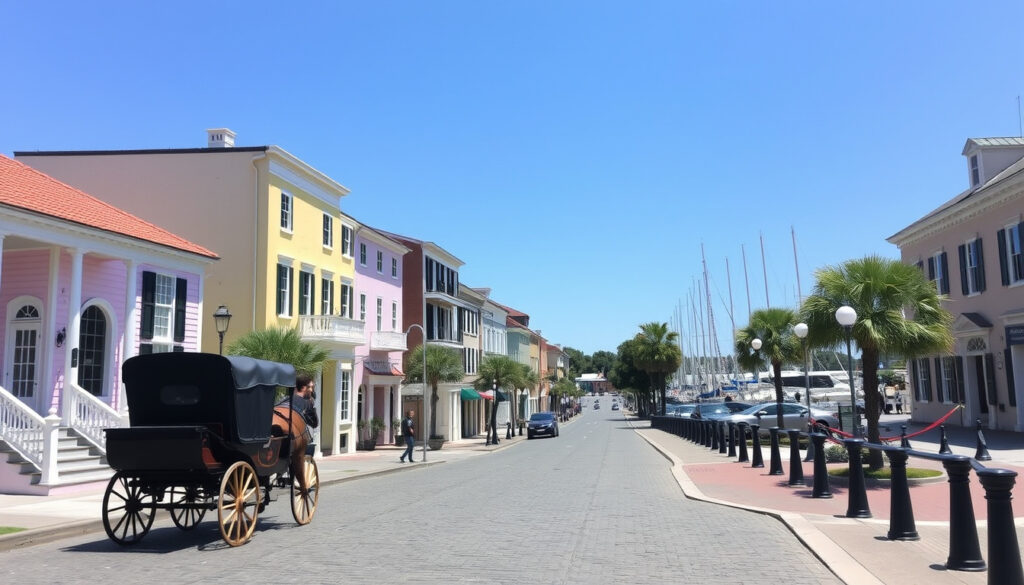
Things to Do in Charleston SC: Attractions & Itineraries
There’s a reason Charleston, South Carolina, keeps landing at the top of travel lists: it’s a rare American city where history, food, and a relaxed coastal pace actually coexist. Founded in 1670, this walkable city of about 150,000 residents now welcomes more than 7 million visitors a year, each drawn to its cobblestone streets and Lowcountry cuisine. This guide is built to help you decide what matters most—whether that’s a packed historic-district itinerary or a few unhurried days of eating and beach time—instead of trying to see everything at once.
Founded: 1670 ·
City population (2020): 150,227 ·
Annual visitors: 7+ million ·
Average high in July: 89°F (32°C)
Quick Snapshot
- Charleston’s historic core is the walkable French Quarter and Rainbow Row district (GetYourGuide Explorer (travel guide))
- Fort Sumter sits in Charleston Harbor and is accessible by ferry (Old Town Trolley Tours (local tour operator))
- Shrimp and grits are a Lowcountry staple (Eater Carolinas (food publication))
- The exact current residences of Bill Murray or Reese Witherspoon are not officially documented (GetYourGuide Explorer (travel guide))
- Which TV shows are actively filming in the area changes by season (Old Town Trolley Tours (local tour operator))
- FIG has been a major culinary destination since opening in 2003 (Vogue (lifestyle magazine))
- Spring (March–May) and fall (September–November) typically bring the most comfortable weather (Eater Carolinas (food publication))
- Decide between a historic-core focus or a beach-and-plantation day trip (Old Town Trolley Tours (local tour operator))
- Book a carriage tour or food tour as your first orientation activity (GetYourGuide Explorer (travel guide))
Charleston’s walkable historic core makes it feel like a living museum—one where you can actually eat the exhibits.
| Label | Value |
|---|---|
| Founded | 1670 |
| City population (2020) | 150,227 |
| Annual visitors | 7+ million |
| Historic district character | Walkable, with French Quarter and Rainbow Row |
| Signature food | Shrimp and grits; she-crab soup |
| Best weather months | March–May and September–November |
| Hottest month | August |
| Unique attraction | Charleston Tea Garden (only working tea plantation in America) |
| Popular orientation | Carriage tours, King Street (Upper/Middle/Lower) |
The pattern here is clear: Charleston’s charm comes from its compact, layered character—walkable streets, bold flavors, and a pace that rewards planning over spontaneity.
What not to miss in Charleston, SC?
If you only have one day, focus on the historic core. The walkable French Quarter and Rainbow Row area is where the city’s postcard image lives, with pastel houses and narrow lanes that have been drawing visitors for generations (GetYourGuide Explorer (travel guide)). The Battery, a palm-lined promenade at the tip of the peninsula, offers sweeping harbor views and is a signature walking spot (GetYourGuide Explorer (travel guide)).
- Fort Sumter: This National Monument in Charleston Harbor is reached by ferry from downtown (GetYourGuide Explorer (travel guide)).
- Carriage tours: A classic orientation method that covers a lot of ground in under an hour (GetYourGuide Explorer (travel guide)).
- King Street: Split into three distinct sections—Upper King for food and nightlife, Middle King for fashion, and Lower King for antiques (Old Town Trolley Tours (local tour operator)).
What should I do on my first-time trip to Charleston, SC?
Start with a carriage tour or a slow stroll through the historic district to get oriented. Many first-timers combine a morning walk past Rainbow Row with an afternoon at the Charleston City Market, where local crafts and sweetgrass baskets are on display. If you’re up for a drive, Fort Sumter is worth the ferry ride for the harbor perspective and Civil War history (GetYourGuide Explorer (travel guide)).
The city’s compactness works in your favor: the historic district is genuinely walkable, so you can see the highlights without a rental car (GetYourGuide Explorer (travel guide)). For lodging, staying north of Broad Street keeps you close to the action, while the South of Broad area offers a quieter, more residential feel with grand mansions and private gardens (GetYourGuide Explorer (travel guide)).
For a first-timer, the real trade-off is between depth and breadth: the historic core rewards a slow pace, but the city’s signature foods and nearby beaches pull visitors outward. A single focused day in the district beats two rushed ones that try to do everything.
How to spend 2 days in Charleston, SC?
Two days lets you split your time between the historic core and the surrounding Lowcountry. The classic split: Day 1 for downtown (historic district, City Market, food), Day 2 for a beach or plantation excursion (GetYourGuide Explorer (travel guide)). Sullivan’s Island and Mount Pleasant are short drives from downtown, making them viable half-day trips (Old Town Trolley Tours (local tour operator)).
What to do in one day in Charleston?
- Morning: Walk the historic district, catching Rainbow Row and The Battery before the midday heat (GetYourGuide Explorer (travel guide)).
- Midday: Explore the City Market and grab a low-country lunch (Eater Carolinas (food publication)).
- Afternoon: Take a carriage tour or wander King Street’s three sections (Old Town Trolley Tours (local tour operator)).
- Evening: Head to Upper King for dinner and drinks (GetYourGuide Explorer (travel guide)).
The one-day plan is tight but doable. What you’ll sacrifice is the unhurried feel—Charleston is a city that rewards lingering over coffee or a porch-side cocktail. If you have a second day, that’s when the itinerary opens up to beaches or plantations (Old Town Trolley Tours (local tour operator)).
The catch: a two-day trip works only if you resist the urge to pack both beach and plantation into the second day—pick one and own the pace.
What are some hidden gems to explore in Charleston, South Carolina?
The quieter corners of Charleston—Pitt Street Bridge, the Old Village—feel less like tourist stops and more like the city’s actual pulse.
Beyond the postcard stops, Charleston rewards visitors who wander slightly off the main tourist trail. Pitt Street Bridge, a former trolley bridge in Mount Pleasant, is now a peaceful spot for strolling, fishing, or a sunset picnic (Old Town Trolley Tours (local tour operator)). Closer to downtown, the Gateway Walk threads through one of the city’s oldest neighborhoods, with hidden gardens and historic churchyards that feel a world away from the crowds (Old Town Trolley Tours (local tour operator)).
- Old Village of Mount Pleasant: A walkable neighborhood with historic homes, cozy shops, and art galleries—a quieter counterpoint to downtown (Old Town Trolley Tours (local tour operator)).
- Longitude Lane: A narrow, well-preserved alley lined with historic homes and tiny shops (Old Town Trolley Tours (local tour operator)).
- Charleston Tea Garden: A 30-minute drive to Wadmalaw Island, this is the only working tea plantation in America, with guided tours and tastings (Old Town Trolley Tours (local tour operator)).
These spots share a common thread: they trade spectacle for atmosphere. The trade-off is travel time—the tea garden in particular requires a half-day commitment—but for visitors wanting a slower, more local-feeling day, they’re worth the detour (Old Town Trolley Tours (local tour operator)).
Hidden gems like Pitt Street Bridge and the Old Village change the Charleston experience from a checklist to a place you might actually live in. For repeat visitors avoiding the busy season, these quieter spots are the real reason to return.
What is a must eat in Charleston, SC?
Charleston’s food scene is rooted in Lowcountry traditions—seafood, rice, okra, and West African influences—and it’s the city’s loudest claim to fame.
Charleston’s food scene is the city’s loudest claim to fame, and it’s rooted in Lowcountry traditions that blend seafood, rice, okra, and West African influences (GetYourGuide Explorer (travel guide)). Seafood is a non-negotiable, according to Eater Carolinas (regional food guide), and the city’s signature dish—shrimp and grits—is served everywhere from white-tablecloth rooms to casual lunch counters.
- She-crab soup: A regional specialty that originated in the Lowcountry, found at many historic restaurants.
- Shrimp and grits: A Lowcountry staple that blends coastal seafood with Southern comfort (Eater Carolinas (regional food guide)).
- FIG: A major culinary destination since 2003, known for its seasonal, locally sourced approach (Vogue (lifestyle magazine)).
- Husk: A restaurant that has built its reputation on seasonal, local ingredients (Old Town Trolley Tours (local tour operator)).
- Poogan’s Porch: Known for homestyle cooking and buttermilk biscuits (Old Town Trolley Tours (local tour operator)).
Eater’s guide suggests a tasting menu approach: okra soup, roasted oysters, a caviar sandwich, whole hog, and brisket are all cited as useful entries into the city’s culinary landscape (Eater Carolinas (regional food guide)). The pattern is clear: Charleston’s best food isn’t fussy or over-composed—it’s ingredient-driven and confident.
Food-first travelers face a real choice: book the marquee reservations at FIG or Husk weeks ahead, or eat more spontaneously at the city’s oyster bars and lunch counters. Both paths deliver excellent food—the first is weather-proof, the second is more flexible.
When to avoid Charleston, SC?
Charleston’s subtropical climate means hot, humid summers and a real hurricane season. The Atlantic hurricane season runs from June through November, with the highest risk typically in late summer and early fall (Eater Carolinas (regional food guide)). August is the hottest and most humid month, when afternoon heat can make walking the historic district feel like a endurance test.
- Best weather: Spring (March–May) and fall (September–November) bring mild temperatures and lower humidity, making them ideal for walking tours (Eater Carolinas (regional food guide)).
- Peak crowds: Spring and early summer weekends draw the heaviest tourist traffic, especially during major events.
- Hurricane risk: June through November carries a real weather risk; check forecasts before committing to a longer stay.
The practical takeaway: if you can choose your dates, target April or October for the sweet spot between comfortable weather and manageable crowds. If you’re flexible, weekdays in any season are quieter and often cheaper than weekends (GetYourGuide Explorer (travel guide)).
The catch: even the best-planned trip can be derailed by a hurricane week—check the long-range forecast before booking nonrefundable flights.
Where not to go in Charleston, SC?
Charleston is a generally safe city, but like any urban area, it has pockets where visitors should exercise standard caution. Most violent crime occurs in areas away from the historic district, which is heavily policed and tourist-oriented (GetYourGuide Explorer (travel guide)). The area around King Street is generally safe, though the character changes noticeably north of Line Street, where the commercial corridor gives way to more residential and less busy blocks (Old Town Trolley Tours (local tour operator)).
- Historic district: Safe, heavily trafficked, and well-lit—ideal for evening walks.
- Upper King: Bustling and safe, especially in the evening when the restaurant and bar scene is active.
- North of Line Street: Less touristed and less predictable after dark; use standard big-city awareness.
The honest guidance: no neighborhood in Charleston requires active avoidance, but the same street smarts you’d use in any unfamiliar city apply—stay aware, stick to well-lit areas at night, and don’t wander far from the main drag without a reason.
The pattern: safety in Charleston correlates with foot traffic—stick to the crowds and you’ll be fine.
What celebrity lives in Charleston, SC?
Charleston’s charm has attracted a fair share of famous residents and film crews alike. The area has become a notable backdrop for TV and movies, with production activity adding to its cultural cachet (GetYourGuide Explorer (travel guide)).
Where is Bill Murray’s house on Sullivan’s Island?
Bill Murray is the most famous celebrity associated with the Charleston area, and his connection to Sullivan’s Island is well known among locals. However, the exact location of his property is not officially documented in public records or tourism materials—it’s a matter of local knowledge and speculation rather than confirmed fact (Old Town Trolley Tours (local tour operator)).
Does Reese Witherspoon live in Charleston, SC?
Reese Witherspoon has been reported to have spent time in the Charleston area, but her current permanent residence is the subject of speculation rather than verified public information. As with Murray, the details are more rumor than documented fact (GetYourGuide Explorer (travel guide)).
What TV show was filmed in Charleston, South Carolina?
Charleston has served as a filming location for several notable productions. The popular series ‘Outer Banks’ uses Charleston-area locations for its coastal scenes, and the iconic movie ‘The Notebook’ was filmed in nearby Mount Pleasant, giving fans a recognizable point of reference for the area’s cinematic appeal (GetYourGuide Explorer (travel guide)).
The celebrity connection adds a layer of intrigue to the city, but it shouldn’t shape your itinerary. The real draw is the city itself—its food, architecture, and coastal setting are the durable attractions that keep visitors returning year after year.
What this means: let the city’s actual character—not its celebrity rumors—drive your plans.
Practical Itinerary Steps
Here’s a step-by-step approach to building your Charleston visit, whether you have one day or a full weekend. The structure prioritizes the historic core first, then expands outward based on your interests.
- Step 1: Choose your core. Decide on Day 1 if you’re a history-first visitor (historic district, Fort Sumter) or a food-first visitor (City Market, Upper King restaurants) (GetYourGuide Explorer (travel guide)).
- Step 2: Book orientation. Reserve a carriage tour or a guided walking tour for your first morning—it gives you spatial context for everything else (GetYourGuide Explorer (travel guide)).
- Step 3: Plan your meals. Make dinner reservations at FIG, Husk, or another marquee restaurant on Day 1; leave Day 2 flexible for oyster bars and casual lunches (Old Town Trolley Tours (local tour operator)).
- Step 4: Add a day trip. On Day 2, choose between Sullivan’s Island for beach time or a plantation/Mount Pleasant excursion for history and scenery (Old Town Trolley Tours (local tour operator)).
- Step 5: Factor in weather. If you’re visiting in July or August, plan indoor activities (museums, restaurants) for midday and save outdoor walking for mornings and evenings (Eater Carolinas (regional food guide)).
The most common Charleston itinerary failure is over-booking: visitors who try to see the historic district, take a plantation tour, and hit the beach in a single day end up rushing everywhere and experiencing none of the city’s essential rhythm. Two or three well-chosen experiences beat five rushed stops.
Related reading: First-Time in Charleston: What to See and Do · Charleston Hidden Gems Off the Beaten Path
travelersuniverse.com, travelandleisure.com, leisurelylinds.com, getyourguide.com, getyourguide.com, charlestonmag.com, thisisraleigh.com
Frequently Asked Questions
What not to miss in Charleston, SC?
The walkable historic district—including Rainbow Row and The Battery—is the essential Charleston experience, along with the food scene anchored by shrimp and grits and Lowcountry seafood (GetYourGuide Explorer (travel guide)). Fort Sumter and a carriage tour round out the first-time visitor’s essentials.
How to spend 2 days in Charleston, SC?
Day 1 for the historic district and City Market, Day 2 for a beach trip (Sullivan’s Island) or plantation visit. This split gives you both the cultural core and the Lowcountry landscape (Old Town Trolley Tours (local tour operator)).
What to do in one day in Charleston?
Start with a morning walk through the historic district (Rainbow Row, The Battery), visit the City Market at midday, take a carriage tour in the afternoon, and end with dinner on Upper King Street (GetYourGuide Explorer (travel guide)).
What is a must eat in Charleston, SC?
Shrimp and grits is the signature Lowcountry dish, and she-crab soup is a regional specialty. For a full culinary picture, try roasted oysters and okra soup alongside a reservation at a farm-to-table restaurant like FIG or Husk (Eater Carolinas (regional food guide)).
What are some hidden gems to explore in Charleston, South Carolina?
Pitt Street Bridge in Mount Pleasant offers peaceful sunset views, and the Old Village neighborhood provides a quieter, walkable alternative to downtown. The Charleston Tea Garden on Wadmalaw Island is the only working tea plantation in America (Old Town Trolley Tours (local tour operator)).
When to avoid Charleston, SC?
August is the hottest and most humid month, and hurricane season runs from June through November. Spring (March–May) and fall (September–November) offer the most comfortable weather for walking the city (Eater Carolinas (regional food guide)).
Where not to go in Charleston, SC?
The historic district and King Street areas are generally safe and heavily touristed. Away from the historic core, standard big-city awareness is recommended, especially at night; most violent crime occurs in areas without tourist traffic (GetYourGuide Explorer (travel guide)).
What TV show was filmed in Charleston, South Carolina?
‘Outer Banks’ is a recent series that films in the Charleston area, and the movie ‘The Notebook’ was shot in nearby Mount Pleasant, making the region a recognizable backdrop for both (GetYourGuide Explorer (travel guide)).
What should I do on my first-time trip to Charleston, SC?
Start with a carriage tour or a slow stroll through the historic district to get oriented. Combine a morning walk past Rainbow Row with an afternoon at the Charleston City Market, and consider a ferry ride to Fort Sumter for harbor views and Civil War history (GetYourGuide Explorer (travel guide)).
Does Reese Witherspoon live in Charleston, SC?
Reese Witherspoon has been reported to have spent time in the Charleston area, but her current permanent residence is the subject of speculation rather than verified public information (GetYourGuide Explorer (travel guide)).
Related Reading
- First-Time in Charleston: What to See and Do
- Charleston Hidden Gems Off the Beaten Path
More related posts
 Hayden Panettiere Movies and TV Shows Guide
 How Many Justices Are on the Supreme Court? 2025 Guide
 Seahawks vs Arizona Cardinals Player Stats: Full Recap
 Best Stainless Steel Cookware 2026: Expert Picks, Grades & Pro Tips
 How Many Hours in a Week? Total 168 Hours Explained
 Charlie Kirk South Park Episode: Parody, Removal & Reaction
 Tankless Water Heater Cost: Worth the Investment
 HP Instant Ink Login: Troubleshoot & Manage Your Account